




Receipt of Service: What It Is and What It Must Include
A receipt of service acknowledges that payment for a service has been made. An invoice carries the other half of the story: it sets out what is owed, for what, and by when.
Most freelancers and sole traders keep the first and lose the second. A phone full of card slips, app notifications and emailed confirmations proves money left the account, yet says almost nothing about what was bought, when it was supplied, or how much VAT sat inside the price. That gap stays quiet until a VAT return, a self assessment, or an accountant's question exposes it.
The useful question isn't "did I save the receipt?" It's "could I prove who supplied what, when, for how much, and why it was business-related?" Work through that question in order, from what a receipt proves to the records worth checking before you file.
What a Receipt of Service Proves
A service receipt works like a coat-check ticket. It shows that something was handed over and settled, but it gives only a thin outline of the service itself. The fuller story sits in the invoice, where the supplier sets out the work, the amount owed and the terms.
That distinction matters because businesses often treat every payment record as interchangeable. A card slip, a bank note and a payment confirmation may all prove that money moved. They may also leave the most important question unanswered: what service was supplied?
A plain-language receipts and invoices distinction puts the split clearly. A receipt acknowledges payment. An invoice requests payment and describes the supply. One points backwards to settlement, the other sets out the transaction before or around the point of supply.
For VAT records, the invoice carries more weight because it can show the details needed to identify the charge. UK VAT invoices need prescribed information, including the supply date, invoice date, supplier VAT number, VAT amount and VAT rate. Those details explain why an invoice can support a VAT claim while a simple receipt may only show a total paid. If you are checking what a usable VAT record should carry, reclaiming VAT with proper receipts gives a useful comparison point.
Here is the split side by side.
| Feature | Receipt of service | Invoice |
|---|---|---|
| Main purpose | Confirms that payment has been made | Requests payment and sets out the amount due |
| Typical timing | After the payment is made | At or around the time the service is supplied |
| Shows amount owed and payment terms | Usually not | Yes |
| Common forms | Card slip, till receipt, e-receipt, emailed confirmation | Supplier's billing document, often PDF |
| Evidence for VAT input-tax recovery | Shows payment only; may not show VAT | Primary evidence when it is a valid VAT invoice |
| Shows what service was supplied | Sometimes, if the description is detailed | Yes, with the supplier's description and VAT lines |
Three practical consequences follow.
- A receipt proves money moved. It gives an amount, a date and a supplier name. That helps when matching a bank payment to a supplier record.
- An invoice proves the supply more clearly. It can name what was bought, the period covered, the net figure, the VAT rate and the unique number that ties the deal to your files.
- Holding one without the other leaves a gap. A receipt alone shows payment without a full explanation. An invoice alone describes the charge without proving that the balance left the account.
Service receipts rarely look like traditional till slips. They arrive as card slips in a coat pocket, PDFs attached to emails, payment processor notices or lines on app store statements. Each can show payment. Far fewer show the scope of the work, the job reference or the VAT breakdown, because they were not built to do that job.
The safest habit is to keep both sides of the transaction together. Hold the supplier's invoice for what was supplied, keep the payment evidence for what was settled, and use a reference that links them. That way, a receipt proves payment while the invoice explains the service behind it.
Details Every Receipt of Service Should Include
A complete record answers questions a stranger could ask about your business while you're out of the room. The checklist below is the short version.
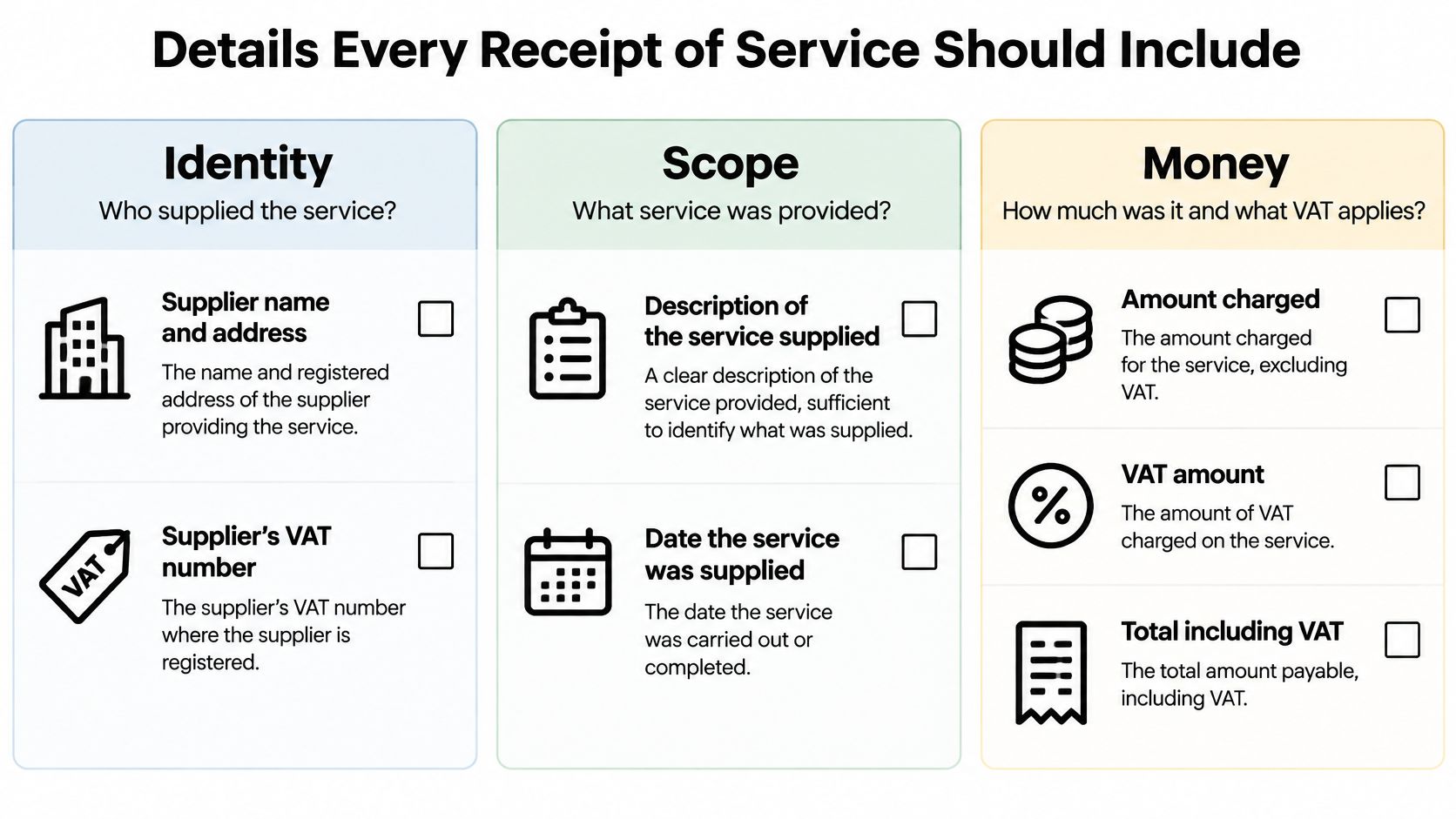
In UK practice, a receipt of service is evidence of two things at once: the supply and the payment of it. HMRC treats received VAT invoices as the primary evidence for recovering input tax, and expects them to be stored so they can be located readily during a check, as the GOV.UK invoicing and payment guidance explains. That guidance lists the fields a record should preserve at minimum: supplier identity, a clear description or extent of the service, supply date, invoice date, net amount, VAT amount, gross amount, and a unique invoice number.
Identity, scope and money
Those fields fall into three groups, and the groups make checking faster.
Identity covers the supplier's name and address, plus the VAT number where the supplier is registered. Scope covers what the service was, the client or job reference it relates to, and the date it was supplied. Money covers the net amount, the VAT amount and rate, the gross total, the currency and the payment method. A unique reference from the supplier, whether INV-2041 or RCPT-2041, lets you trace the record to a bank line months later.
| Detail | What it proves |
|---|---|
| Supplier name and address | Who supplied the service |
| Supplier VAT number | The supplier is VAT-registered, where applicable |
| Description of the service | What was actually supplied |
| Date of supply | When the service was performed or completed |
| Date of payment | When the amount was settled |
| Net amount | Value before VAT |
| VAT amount and rate | VAT charged and how it was calculated |
| Total paid | The gross amount settled |
| Unique reference | Lets the record be traced to a bank payment |
| Client or job reference | Links the service to the work it supports |
Extraction tools carry a lot of this weight. Snyp's AI extracts vendor, date, line items, VAT and total from each receipt, which gets the raw fields onto the record quickly. What it can't decide for you is whether the description makes sense for your business and whether VAT lines exist at all.
Practical rule: if you can't see a supplier VAT number, a VAT amount and a recognisable service description, the record is payment evidence, not VAT evidence.
Here's a complete record in practice. Brightline Design Ltd, 12 High Street, Leeds, VAT number GB123456789, invoice INV-2041 for a monthly website maintenance retainer, supplied 14 March, paid 20 March by card ending 4421, net £600.00, VAT at 20% £120.00, gross £720.00, client reference CL-07. Every field earns its place: the VAT number supports a reclaim, the supply date fixes the VAT period, CL-07 links the invoice to a piece of work.
Where the supplier isn't VAT-registered, the VAT number and VAT lines are absent. The record still belongs in your books as an expense, but it can't support a reclaim.
The final test is short. Could someone who has never met you find this document, see what you bought, and rebuild the VAT figure from the numbers on it? If yes on all three, the record is complete.
Dates That Decide Which Period a Service Belongs To
A consultant finishes a project on 28 March, invoices on 4 April and gets paid on 12 May. The work straddles two VAT quarters and the payment falls in a third period. Which return picks up the input tax?
That depends on which tax point rule applies, and the answer changes the period, not just the paperwork.
VAT Notice 700 states that the date of issue of a VAT invoice, or the date payment is received, can be the actual tax point to the extent invoiced or paid. The same notice asks businesses to record all taxable supplies received with enough transaction detail, including the value of the supply. For services received before VAT registration, HMRC specifically asks for an account showing the service description, date received, and amount paid including VAT.
| Date type | What to record | How it is used |
|---|---|---|
| Service supplied | Date the work was completed or performed | Compared with the invoice and payment dates to find the period |
| Invoice issue date | Date printed on the VAT invoice | Can be the tax point to the extent invoiced |
| Payment date | Date the amount was settled | Can be the tax point to the extent paid |
| Upload date | Date the paperwork reached you | Never used in place of any date above |
The upload date is the sneaky one. It records when the document reached your inbox or your software, not when the supply happened. Filing by upload date moves costs into the wrong period and distorts two returns at once, one that misses the cost and one that claims it twice over.
Flag these mismatches rather than posting through them:
- Payment in a different period from the supply, which is exactly the consultant case above.
- A missing invoice date, where the file shows only a payment date and a vague service period.
- A service date before VAT registration, which needs the pre-registration account HMRC asks for.
A defensible record carries three dated fields, a resolved note on each mismatch, and the rule you applied written down, so the same choice gets made next quarter instead of re-argued from memory.
Why a Receipt Alone May Not Reclaim VAT
A freelancer pays for a design tool by card. The bank statement shows the payment, the card slip shows the same amount, and the reclaim goes in. Then a review asks for the supplier's VAT invoice and there isn't one, because the tool was bought through an app store and the confirmation email carries a total with no VAT breakdown.
Three kinds of evidence get muddled here, and only one of them supports input tax.
- Transaction evidence proves a payment happened: a card slip, a bank statement, a payment notification.
- Allowable-expense evidence proves the cost was incurred for the business and belongs in your books, which is where digital records of expenses, including the date incurred, come in under HMRC's Making Tax Digital guidance.
- Valid VAT-invoice evidence proves VAT was charged and identifies the taxable supply, which is what a reclaim rests on.
The gap sits between the second and third. A card slip or abbreviated till receipt may prove money was paid without proving VAT was charged or adequately identifying the taxable supply, and ordinary bookkeeping guidance rarely separates those two standards.
If you'd rather see the mechanics before you file, the walkthrough below covers the practical side.
Sort the documents you receive against this table.
| Document | Proves payment | Proves the service | Enough to reclaim VAT? |
|---|---|---|---|
| Card slip or bank statement | Yes | Partly, only if it names the supplier | No |
| Abbreviated till receipt | Yes | Limited | Only if it carries full VAT invoice details |
| Emailed order confirmation | Partly | Yes, if it describes the service | No, unless paired with a valid VAT invoice |
| Full VAT invoice from the supplier | Yes, with payment linked | Yes | Yes, if it contains the required VAT details |
| Contract with payment schedule | Partly | Yes | No, unless paired with a valid VAT invoice |
So apply a simple threshold. If a document lacks the supplier's VAT number, the VAT amount or a clear description of the service, mark it bookkeeping acceptable only and request a proper invoice before any reclaim.
Better OCR doesn't solve this, and that's the part most capture tools get wrong. Extraction can turn an incomplete receipt into an accounting entry that looks complete, and a confident-looking wrong claim is worse than an obviously missing one. If you run a billing side too, this billing workflow from Mazurly is worth reading alongside, because the same details that make your own invoices defensible are the ones to demand from suppliers.
A receipt answers "was I charged?" An invoice answers "what was I charged for, and how much of it was VAT?" Only the second question gets money back.
When you chase the document, request it in writing, record the date of the request against the transaction, and hold the reclaim until it arrives. The full list of what a compliant document needs sits in this guide to VAT receipt requirements. If the supplier can't issue a VAT invoice at all, that's your answer: there's nothing to reclaim.
Building an Evidence Trail Without a Till Receipt
A consultant bills a monthly retainer. There is no till, no shop counter and no printed slip, only a PDF invoice, a bank transfer and emails about scope. Proving the service was supplied means turning those separate scraps into one bundle per job or supplier. Keep a file folder for each job. The receipt may show payment, while the other papers show what was delivered.
Trading Standards guidance on problems with services lists what counts as proof: a paper receipt, an e-receipt, a gift receipt, a contract, or a bank or card statement. The same guidance notes proof may be requested to demonstrate that the trader supplied the service. That distinction matters because a payment line can answer one question while leaving the main question open. It shows money moved, but it may not show the work, advice or service behind it.
A single receipt image rarely passes that test. It may not show the scope of work, the delivery date, the client, the job reference or the link to the contract, so build the bundle instead: invoice or contract, payment evidence, email confirmation and job documentation, all attached to the same record. Test each bundle with three questions. Who supplied what, when, and for how much? If you cannot answer all three from the folder, the record is still thin.
The habit that keeps this cheap is naming the job when it opens and attaching documents as they arrive, each tagged with its service date, rather than rebuilding the file at year end. That matters more from April 2026, when Making Tax Digital for Income Tax applies to unincorporated businesses and landlords with qualifying income above £50,000 and requires digital records of income and expenses.
Forwarded professional invoices carry the scope already. Snyp extracts the provider, service description, amount and VAT from them, so the bundle starts with the document that proves supply. If a receipt has gone missing entirely, this guide to recording an expense without a receipt covers the fallback evidence.
Common Service Scenarios and What to Keep
Four patterns cover most service spend for freelancers and small firms. Each needs the same two documents, and each hides one detail that gets missed.
The IT retainer. A monthly invoice of £600 plus £120 VAT arrives on the first, the card statement shows £720 leaving on the third. Keep the monthly invoice and the statement line that matches it. The missed detail is the service period the invoice covers, which decides which month the cost belongs to.
The accountant's quarterly fee. Same pairing, different rhythm: quarterly invoice, payment matched to its date, and the period the fee covers noted on the record. Quarterly bills are the ones most often posted to the wrong period because the payment date feels like the obvious date.
The tradesperson's deposit. Take a kitchen fit, where a deposit is paid in March, work finishes in May, and the balance follows. Keep the deposit invoice, the final invoice and the receipt for each payment. The detail that trips people up is how the deposit offsets the full invoice, which is why each payment should be recorded against the original invoice rather than as a free-standing cost.
The overseas design service. An overseas supplier's invoice needs its currency, VAT treatment and supplier location kept with it, because none of those are visible on the card line. Check the currency amount against the amount you were charged.
Ask of any service record: could I hand this to someone else and have them rebuild the transaction without calling me?
Three traps recur. An invoice with no service description, which proves a payment but not a supply. A subscription billed monthly in a foreign currency, where nobody checks the conversion. A receipt showing only a total, with no supplier name worth the paper.
Solicitors' contract review invoices and graphic designers' freelance invoices follow exactly the same pattern; the vocabulary changes and the documents don't. Snyp processes accountant quarterly fees, solicitor contract review invoices, IT consultant monthly retainers, business coach invoices and graphic designer invoices through one pipeline, which keeps these four scenarios in a single place instead of four.
The rule that repeats across all of them is short: one document for the supply, one for the payment, and a reference that joins them.
Check Your Service Records Before You File
Check each service record before the next VAT return, not after it. An incomplete record can't be repaired at filing time. The only choices left then are to drop the reclaim or claim it on evidence you don't hold.
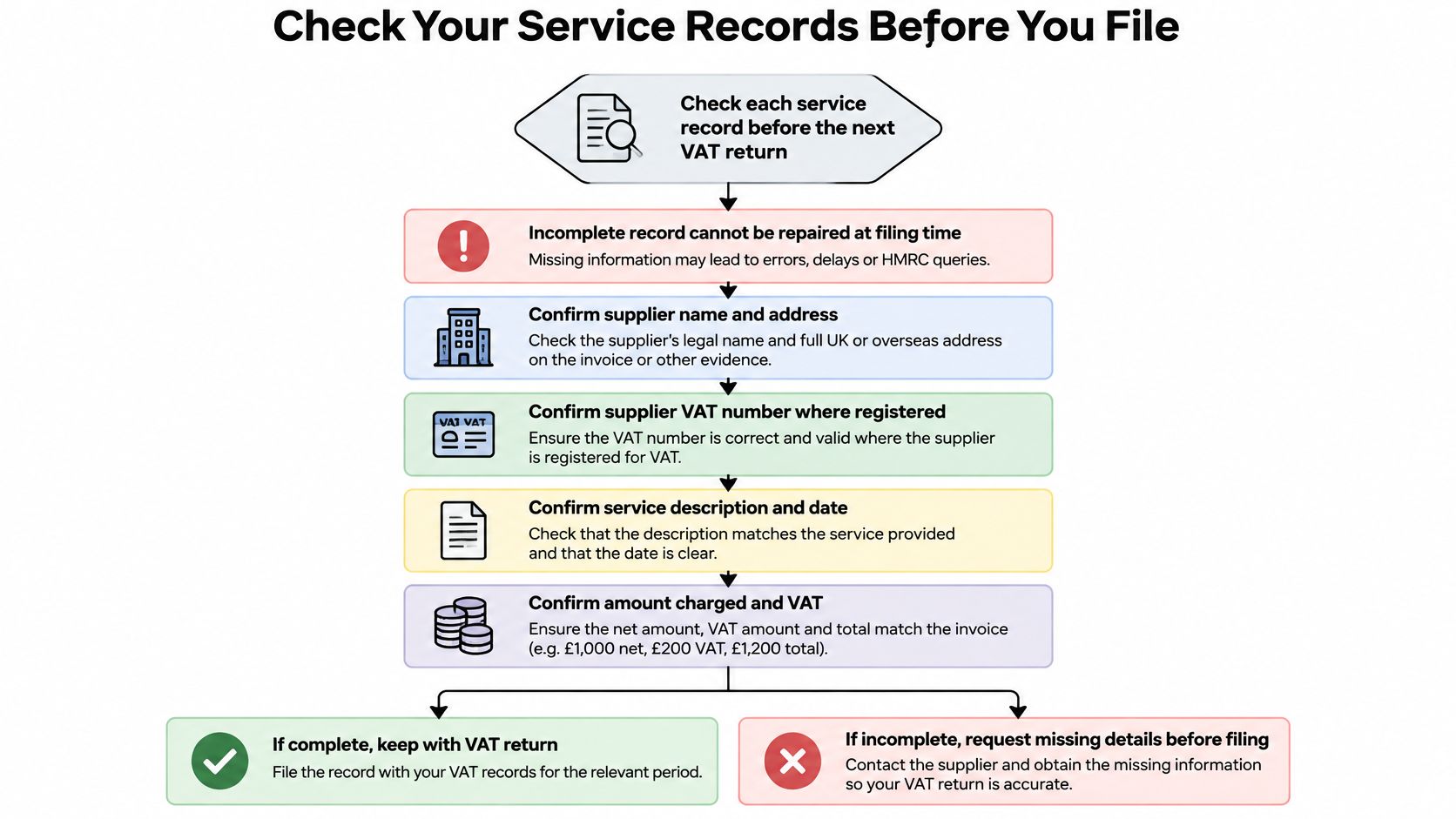
- Mark each record complete or incomplete against the VAT evidence threshold, and keep the two piles separate.
- Request the missing document from any supplier whose record has no VAT number, no VAT line or a hollow service description, and note the date you asked.
- Confirm the three dates on every record, then write down the tax point rule you applied.
- Link each document to its bank or card payment so the bundle opens from either end.
- Pull every channel into one place so nothing drifts into a personal folder or a screenshot roll.
Receipts arrive however the supplier chose to send them. Send them to Snyp as a phone photo, a forwarded email receipt or a WhatsApp message, or upload them on the web, and the flow stays four steps: snap or upload, AI extracts the details, you review and confirm, then approved data syncs to Xero or QuickBooks.
One action for this week: open last quarter's service receipts, find the ones without VAT details, and send the requests before the next return is due.
The final sign-off is yours. No checklist can decide whether a particular VAT amount is reclaimable on the evidence in front of you, and that judgement is exactly the part worth keeping in human hands.
Keeping a clean trail of service invoices and payment evidence is the difference between a reclaim you can stand behind and one you drop. Snyp captures receipts and invoices sent as photos, forwarded emails or WhatsApp messages, pulls out the provider, service description, amount and VAT, and syncs the approved data to Xero or QuickBooks so the supply and the payment end up in the same place. Start with a trial and see how quickly your next VAT return stops depending on a folder of unopened emails. Visit Snyp to get started.