




Receipts vs Invoices: What Each Proves for Your Books
You've got a till receipt for £4.20 from a client coffee, a PDF invoice from your software supplier, and a bank line that matches neither of them cleanly. The question underneath all of it is the one that matters: can I claim this, and can I reclaim the VAT?
Those are two separate tests. Income-tax deductibility asks whether the business incurred the cost. VAT recovery asks whether you hold the right document from a VAT-registered supplier, with the right details on it. A receipt can pass the first test and fail the second, which is why treating receipts vs invoices as a naming question costs small businesses money every quarter.
Receipts and Invoices Compared
A receipt and an invoice answer different questions at different points in the same transaction, and the shape of each document follows from that.
| Feature | Receipt | Invoice |
|---|---|---|
| Issued by | Seller at the point of payment | Supplier when a sale is billed, often later or in instalments |
| Main purpose | Evidence that payment was made | Record of a sale or purchase and the amount due |
| Typical trigger | Card, cash or contactless payment at the till or online checkout | Goods or services billed on account or on a retainer |
| VAT reclaim role | Only where it meets HMRC's authenticated receipt rules | Primary evidence for recovering input VAT when it is a valid VAT invoice |
| Retention | At least 6 years where it evidences an expense or VAT claim | At least 6 years from the date of issue |
A receipt proves money changed hands. An invoice sets out what was sold, on what terms and with which VAT.
HMRC treats the two as distinct evidence rather than two names for one thing. A receipt confirms that payment has been made. An invoice records the sale itself and carries the transaction detail your accounts and VAT returns are built from, with invoices received named specifically as the primary evidence for recovering VAT incurred as input tax.
The obligation runs to retention. Copies of every invoice you issue and every invoice you receive, paper or electronic, sit alongside records of everything the business buys and sells, and HMRC's record-keeping guidance sets the period at at least 6 years from the date of the record, rising to 10 years for businesses using the VAT One Stop Shop or the former VAT Mini One Stop Shop. No receipt, however neatly filed, does the work of an invoice when the VAT question comes up.
Why the paper tells you nothing
A till receipt and a solicitor's bill can come out of the same printer. Some till receipts carry the shop's VAT number and a VAT breakdown, particularly from builders' merchants, wholesalers and larger retailers. Some properly issued invoices get stamped "paid" and handed over as a receipt.
The category comes from what the document proves and when it was produced. The paper, the font and the logo decide nothing.
Three situations, three documents
- Coffee after a client meeting. You tap a card at the till and leave with a receipt. It proves the spend and the date, so it defends the deduction. It usually won't carry the supplier's VAT registration number, so it rarely supports a VAT reclaim on its own.
- A designer's monthly retainer on 30-day terms. The invoice arrives before any money moves. It states the scope, the fee, the VAT and the payment terms, and it sits in your purchase ledger as a creditor until it's paid.
- An online supplies order confirmed by email. An order confirmation isn't a VAT invoice. If the supplier is VAT-registered and you need the VAT, ask for a full VAT invoice, which they're obliged to give you.
The same purchase in two documents
Say you buy a toner cartridge for the office printer at £120 plus 20% VAT. The card receipt shows £144 leaving your account. That's strong evidence of the spend, and it's what you'd want if anyone asked whether the purchase happened at all.
The VAT invoice shows something different. It breaks the price into £120 net and £24 VAT, names the supplier's VAT registration number, and carries an invoice number and a tax point. That's the document that puts £24 back into your business, and it's the one your accounting software should be matching to the bank line.
Two documents, one transaction, two jobs. The receipt defends the expense. The invoice defends the VAT.
The test to apply when a document lands
Ask two questions in this order. Did it arrive after the money moved? Then it's a receipt, and it belongs with your expense evidence. Does it ask you to pay later, or show a VAT breakdown alongside the supplier's registration number? Then it's an invoice, and it belongs in the purchase ledger with the VAT fields intact.
When a document does both, meaning an invoice marked paid with a payment date and method, file it as the invoice and note the payment date. You don't need a second sheet of paper for the file to be complete.
Details Each Document Must Carry
A receipt can be perfectly valid as proof of payment and still be useless for VAT. The difference is field by field.
| Detail | Receipt | Full VAT invoice |
|---|---|---|
| Supplier name and address | Usually shown | Required |
| Supplier VAT registration number | Often missing | Required |
| Unique sequential invoice number | Not required | Required |
| Date of issue or tax point | Shown as transaction date | Required |
| Description of goods or services | Brief item list | Required, with quantity and unit price where applicable |
| VAT rate and VAT amount for each rate | Sometimes missing | Required |
| Total excluding VAT and total including VAT | Total paid only | Required |
| Customer name and address | Not usually shown | Required above £250, with simplified invoices allowed up to £250 |
What a full VAT invoice has to show
Work down the document in this order and you'll catch gaps before your accountant does:
- Supplier identity. Trading name, address and VAT registration number.
- A unique sequential invoice number. It's how you match the invoice to a payment and to a credit note later.
- Date of issue and the tax point. The tax point can differ from the invoice date on deposits and advance payments, which changes the VAT period.
- A description of the goods or services, with quantity and unit price where it applies. This is what a clear line item looks like on an invoice that will hold up in a review.
- The VAT rate and VAT amount for each rate charged. Mixed-rate invoices need this shown separately, not blended into one figure.
- Totals excluding VAT and including VAT.
Why most receipts fail the check
Till receipts typically show the merchant, the date, the items and the total paid, and stop there. No VAT registration number, no split between net and VAT, no invoice number. That's enough to prove a payment happened and not enough to substantiate input tax.
A pro-forma invoice fails for a different reason. It's a quotation or a request for advance payment, not a demand for tax, and a document marked "this is not a tax invoice" can't support a reclaim. If you've been handed one, ask for the final invoice.
The 30-second check
Four lookups on any document: the supplier's VAT number, the VAT rate, the VAT amount and the invoice number. If any of the four is missing, mark the document incomplete and chase the supplier the same week. Chasing in March for a January invoice is how businesses lose VAT they were entitled to.
How to Record Each in Your Bookkeeping
Recording does two jobs at once, and treating it as one is where ledgers go wrong. Each document has to prove the expense for the tax deduction, and separately carry the details input tax recovery needs. The same seven steps serve both tests.
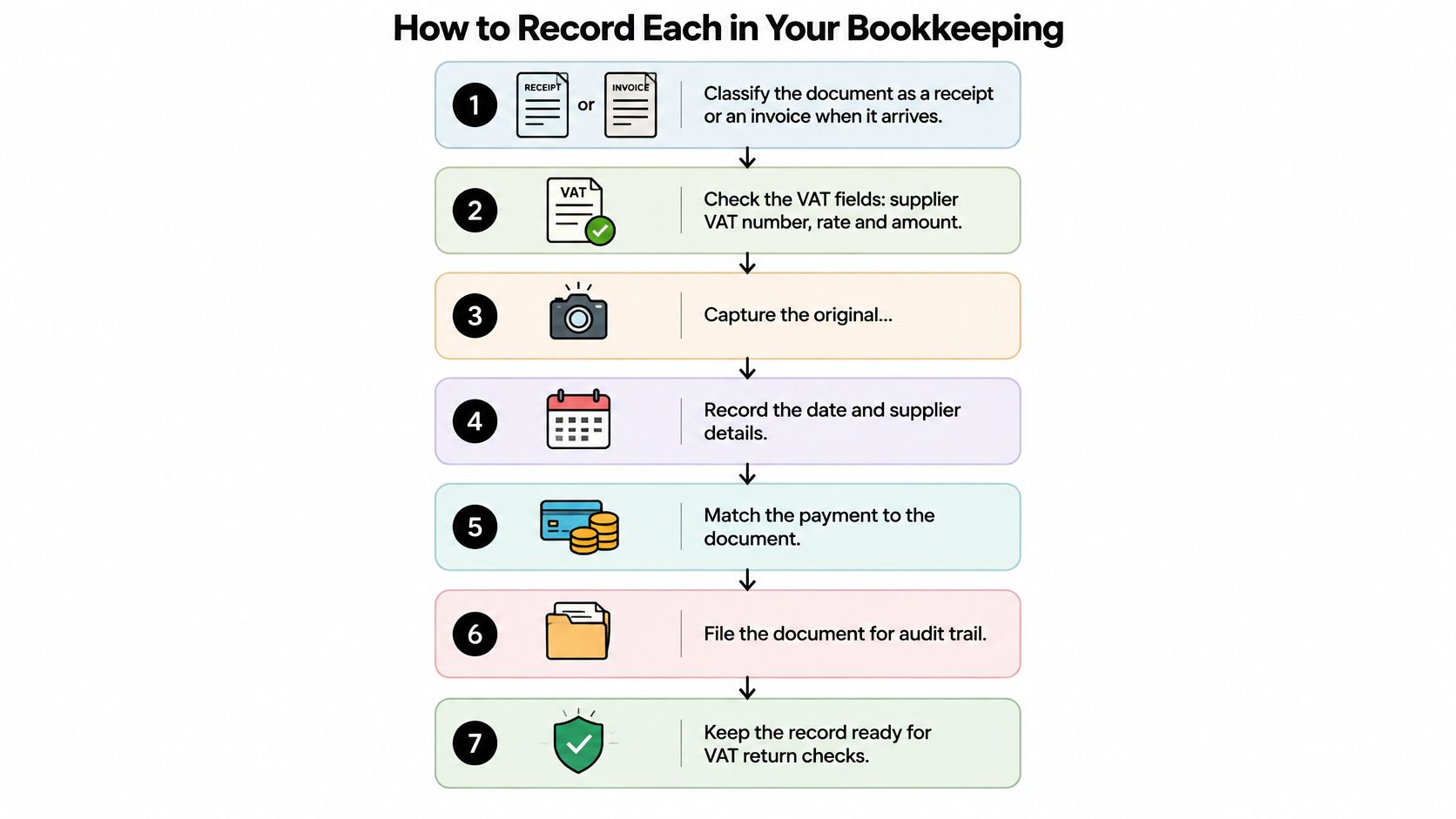
- Classify it on arrival. Receipt or invoice, decided the day it lands. The classification tells you which test the document can pass and what to check next. The common slip is one "misc" folder where receipts, invoices and delivery notes all sit together until year end.
- Mark what it can prove. A card receipt proves the spend and nothing about the tax, so it earns its place on the deduction side of the ledger and waits on a VAT invoice for the reclaim. Treating it as both is the single most expensive habit in small-business bookkeeping.
- Capture the original. A photo or a PDF, kept unaltered and readable. A retyped summary isn't evidence, and a blurry photo won't survive an HMRC query either.
- Assign an expense category. Pick from your chart of accounts and keep it consistent, so the same vendor always lands in the same place. Snyp takes documents by web upload, email forwarding or WhatsApp and assigns the most appropriate category from your own chart of accounts, and if you re-categorise a receipt it applies that change to future ones from the same vendor. Freelancers using it describe receipts being handled without them needing to check.
- Match it to the bank or card line. Unmatched receipts are the biggest hole in most ledgers. If your feed is already full of duplicates, splits and transfers, get a bookkeeper to clean up messy bank feeds before you start matching, or you'll be reconciling against noise.
- Flag what's incomplete. Mark any document that can't yet support the reclaim and chase the supplier for a full VAT invoice. Approved documents sync to Xero or QuickBooks categorised and formatted for reconciliation, which is the point at which the outstanding chase list becomes visible.
- Store it for retrieval. Six years minimum, searchable by supplier and date. A box in the loft technically retains records and fails the moment anyone asks for one.
Unpaid invoices need one extra habit. They sit in your ledger as creditors until the money leaves, and recording them on the payment date instead of the invoice date shifts the cost into the wrong period and distorts both.
The retention rule that covers both documents
HMRC's compliance handbook lists purchase invoices, copy sales invoices, credit notes, debit notes and authenticated receipts among records ordinarily kept for at least 4 years under its minimum-preservation table. Where a document forms part of the VAT account, the broader rule applies and the figure becomes 6 years. Invoices should be kept for 6 years from their date of issue, including invoices covering future supplies or payment events, because the clock starts when the document is issued rather than when the transaction finally happens.
Practical default: keep receipts and invoices together for 6 years from the date on the document. It's simpler than splitting them across two retention periods, and simpler survives busy quarters.
Mixed Evidence and Missing Paperwork
The standard advice to get an invoice for everything is fine in theory and wrong in practice. Plenty of legitimate business purchases arrive with nothing but a till slip, and telling a sole trader to write those costs off is bad counsel.
The two tests run separately. Making Tax Digital for VAT requires digital records of purchases, VAT, time of supply and value excluding VAT, and the government's e-invoicing implementation roadmap points the same way. A receipt proves money left the account. Whether it proves anything for VAT depends on three fields a till slip often lacks: the supplier's VAT registration number, the rate applied and the VAT amount.
| Situation | Evidence you hold | Usable for VAT reclaim? | What to do |
|---|---|---|---|
| Till receipt with no supplier VAT number | Till receipt | Not on its own | Request a full VAT invoice from the supplier |
| Card statement plus till receipt | Statement and receipt | Only if the receipt carries the VAT details | Attach both and note why the invoice is missing |
| Hospitality receipt | Restaurant or hotel bill | VAT on business entertainment is generally not reclaimable | Record the expense and check income-tax treatment separately |
| Supplier invoice received late | Late VAT invoice | Yes, if it is a valid VAT invoice | Record it when received and keep the original |
| Pro-forma or 'not a tax invoice' document | Pro-forma | No | Ask the supplier for the final VAT invoice |
Can you claim the expense and reclaim the VAT
With only a receipt, you can usually claim the expense and usually cannot reclaim the VAT. The expense claim needs proof the business incurred the cost and that it relates to the trade. The VAT reclaim needs the supplier's registration number, the rate and the VAT amount, which is exactly what a till slip omits.
I treat the receipt as proof of cost and nothing more until a valid VAT invoice arrives. Claim the expense now, park the VAT, and chase the supplier for the proper document. If the paperwork has gone entirely, claiming an expense without a receipt is still possible with supporting evidence such as the card statement and an order confirmation, but a missing VAT invoice is a different problem with a different fix.
Two habits keep mixed evidence manageable. Attach the card statement to the receipt and write one line explaining why the invoice is absent, so nobody has to reconstruct the reasoning eighteen months later. And if an enquiry does arrive, keeping your records organised and matched to each payment keeps the conversation about documents rather than about trust. The framework differs outside the UK: in the US, taxpayer rights during an audit sit with the IRS rather than HMRC.
Invoices aren't universally superior. They win on one job only: proving VAT.
Which Document Fits Which Situation
The right document depends on which side of the transaction you're on and what you need to prove. Run down this checklist before you file anything.
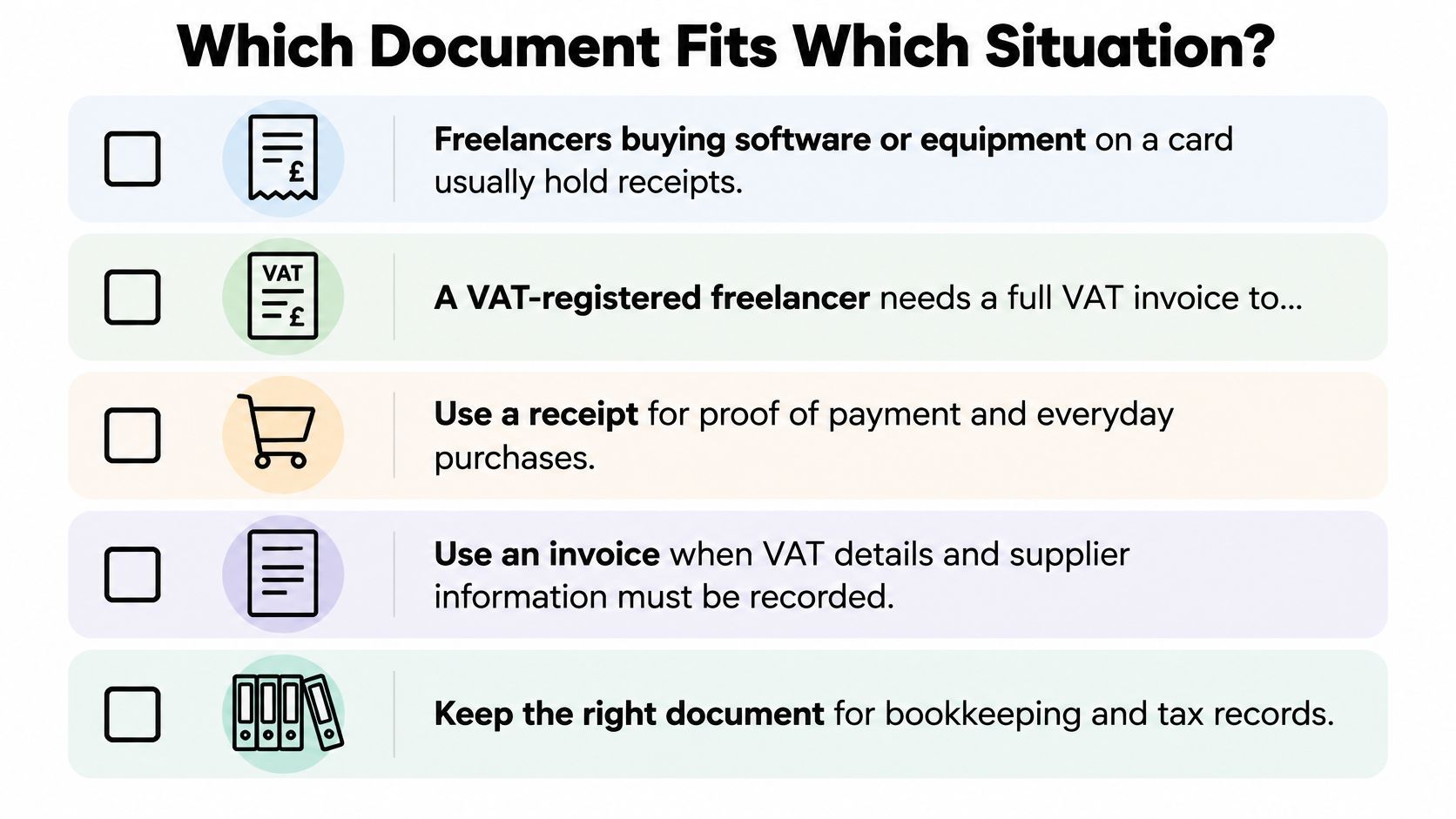
- Freelancer buying software or equipment on a card. You'll hold a receipt from the checkout. A VAT-registered freelancer needs a full VAT invoice to reclaim, and most software vendors will issue one from the billing dashboard in about two clicks.
- Sole trader buying materials on account. Expect an invoice with payment terms. The cost belongs in the period the invoice is dated, and it stays a creditor until settled.
- Contractor buying fuel or parts on the road. You collect receipts at the pump. Check for the VAT number and VAT amount before you drive off, and ask at the counter for a VAT invoice if they're absent.
- Business paying professional fees. An accountant's quarterly fee, a solicitor's contract review or an IT consultant's monthly retainer should arrive as an invoice showing the breakdown and the VAT. These are exactly the documents Snyp handles, along with business coach invoices and graphic designer invoices, in the same pipeline as receipts, bank statements and purchase orders.
A standard VAT invoice is the normal documentary basis for reclaiming input tax and must carry the information HMRC's VAT guide, Notice 700 requires, together with evidence that the supply occurred, was made to you and was used in the business.
The one narrow exception: an authenticated receipt can stand in for a VAT invoice only in qualifying periodic-payment contracts, and only if it contains the prescribed VAT invoice information, is authenticated by the supplier and is the only document issued for the supply.
Here's how that plays out in practice on a typical month of documents.
The decision rule is short. If you need the VAT, look for an invoice. If you only need proof of spend, a receipt is enough. Most months you need both, for different purchases.
Prepare for Mandatory Digital Invoicing
Digital invoicing does not create evidence. It only changes the form that evidence arrives in. UK businesses can already receive electronic invoices where the recipient agrees, provided authenticity of origin, integrity of content and legibility are preserved. The government is still consulting on the future use of e-invoicing and digital reporting, so treat compulsory structured invoices as a direction of travel rather than a switch with a settled start date.
For a sole trader or limited company, the same document still has to pass two separate tests. For income tax or corporation tax, it needs to tie the spend to the business clearly enough to support the deduction. For VAT, it needs to show the supplier, the tax point, the VAT charged and the transaction detail before input tax goes on the return. A sharper file format helps only if those fields survive capture, storage and retrieval.
If you sell online or already exchange invoices with EU-facing systems, the e-Fatura app for online stores shows invoice data moving as structured fields rather than a picture.
The useful preparation is modest. Ask main suppliers whether they can send invoices electronically to your accounting inbox, agree## Prepare for Mandatory Digital Invoicing
Electronic invoices are already permitted when the recipient agrees to receive them, provided the business preserves authenticity of origin, integrity of content and legibility. The direction of travel is clear from there: the government is consulting on and moving toward mandatory e-invoicing, as set out in the e-invoicing and digital reporting consultation. When a mandate takes effect, a document will need to carry its data in a structured, machine-readable form rather than relying on a tidy PDF.
The practical risk is storing an image that can't reliably show the supplier, the tax point, the VAT and the transaction details when someone asks. A photo of a receipt that never carried a VAT number looks like evidence and isn't. That failure bites twice, because the same file answers two separate tests: proof of spend for income-tax deductibility and proof of VAT for input tax recovery. A weak image fails both.
If you run an online store or issue invoices into other EU systems, tools such as the e-Fatura app for online stores show how structured invoice data is already handled in practice.
The action for now is modest. Ask your main suppliers whether they can send invoices electronically to your accounting inbox, confirm in writing that you've agreed to receive them that way, and build the habit of digital record keeping that keeps the original, captures the key fields and links each document to a payment. Snyp already runs that sequence in four steps: upload the document, the AI extracts the details, you review and confirm, and the approved data syncs to Xero or QuickBooks. Do that consistently and, whenever the mandate lands, it becomes a format change rather than a rebuild.
Snyp takes the documents you already collect, receipts forwarded from WhatsApp, invoice PDFs from your inbox, and turns them into categorised, VAT-aware data waiting in Xero or QuickBooks when you sit down to reconcile. If your shoebox currently holds three months of mixed evidence and no clear answer on what's reclaimable, give Snyp a try and start with this month's documents rather than last year's.