




Expense Without Receipt
A client lunch is finished, the cash has changed hands, and the printed receipt has vanished before you reach your desk. Or your supplier's invoice landed in a junk folder, your card statement shows only an unhelpful merchant name, and your bookkeeping deadline is approaching. The expense happened, but the neat piece of paper proving it didn't.
Don't panic, and don't just delete the transaction. An expense without a receipt creates three separate risks: HMRC may challenge the deduction, you may lose VAT input recovery, and your employer or company may reject the reimbursement. Those risks aren't the same, so they need different evidence and different decisions.
When the Receipt Disappears and What to Do Next
Start by separating the missing document from the underlying transaction. A lost receipt doesn't automatically mean the expense never happened, and it doesn't automatically make the whole claim invalid. HMRC's guidance recognises that small cash expenses can occasionally lack receipts, provided you create a prompt note of the amount, date and purpose and retain the wider supporting records where possible (GOV.UK's record-keeping guidance).
The first job is to establish which of the three risks you're dealing with:
- Income tax or corporation tax deduction: Can you demonstrate that the purchase was a genuine business expense, with enough detail to support the amount and business purpose?
- VAT input recovery: Do you have the evidence needed to reclaim VAT, which is generally more demanding than evidence for an income tax deduction?
- Company reimbursement: Does your employer's or company's written policy permit alternative evidence, or does it insist on a receipt before paying you?
Those questions often produce different answers for the same transaction. A bank entry might help show that money left your account, but it may not prove what you bought or establish that the supplier charged VAT. It might also fail an internal policy that requires a digital receipt, attendee details or prior approval.
Practical rule: Treat a missing receipt as an evidence gap, not as permission to guess.
Write the missing-receipt note while the details are fresh. Search your inbox and junk folder, check the merchant's account portal, save any booking confirmation, and capture the bank or card entry. If you can reconstruct the transaction accurately, keep the claim with a clear audit trail. If you can't establish the supplier, amount or business purpose, leave it out until you can substantiate it.
A practical overview of the wider issue is available in these tax receipt tips from HireAccountants. For the self-assessment angle, compare the treatment with this guide to receipts for Self Assessment.
What HMRC Actually Says About Missing Receipts
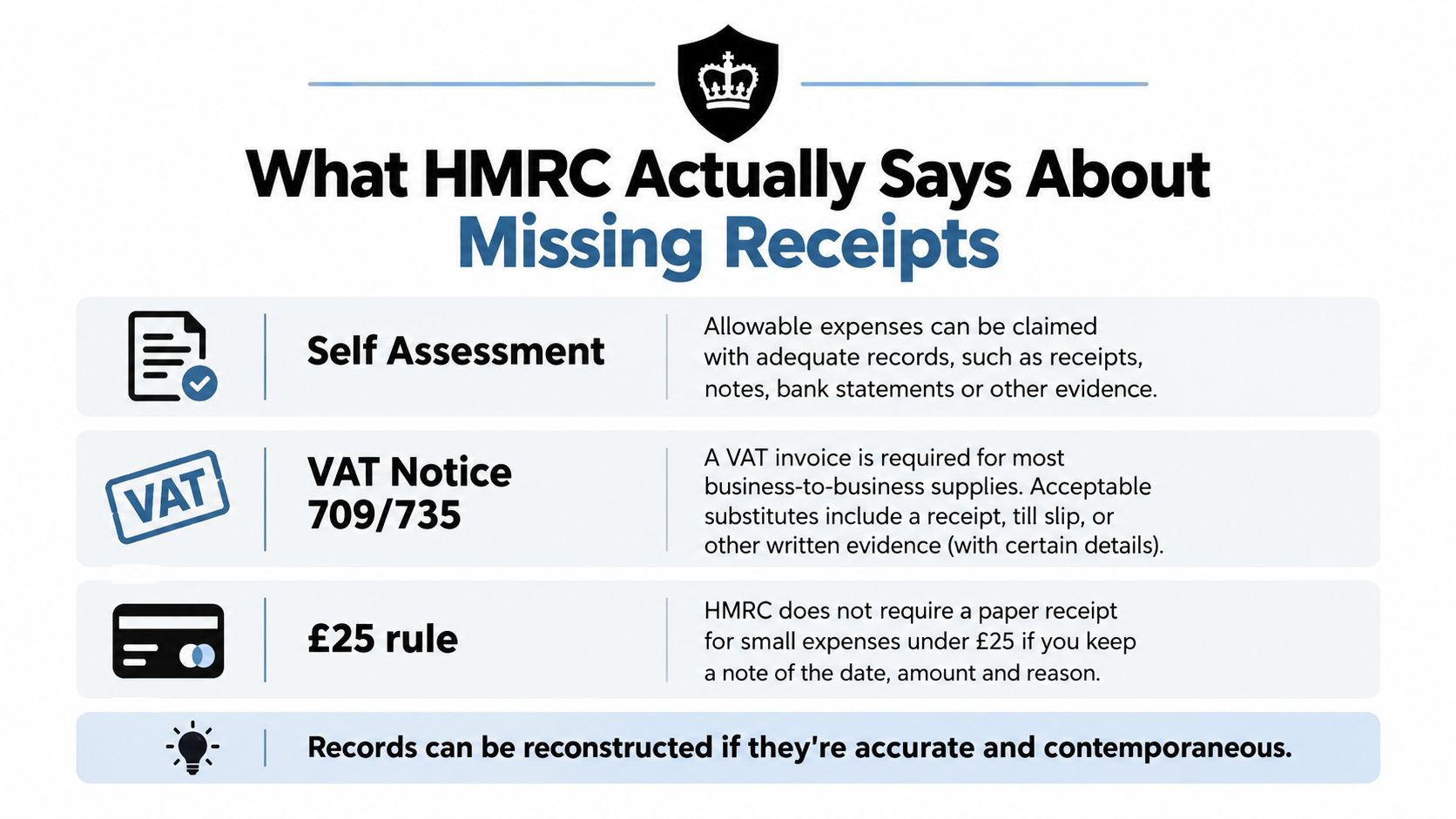
HMRC's position is more practical than the familiar slogan that says “no receipt, no claim”. For a small cash expense with no receipt, its guidance says you should make a brief, contemporaneous note recording the amount, date and purpose. You should also retain supporting evidence and be able to explain the transaction if HMRC asks to inspect your records.
That doesn't make a self-written note equivalent to a supplier invoice in every situation. It gives you a way to document an exceptional missing receipt, especially where other evidence supports the entry. A bank record, calendar entry, email, booking reference, delivery note or supplier correspondence can help establish what happened, but each item proves something different.
What an audit trail needs to show
For an income tax claim, the record should make the transaction intelligible to someone who wasn't there. Include:
- The date and amount: Match the note to the bank, card or cash record.
- The supplier: Record the business name, not just “lunch” or “travel”.
- The purchase: Describe what you bought rather than relying on a vague category.
- The business purpose: State the client, project, journey or work reason.
- The supporting trail: Attach emails, booking references, delivery notes or other relevant documents.
For limited companies, the record-keeping obligation covers all money spent by the company. HMRC's guidance identifies items such as receipts, petty cash books, orders and delivery notes as part of the company's accounting records. Digital copies are acceptable when they're legible, so the issue is reliable proof, not whether the original was printed.
The risky pattern is repeated or substantial claims supported only by notes written after the event. That pattern makes it harder to distinguish a genuine omission from careless record keeping, and a dishonest claim can create tax and compliance consequences far beyond a missing piece of paper. Don't manufacture a receipt, alter a document or inflate an amount. Record what you know, identify what you can't prove, and ask your accountant before submitting an aggressive claim.
A short video can reinforce the practical distinction between recording an expense and proving it:
The key point is simple. HMRC can accept reconstructed evidence where it is accurate and made promptly, but weak documentation becomes less persuasive when the expense is large, unusual, repeated or unsupported by anything else.
Reconstructing Proof When There Is Nothing to Scan
Reconstruction works best when you act before the transaction becomes a vague memory. Photograph any torn receipt or partial till slip, even if it only shows the merchant and date. Open your banking app while the entry is easy to identify, capture the transaction details, and search the merchant's website or your email for a replacement invoice.
The bank entry is useful, but don't mistake it for the whole file. “CARD PAYMENT” or a shortened merchant descriptor may confirm that money left your account without showing the items purchased, the business purpose or the VAT treatment. A supplier invoice, booking confirmation or email thread usually adds far more context.
Build one coherent record
Write an internal receipt or missing-receipt memo for the gap. Include the date, supplier, gross amount, VAT position if known, payment method, and a plain explanation of why the purchase was for the business. Add the project or client reference where relevant, then sign and date the note. A note created on the day is more credible than one produced during a year-end panic because it captures facts you may otherwise forget.
Keep the note with the transaction, not in a separate folder that nobody checks. If you use a bookkeeping system, attach the note and supporting files to the expense entry. If you manage records manually, use a consistent digital folder structure and a filename that identifies the date, supplier and amount.
| Evidence Type | Strength | Typical Use |
|---|---|---|
| Supplier invoice or replacement receipt | Strongest | Establishes supplier, items, amount and VAT details |
| Booking confirmation or delivery note | Strong | Supports the date, supplier, service or goods received |
| Bank or card transaction record | Moderate | Confirms payment, date and amount, but may lack purchase detail |
| Email or client correspondence | Moderate | Supports the business purpose, project or meeting |
| Contemporaneous missing-receipt note | Useful when supported | Explains a small cash item or exceptional missing document |
| Late note with no external evidence | Weak | Shouldn't carry a significant or unusual claim by itself |
For recurring work, streamline workflows with digital forms so the person making the purchase can capture the details before the evidence disappears. The same discipline improves bank statement reconciliation, because each unexplained line gets investigated while the context is still available.
Don't backfill a story to fit a number. If the bank entry is clear but the VAT status isn't, record the expense for the tax deduction if the business evidence supports it and handle the VAT question separately. That separation prevents a defensible expense claim from becoming an overconfident VAT claim.
Income Tax Versus VAT Evidence Rules
The same missing-receipt purchase can pass one tax test and fail another. Income tax or corporation tax asks whether the business incurred a genuine allowable cost and whether the records support the amount, nature and business purpose. VAT recovery asks an additional question: whether you hold the evidence required to reclaim input tax.
For income tax, assemble a sensible chain from the payment to the work. A bank or card record can support the amount and date. An email, calendar appointment or client file can support the business purpose. A contemporaneous note can fill the specific gap where a small cash receipt is unavailable. The more unusual the transaction, the more complete the surrounding evidence should be.
VAT is less forgiving. A VAT reclaim generally needs a VAT invoice, and a missing till receipt can therefore affect the VAT claim even where the underlying cost remains supportable for income tax. The narrow alternative-evidence rules should not be treated as a general licence to reclaim input tax whenever a receipt has been lost. The distinction is reflected in HMRC material discussing evidence for small expenses and VAT treatment, including the HMRC guidance on small cash expenses and VAT evidence.
| Requirement | Income Tax or Corporation Tax | VAT Input Recovery |
|---|---|---|
| Proof of payment | Bank, card, cash record or other payment evidence | Helpful, but normally not sufficient by itself |
| Business purpose | Clear explanation linked to the work | Still relevant, alongside VAT evidence |
| Supplier and date | Should be recorded and corroborated where possible | Needed to establish the transaction and invoice details |
| VAT details | Useful if known, but not always decisive for the deduction | Critical to a valid input tax claim |
| Missing receipt | A prompt note and supporting records may support the expense | Usually requires stronger evidence and careful review |
| Small purchase treatment | Assess the underlying business cost | The £25 threshold can change the invoice evidence analysis |
Why the £25 rule causes confusion
The £25 VAT threshold does not mean every expense below that amount can be reclaimed without thought. It concerns conditions for small purchases where a full VAT invoice may not be required, and the transaction still needs to be genuine, business-related and supported by appropriate records. A bank entry plus a clear note may help, but don't use the threshold to turn an unidentified or personal payment into a VAT claim.
For a small purchase, keep the card or bank entry, any delivery note or email, and your contemporaneous internal record together. If the amount is above the threshold, obtain the proper VAT invoice before reclaiming input tax, or exclude the VAT until the evidence is available. For a detailed treatment of the two sides, see this explanation of VAT input and VAT output.
Company Policy and Reimbursement Risks
HMRC sets the tax baseline. Your employer, company or client can set a stricter reimbursement standard, and it often will. A policy might demand an original or digital receipt, a business purpose, names of attendees for a client meal, mileage records, pre-approval for travel and submission by a stated deadline.
That policy is a payment rule, not a tax ruling. HMRC may accept alternative evidence, while the finance team still refuses reimbursement because the employee hasn't met the internal process. UK guidance also recognises that employees may sometimes use evidence such as a bank statement or booking reference, and that receipts aren't always required for ordinary expenses where the amount isn't substantial. The employer can nevertheless apply its own policy and may treat a payment that doesn't meet the policy as taxable pay, as discussed in the HMRC material on alternative employee expense evidence.
What happens after a rejected claim
The finance team may decline the expense, ask for more evidence, reimburse only part of it, or require the employee to repay an amount already paid. A company may also need to decide how an unsupported personal payment is recorded in its accounts, particularly where a director paid personally and the company hasn't documented the reimbursement properly.
Don't wait for a missing receipt to expose a weak policy. Write down the fallback evidence allowed, the approval route, the deadline for claims and the treatment of exceptions. A good policy tells people what to capture at purchase, not just what finance will reject at quarter end.
Building a Habit That Stops the Problem at Source
The cheapest missing-receipt solution is capture at the point of purchase. A freelancer finishes a train journey, photographs the ticket and links it to the card transaction before the trip details blur. A contractor receives an invoice by email, forwards it into the expense system immediately, and adds the job reference while the work is still fresh.
An end-of-day routine is enough for many small businesses. Photograph every paper receipt, save emailed invoices before they disappear into a crowded inbox, and match card transactions to their supporting documents. Store everything in one searchable folder or expense app instead of scattering files between personal phones, email accounts and download folders.
The useful record isn't just an image. Add the short context that a photograph can't provide, such as the client discussed over lunch, the project that required the journey, or the reason a purchase was necessary. That note protects the business purpose and helps someone else understand the entry later.
A capture tool can let you photograph a receipt, forward a supplier email, attach a bank statement line and preserve a short explanation against one expense record. Snyp is one option that accepts receipts and related documents through WhatsApp, email forwarding or file upload, extracts details such as the merchant, amount, date, tax, currency and category, and syncs structured records with accounting platforms including Xero and QuickBooks.
Better routine: Capture first, explain second, reconcile while the transaction is still familiar.
This turns the missing-receipt problem from a quarterly rescue operation into a small daily task. You won't remember every detail weeks later, especially for cash purchases and client meetings. A contemporaneous note does the remembering for you.
Quick Checklist and Common Questions
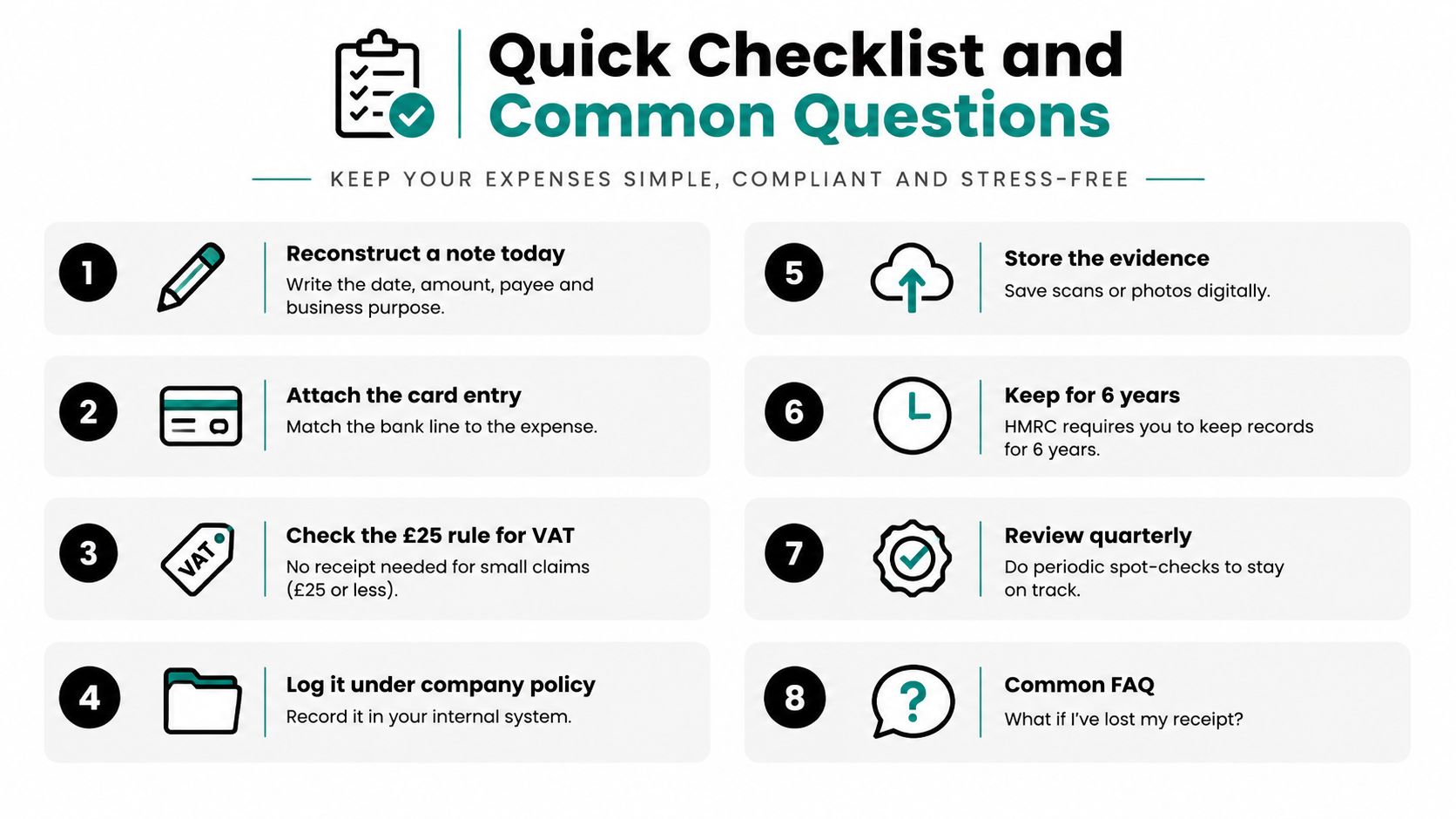
Use this checklist whenever a receipt is missing:
- Write the note today: Record the date, supplier, amount and business purpose.
- Match the payment: Attach the bank or card entry to the expense.
- Check the £25 VAT rule: Don't assume a small amount automatically supports VAT recovery.
- Find substitute evidence: Search email, booking systems, delivery records and supplier portals.
- Apply company policy: Record approvals, attendees, mileage and deadlines where required.
- Store it digitally: Keep the note and supporting documents with the bookkeeping entry.
- Review exceptions: Ask your accountant about unusual, repeated or substantial claims.
Common questions
How long should I keep the records?
The retention period depends on the type of business and record involved. Check the relevant GOV.UK record-keeping guidance and keep the evidence long enough to support the return and any possible inspection.
Is a bank statement enough?
Sometimes it supports the amount and payment date, but it may not show what you bought, why it was business-related or whether VAT was charged. Treat it as one part of the audit trail.
What if the supplier won't reissue the receipt?
Create a contemporaneous missing-receipt note, retain the payment record and add emails, booking details or other evidence. Separate the income tax decision from the VAT decision.
Do phone photos have the same weight as paper?
Legible digital copies are acceptable under HMRC record-keeping guidance. Keep the complete image and attach it to the relevant transaction.
A missing receipt can be recoverable when you reconstruct the evidence promptly and consistently. Prevention is still cheaper than cure.
Use Snyp to capture receipts, emailed invoices and supporting notes in one expense record before they disappear. Start building the habit today, so your next missing receipt is a documented exception rather than a bookkeeping emergency.