




UK Reimbursement Of Expenses A Complete Guide

At its heart, reimbursement of expenses is simply the process of a business paying back an employee, freelancer, or contractor for money they’ve spent out of their own pocket on legitimate, work-related costs. It's a fundamental system that ensures people aren't left footing the bill for things like client travel or essential supplies. When this process is well-organised, it’s a non-issue; when it’s not, it can quickly become a major source of friction.
Turning Chaos Into Clarity

We’ve all been there. Stuffing crumpled receipts into a wallet after a client lunch, then spending hours trying to match them up to a spreadsheet, only to wait weeks for a payment that feels like it might never arrive. This isn't just a minor annoyance; for many, it’s a serious financial strain.
A startling survey revealed that 43% of UK workers have faced financial difficulty while waiting to be reimbursed for work expenses. That figure climbs to a massive 66% for those who have to claim their expenses monthly. With the average worker paying out £4,255 a year on business costs, a slow or broken system has a real-world impact. You can discover more insights about why expense systems are failing UK staff in 2025 to see the full picture.
Think of your reimbursement process like the engine of a car. When it's well-oiled and running smoothly, it powers your business forward, keeping cash flowing and morale high. But when it's clogged with lost receipts, convoluted approval chains, and slow payments, it just creates friction, frustration, and financial headaches for everyone.
What Is A Reimbursable Expense?
At its most basic, a reimbursable expense is any cost an individual covers on behalf of the company that is both necessary and directly related to their job. This isn't a free-for-all for personal purchases; it's about covering the essential costs of doing business. A crystal-clear policy is the best way to eliminate any grey areas from the start.
A strong reimbursement system does more than just repay costs; it builds a foundation of trust and financial transparency. It signals to your team that you value their contribution and respect their personal finances.
To keep things compliant and clear, every business needs to define what counts as a legitimate expense. Below are some of the most widely accepted categories under UK rules.
Common Types Of Reimbursable Expenses In The UK
This table provides a quick-reference guide to the kinds of costs that are typically covered by a business expense policy.
| Expense Category | Common Examples | Key Consideration |
|---|---|---|
| Business Travel | Train tickets, airfare, fuel for business journeys, parking, and tolls. | The travel must be for business purposes only; commuting to your usual workplace is generally not included. |
| Accommodation & Meals | Hotel stays and reasonable food costs incurred while travelling for work. | Often subject to daily limits (per diems). Lavish or excessive spending is usually not permitted. |
| Supplies & Software | Office stationery, specific software subscriptions, or tools needed for a project. | The item must be necessary for performing your job duties, not just a personal preference. |
| Client Entertainment | Taking a client out for a meal to discuss business or build a relationship. | There are often strict spending limits and rules about who can be entertained. Alcohol may have specific guidelines. |
| Training & Development | Costs for courses, certifications, or conferences that enhance job-related skills. | Must be approved in advance and directly relevant to your role or professional growth within the company. |
Having a structured, well-documented process for the reimbursement of expenses isn't just good admin—it's vital for your company's financial health and legal standing. It ensures your records are spot-on for tax purposes and that everyone knows where they stand, preventing disagreements before they even start.
Getting to Grips with UK Tax and Legal Rules
Figuring out the rules for expense reimbursements isn't just about tidy bookkeeping; it's absolutely vital for staying on the right side of UK tax law. If you get it right, everything runs smoothly and is tax-efficient. But get it wrong, and you could be looking at surprise tax bills and penalties from HM Revenue & Customs (HMRC).
The whole thing boils down to one crucial difference: is it a genuine business expense, or is it what HMRC would call a 'perk' or benefit? This single distinction decides whether the money your employee gets back is tax-free or if it's treated as taxable income.
The Golden Rule: Wholly, Exclusively, and Necessarily
At the very heart of UK expense law is a straightforward but very strict principle. For an expense to count as a legitimate, tax-deductible business cost, it must be incurred “wholly, exclusively, and necessarily” while an employee is doing their job.
Think of this phrase as the ultimate test for any expense claim. Let's look at a practical example to see what it really means.
- Passes the Test: A train ticket bought to travel from your office to a client's headquarters for a key project meeting. The cost is entirely for business, specifically for that meeting, and was essential for you to be there. It ticks all the boxes.
- Fails the Test: Your daily train ticket to get from home to your usual workplace. This is just an ordinary commuting cost. HMRC sees this journey as getting you to your job, not doing something for your job, so it’s not tax-deductible.
This rule is precisely why having a crystal-clear expense policy is non-negotiable. It helps everyone in the company understand the line between a justifiable business expense and a personal cost.
Reimbursed Expenses vs. Benefits in Kind
This is a common stumbling block where many businesses get into trouble. How you handle these payments has major tax consequences for both your company and your employees.
A reimbursed expense is simple. It's a direct repayment for money an employee has spent out of their own pocket on a legitimate, receipt-backed business cost. When you have a compliant system, this money isn't seen as extra income, so it isn't subject to tax or National Insurance.
A Benefit in Kind (BIK), on the other hand, is any non-cash perk that has a real monetary value. Think of a company car that can be used personally, or private health insurance. These are treated as part of an employee’s income and are therefore taxable. If you reimburse an expense that fails the "wholly, exclusively, and necessarily" test, HMRC can reclassify it as a BIK, which suddenly creates a tax problem.
Think of an 'accountable plan' as your shield against tax headaches. It’s not a single document, but rather the set of rules your business follows to prove to HMRC that your reimbursements are for genuine business expenses, not just disguised wages.
HMRC's Record-Keeping Requirements
To keep HMRC happy, your whole reimbursement process needs to operate under what's known as an 'accountable plan'. This is just a formal way of saying you have a proper system in place that makes employees fully account for what they've spent.
There are three main pillars to a solid accountable plan:
- Business Connection: The expense must have a clear and obvious business purpose.
- Substantiation: The employee must provide solid proof of the expense, like a receipt or an invoice, within a reasonable amount of time.
- Return of Excess: If an employee is given an advance or payment that’s more than the substantiated expense, they must return the extra money to the company.
Keeping good records is not optional. For every single claim, you must hold onto evidence that shows the amount, date, location, and business purpose of the expense. This detailed approach is your best defence in an HMRC audit and is also a critical part of an effective bank statement reconciliation for your business.
Here’s the rewritten section, designed to sound like it was written by an experienced human expert.
How to Create an Expense Reimbursement Policy That Actually Works
Moving from a vague, unwritten understanding of expenses to a formal, written policy is a game-changer. Think of it as your company's rulebook for spending. It stops misunderstandings dead in their tracks, protects the business from runaway costs, and, most importantly, ensures everyone gets treated fairly. It turns a process that can easily become chaotic into something structured and predictable.
Without that clarity, you’re not just risking your budget; you're also damaging team morale. When the rules are fuzzy, employees essentially become an unwilling credit line for the company, a problem far more common than you might think. A recent survey revealed a shocking 63% of UK workers who claimed expenses never got fully paid back, with some losing over £500 for good. You can read more about the impact of delayed payments on UK workers to see just how critical a dependable policy is.
Ultimately, a well-crafted policy is your first line of defence. It builds a foundation of trust and transparency from the ground up.
The Core Components of a Strong Policy
A great expense policy doesn't need to be a 50-page legal document. It just needs to be clear, comprehensive, and easy for everyone to find and understand. If you focus on getting these key elements right, you'll have a policy that works for your business.
At a minimum, your policy needs to spell out:
- What You’ll Actually Pay For: Be specific. List the categories the company covers, like business travel, client meals, or essential software. It’s just as important to list what you don't cover, such as the daily commute or personal coffees.
- Spending Limits and Guidelines: This is all about setting clear boundaries. Put firm caps on different categories. For instance, you could set a daily limit for meals (£40 per day) or a maximum nightly rate for a hotel (£150 per night in major cities). This gives your team confidence and helps you budget accurately.
- How to Submit a Claim: Don't leave this to guesswork. Detail the exact steps. Explain what information is mandatory (date, amount, vendor, business purpose) and what proof you need, like an itemised receipt.
- When to Submit By: Set a firm deadline. A common and fair rule is that all expenses must be submitted within 30 days of the purchase. This simple step prevents a huge backlog of old claims from piling up at the end of the quarter.
- The Approval Chain: Map out who needs to sign off on expenses. In a small startup, it might be the founder. In a larger organisation, it's usually the employee's line manager.
- When People Get Paid Back: Set clear expectations for how quickly you'll process reimbursements once they're approved. Promising to pay within the next payroll cycle or within 15 working days is a standard and fair approach.
Communicating The Policy So People Listen
Writing the policy is just the first step. Getting everyone to read, understand, and stick to it is the real challenge.
Once it's finalised, don't just bury it in a shared drive. Announce it properly to the whole team. Make it incredibly easy to find in your company handbook or intranet. And make sure it’s a quick but essential part of the onboarding process for every new employee or contractor.
A policy is a living document. Make a point to review it once a year. This gives you a chance to check if it still makes sense for your business, reflects current travel costs, and aligns with any changes in tax rules. A proactive review keeps the entire process relevant and fair for everyone.
The Step-By-Step Expense Reimbursement Process
Knowing your company’s expense policy is one thing, but understanding the practical steps to get your claim approved and paid is what really matters. The whole journey from spending your own money to getting it back can be broken down into a simple, repeatable workflow.
Following these stages doesn't just tick a box for compliance; it's the fastest way to get reimbursed. Let’s walk through what this looks like for a contractor heading to a two-day industry conference in Manchester.
Stage One: The Purchase and The Proof
The clock starts ticking the moment you pay for something. Our contractor books their train ticket, sorts out the hotel, and buys a pass for the conference. For every single one of these transactions, the most important thing they can do is immediately capture proof of payment. This isn’t just a good habit—it’s the absolute foundation of a valid claim.
You need to make sure your receipt or invoice is clear and legible. It’s the evidence that turns a personal payment into a legitimate business expense.
A good receipt captures the essentials: the merchant's name, the date, an itemised list of what was bought, and the total amount paid, including any VAT. Snapping a quick photo on your phone is a good first step. Even better, using a tool that can instantly read and digitise that information saves you a headache later on. You can see how this works by checking out our guide on how to read email receipts automatically.
Stage Two: Submitting the Claim
With all the receipts gathered, it’s time to formally submit the claim. This usually means filling out an expense report, which might be a digital form in a software platform or a classic spreadsheet. This is where you connect the proof (your receipts) with the purpose (why it was a business expense).
Each item on the report should match a single receipt and clearly explain why you spent the money. For example, the train ticket shouldn’t just be listed as "travel." A much better description would be: "Return travel to Manchester for the Annual Tech Innovators Conference." Vague descriptions are a red flag and one of the main reasons claims get stuck or rejected.
This whole process works best when the company has set clear ground rules from the start.
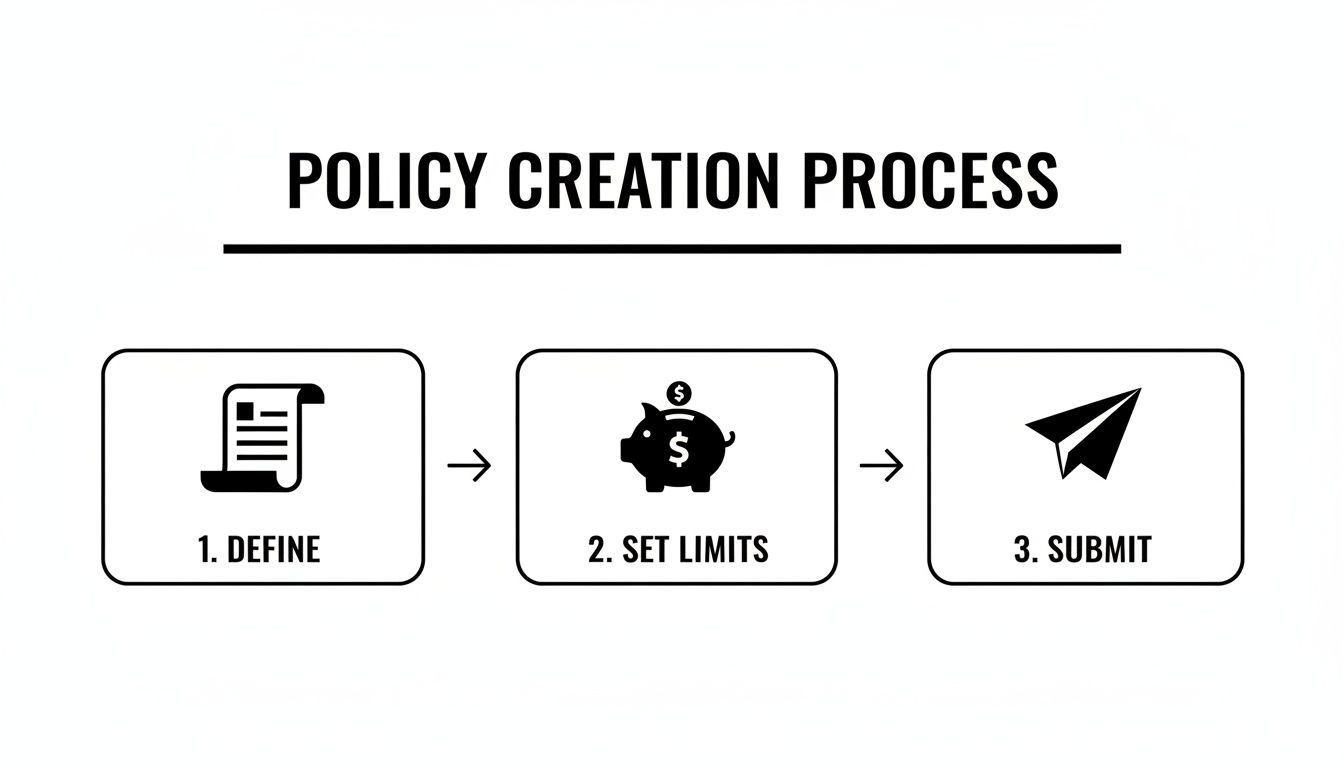
This simple flow—defining the rules, setting the limits, and clarifying the submission steps—is the backbone of any efficient reimbursement system.
To make sure your claim sails through, you need to provide all the right details. Think of it as a checklist for getting paid quickly.
Essential Information For An Expense Claim
| Data Point | Why It's Needed | Example |
|---|---|---|
| Your Name & Role | Identifies who is making the claim. | "Alex Ray, Marketing Consultant" |
| Date of Expense | Confirms the expense occurred within a relevant period. | "15 October 2023" |
| Merchant Name | Verifies where the money was spent. | "Avanti West Coast" |
| Expense Category | Helps with accounting and budget tracking. | "Travel - Rail" |
| Total Amount (inc. VAT) | The exact figure to be reimbursed. | "£92.50" |
| Business Purpose | Justifies the expense as a business need. | "Return travel for Annual Tech Innovators Conference" |
| Proof of Payment | Non-negotiable evidence for audit and tax purposes. | "Attached receipt/invoice #AWC-12345" |
| Project/Client Code | (If applicable) Allocates the cost to specific work. | "Project #T23-04" |
Getting all of this right from the start means less back-and-forth and a faster approval process for everyone.
Stage Three: Review and Approval
Once you hit 'submit', your expense report lands on someone’s desk—usually a line manager or a member of the finance team. Their job is to put on their detective hat and check that every claim aligns with company policy. They’ll be looking to see if you’ve stayed within spending limits, attached all the right receipts, and provided a valid business reason for each cost.
Honestly, this stage is often where things grind to a halt. Manual reviews are slow, tedious, and prone to human error, which creates frustrating delays for the person waiting to be paid.
How smoothly the approval stage goes is a direct reflection of how clear your policy is and how well you prepared your claim. A tidy, complete submission flies through; a sloppy one gets tangled up in a web of questions and corrections.
Stage Four: Payment and Reconciliation
After getting the green light, the claim moves to the finance or accounts payable team for the final step. They process the payment, and the money is sent to the employee or contractor, usually through a bank transfer in the next pay run or as a standalone payment.
But for the business, there’s one more job to do: reconciliation. The approved expense gets logged in the company's accounting software, filed under the right category, and matched up with the payment that was sent out. This keeps the company's financial records accurate and creates a clean audit trail.
This entire manual process can be a massive administrative burden. In the UK, finance teams are often buried under a mountain of paperwork. An analysis of over 371,000 claims revealed that a shocking 27% took over a month to be approved, with mileage, fuel, and travel expenses being the worst offenders. It's a clear sign that traditional methods are creating a real strain on businesses.
Automating Your Workflow With Modern Expense Tools
Let's be honest: the manual process of tracking, submitting, and approving expenses is often the biggest headache in the entire reimbursement cycle. It’s a clunky system, weighed down by tedious data entry, misplaced receipts, and slow, mistake-prone reviews. This administrative slog doesn't just frustrate your team; it eats up precious time that you and your finance people could be spending on growing the business.
Thankfully, modern expense management tools are here to solve this. By automating the most repetitive parts of the workflow, these platforms can turn expense reimbursement from a dreaded chore into a smooth, efficient process. Think of them as a central hub for your spending, bringing order and control to what was once chaotic.
The real magic is in how these tools integrate with things people already use every day, like WhatsApp and email, making it almost effortless to submit an expense on the go.
The Power of Automated Receipt Capture
The single biggest game-changer is getting rid of manual data entry for good. Instead of squinting at a crumpled receipt and typing the details into a spreadsheet, you can just snap a photo and let the technology handle the rest. This isn’t just a nice-to-have for convenience; it’s a massive leap forward in accuracy and speed.
Modern tools use clever AI to scan and instantly pull out the crucial information from a receipt. This includes:
- The Merchant Name: Who you paid.
- The Transaction Date: When the purchase happened.
- The Total Amount: The exact cost needing reimbursement.
- Tax Information (like VAT): Absolutely essential data for compliant bookkeeping.
Automating this simple step dramatically cuts down the risk of human error. We’ve all seen it—a misplaced decimal or a typo can lead to an incorrect payment or a compliance nightmare later on. By letting a machine handle the details, you ensure the data feeding into your accounting system is clean and correct from the very start.
Automation does far more than just save time. It creates a live, transparent view of company spending, giving business owners the power to make smarter financial decisions with up-to-the-minute data.
Introducing a Smarter Workflow with Snyp
For small businesses, freelancers, and their accountants, a tool like Snyp is designed to make this automation feel completely natural. It’s built around how people actually work, removing the annoying hurdles at every step. The main idea is to capture proof of an expense the moment you get it, using the apps you already have on your phone.
Instead of a fiddly, multi-step submission process, the workflow becomes beautifully simple. You can forward a digital invoice from your email or ping a photo of a paper receipt straight over via WhatsApp. There’s no need to open a separate app, log in, and fill out a complicated form.
Snyp's AI engine then gets to work immediately. It takes that document—whether it's a PDF, JPEG, or PNG—and intelligently pulls out all the key data points. If you're curious, you can learn more about how AI extraction technology works and the precision involved. This information is then neatly organised and ready for the final, most important step.
Seamless Integration and Reconciliation
The true value of an automated system is only really unlocked when it talks directly to your accounting software. A standalone expense tool that forces you to manually export and import data only solves half the problem.
This is where a solution like Snyp closes the loop. Once the expense data is captured and processed, it syncs automatically with leading platforms like Xero and QuickBooks. This direct connection means an approved expense report doesn't just sit in a digital folder; it pops up in your accounting software, ready to be matched against your bank transactions.
This seamless integration saves countless hours for business owners and bookkeepers. It ties up the whole reimbursement of expenses journey, ensuring every pound spent is accounted for accurately, compliantly, and with a crystal-clear digital audit trail. By automating the entire workflow from capture to reconciliation, you can finally step away from admin and focus on what you do best: running your business.
Common Reimbursement Mistakes To Avoid
Navigating expense claims can feel like a minefield. One wrong step can lead to delays, rejections, and a whole lot of frustration for everyone involved. But if you know where the common tripwires are, you can make sure your claims process is smooth, compliant, and efficient. It’s all about building trust, not creating friction.
Most problems boil down to a simple lack of attention to detail or a misunderstanding of company policy. These small errors can easily snowball into major administrative headaches. So, let’s get ahead of the game. Knowing what to avoid saves time and makes sure everyone gets paid correctly and on time.
Forgetting The Proof
This is, without a doubt, the most common and easily fixed mistake: submitting a claim without proper evidence. A line on your credit card statement just showing a total amount won't cut it. You need an itemised receipt that shows exactly what was purchased. Without it, your claim is just a number with no proof for tax or audit purposes, and it will almost certainly be sent back.
The fix is incredibly simple: get into the habit of capturing your receipt the second you get it.
A reimbursement claim without a receipt is just a request. A claim with a receipt is a verifiable business transaction. That distinction is everything when it comes to keeping clean and trustworthy financial records.
Using a digital tool like Snyp to snap a quick photo of the receipt means it’s instantly safe. No more worrying about it getting lost in your wallet, fading in the sun, or being forgotten entirely. You have a secure digital record ready to go.
Missing Submission Deadlines
Every company policy should have a clear deadline for submitting expenses, usually within 30 days of the purchase. Letting claims pile up for months creates a nightmare for the accounting team, who need to close their books. It also puts you at risk, as many policies clearly state that late submissions can be denied outright.
A great tip is to set a recurring reminder in your calendar. Whether it's at the end of each week or month, a little nudge to gather and submit your claims turns a big, stressful job into a quick, manageable habit. You’ll never miss a deadline again.
Misunderstanding Policy Limits
Most companies set spending limits to keep costs under control. This could be a per diem for meals or a cap on hotel rates. Claiming for a fancy dinner or a five-star hotel when the policy allows for a modest budget is a guaranteed way to have part of your claim rejected. It's not about being difficult; it's just a crucial part of managing the company's finances.
Before you spend, take two minutes to check the policy for that category. If you think you’ll need to go over the limit for a good business reason—like taking a major client out—get pre-approval in writing from your manager. This simple bit of communication saves you from awkward conversations and being left out of pocket later.
Common policy limits often include:
- Daily Meal Allowances: A fixed amount per day for food when you're travelling.
- Hotel Rate Caps: A maximum nightly rate, which can often vary by city.
- Mileage Rates: A set payment per mile for using your own car, which must align with HMRC's approved rates.
Got Questions About Expense Reimbursement? We’ve Got Answers.
When it comes to getting your money back for business expenses, the details matter. Let's clear up some of the most common questions that pop up in the UK, so you can handle your claims with confidence.
What Is The Difference Between An Allowance And A Reimbursement?
It's easy to get these two mixed up, but the difference is quite simple. A reimbursement is a direct, pound-for-pound repayment for an actual business cost you've paid out of your own pocket. Think of it as the company paying you back for a specific train ticket or a client lunch—you need a receipt to prove the exact amount.
An allowance, on the other hand, is a fixed amount of money given to you upfront to cover expected costs. A classic example is a per diem for a business trip, meant to cover your meals for the day. Whether you spend more or less than the allowance, you get the same set amount. From a tax perspective, proper reimbursements backed by receipts generally aren't counted as income. Allowances, however, might be if they go above the approved rates set by HMRC.
How Long Should I Keep Receipts For Reimbursed Expenses In The UK?
HMRC is very clear about record-keeping, and you don’t want to get caught out.
If you’re running a limited company, you must hang onto all your financial records—including every single expense receipt—for at least 6 years after the end of the financial year they fall into.
For sole traders and freelancers, the rule is slightly different. You need to keep your records for at least 5 years after the 31st January tax return deadline for that year. Honestly, the easiest way to manage this is with a digital tool. It creates a secure, searchable archive of everything, so you’re always prepared if an audit ever comes knocking.
Can I Be Reimbursed For Using My Personal Car For Business?
Absolutely. In the UK, this is handled through something called Approved Mileage Allowance Payments (AMAPs). HMRC has set official tax-free rates that your employer can use to pay you back for business journeys made in your own car.
The current approved rates for a car are:
- 45p per mile for the first 10,000 business miles you drive in a tax year.
- 25p per mile for every mile after that.
To claim this, you can't just guess your mileage. You need to keep a meticulous log showing the date of each trip, where you started and finished, the reason for the journey, and the total miles covered.
Are Home Office Expenses Reimbursable?
This one really depends on how you work. If you're an employee who has to work from home, your employer can pay you back tax-free for the extra household costs you're facing, like a higher electricity bill. HMRC even has a flat-rate allowance to make this simple.
But if you're a freelancer or self-employed, the game changes. You can't technically "reimburse" yourself. Instead, you claim a portion of your home's running costs as an allowable business expense when you file your tax return. This is usually worked out based on how much of your home is used for your business.
Stop chasing paper and start simplifying your finances. Snyp uses AI to automatically capture and categorise your expense documents from WhatsApp and email, syncing everything perfectly with your accounting software. Try Snyp today and reclaim your time.