




What Is Double Entry Accounting? Rules Explained
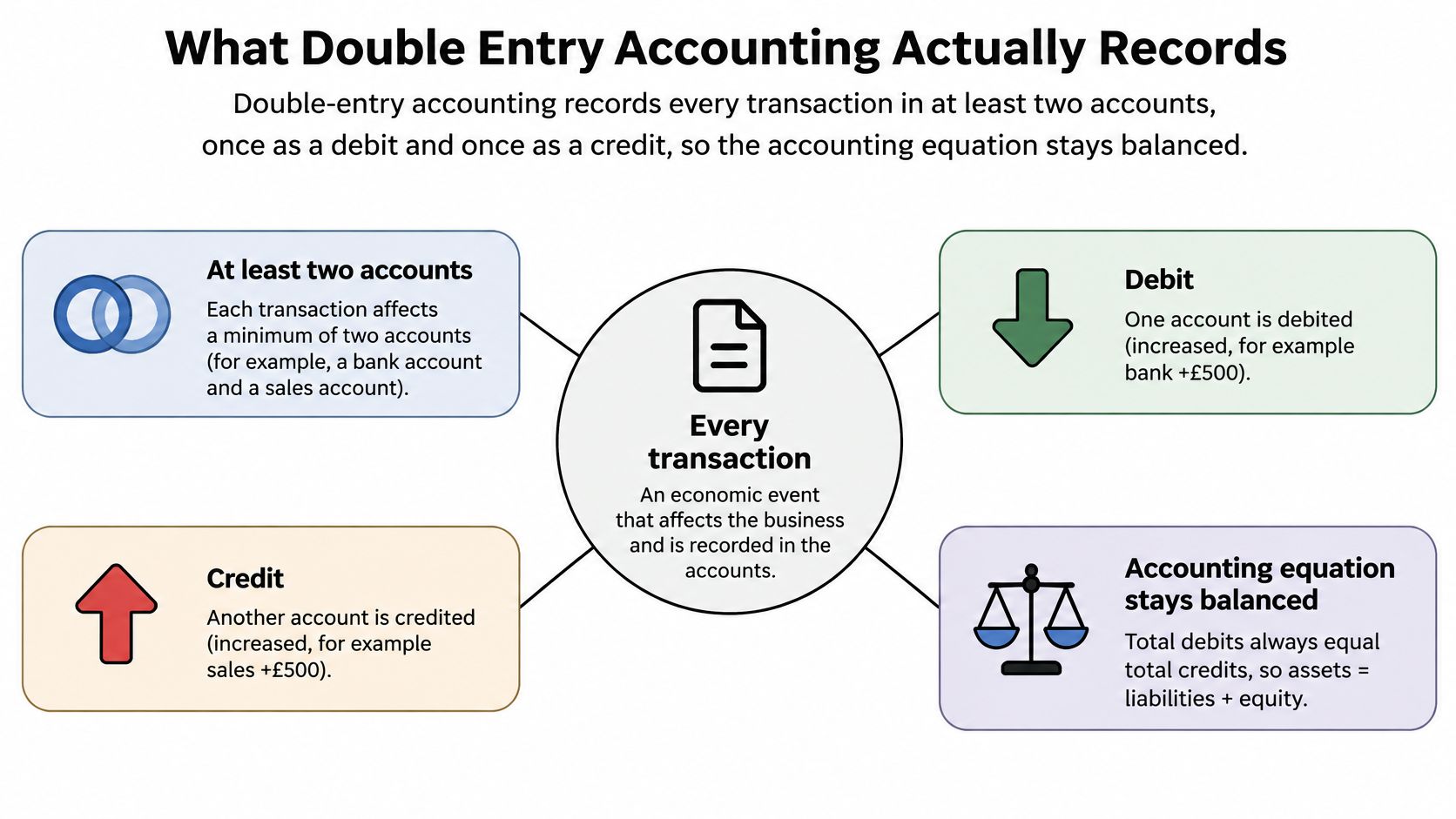
Double-entry accounting records every transaction in at least two accounts, as a debit and a credit, so assets stay equal to liabilities plus equity. You're probably looking at a bank feed, a shoebox of receipts, or a spreadsheet that adds up, and you're still not sure your accounts tell the truth. That's normal for UK sole traders. A list of money in and out can't show what you own, what you owe, or whether VAT is sitting in the right place.
What Double Entry Accounting Actually Records
Say a corner café pays £40 cash for milk. A note saying "£40 spent" tells you money left the till. It doesn't tell you why, which account changed, or how profit moved.
Double entry writes both changes. Cash, an asset, falls by £40. Purchases, an expense, rise by £40. The café gave up one thing and recorded the cost that explains the loss.
That pair keeps one sentence true after every posting.
Assets equal liabilities plus equity.
Equity is also called capital for a sole trader. It's the owner's claim: what you'd have left conceptually if the business sold what it owns and paid what it owes.
How It Differs From Single Entry
Single-entry bookkeeping lists money in and out like a cheque book register. It's easy to maintain, but it can't show stock, equipment, amounts customers owe you, or amounts you owe suppliers. You can't produce a proper balance sheet from one cash list.
What is double entry accounting, then, in one repeatable line? It's the habit of recording every transaction in at least two accounts, once as a debit and once as a credit, with equal amounts, so the equation stays true.
Don't overclaim for that check. The pair proves arithmetic symmetry. It doesn't prove the receipt was real, the VAT code was right, or the date was correct.
Many owners still meet this method in a spreadsheet before they meet it in software. In 2025, 58% of UK small and medium-sized businesses still relied heavily on manual financial processes, while only 4% were fully automated, according to Dext's survey of 500 UK SMB leaders. That's why learning the hand version matters.
Clean paired entries also make later reporting easier, whether you're preparing year-end accounts or learning to organize a buyer-ready financial data room for a future sale. From here, the sequence is practical: learn which side increases each account type, see how a T-account holds those sides, work six everyday postings in pounds, then check the errors balance won't catch and the same pairs inside Xero or QuickBooks.
Debit and Credit Rules by Account Type
Use this table before you try to memorise any slogan. Most confusion starts when beginners treat debit as "money out" and credit as "money in". That's personal banking language, not bookkeeping language.
In your business ledger, debit means the left side of an account. Credit means the right side. Neither word means good or bad. What a debit does depends on the type of account you're posting to.
| Account type | Normal balance | A debit | A credit | Everyday accounts |
|---|---|---|---|---|
| Asset | Debit | Increases the balance | Decreases the balance | Bank, stock, equipment, trade debtors |
| Liability | Credit | Decreases the balance | Increases the balance | Trade creditors, loans, VAT owed |
| Equity or capital | Credit | Decreases the balance | Increases the balance | Owner capital, retained profit |
| Income | Credit | Decreases the balance | Increases the balance | Sales, fees, interest received |
| Expense | Debit | Increases the balance | Decreases the balance | Rent, wages, purchases |
| Drawings | Debit | Increases the balance | Decreases the balance | Cash or goods taken by the owner |
Reading the Table Without Guessing
Assets are what the business owns or is owed. Bank, stock, equipment and trade debtors (customers who haven't paid yet) normally carry a debit balance. Debit the asset and it grows. Credit it and it shrinks.
Expenses behave the same way as assets for posting direction. Rent, wages and purchases increase with a debit. That surprises people until they remember expenses reduce profit, and profit feeds capital, which sits on the credit side.
Liabilities work in reverse. Trade creditors (suppliers you haven't paid yet), loans and VAT owed increase with a credit. Debit a liability when you reduce what you owe.
Equity or capital also increases with a credit. When you put your own money in, capital grows. Income follows the same pattern. Sales, fees and interest received increase with a credit, which is why understanding what a credit does in accounting helps you stop reading "credit" as merely "paid".
Drawings need a separate line in your mind. Drawings aren't wages and they aren't a business expense for a sole trader. They're cash or goods you take out for yourself, so they carry a debit balance because they reduce capital.
The Memory Aid, Used Properly
Once the table makes sense, DEAD CLIC helps you recall it under pressure.
- Debit: Expenses, Assets, Drawings
- Credit: Liabilities, Income, Capital
Don't start with the slogan and force transactions into it. Classify the account first, then check the slogan.
After any posting, run two quick checks. First, total debits equal total credits. Second, assets still equal liabilities plus equity. If either check fails, stop and find the missing or reversed side before you post the next item.
Two UK points catch beginners often. VAT charged on a sale isn't your income. It's a liability until it's paid to HMRC, so the VAT portion is credited to a VAT account, not to sales. A supplier bill also doesn't touch the bank when it arrives. It increases trade creditors. The bank falls later, when you pay.
Try four classifications now using the table. Decide the type and normal side for bank, rent, sales, and an owner loan you've put into the business. Bank is an asset, rent is an expense, sales is income, and money the business must repay you is a liability, separate from capital you've permanently introduced. If you can classify those four, the worked examples will feel mechanical in the best way.
How a T-Account Holds Both Sides
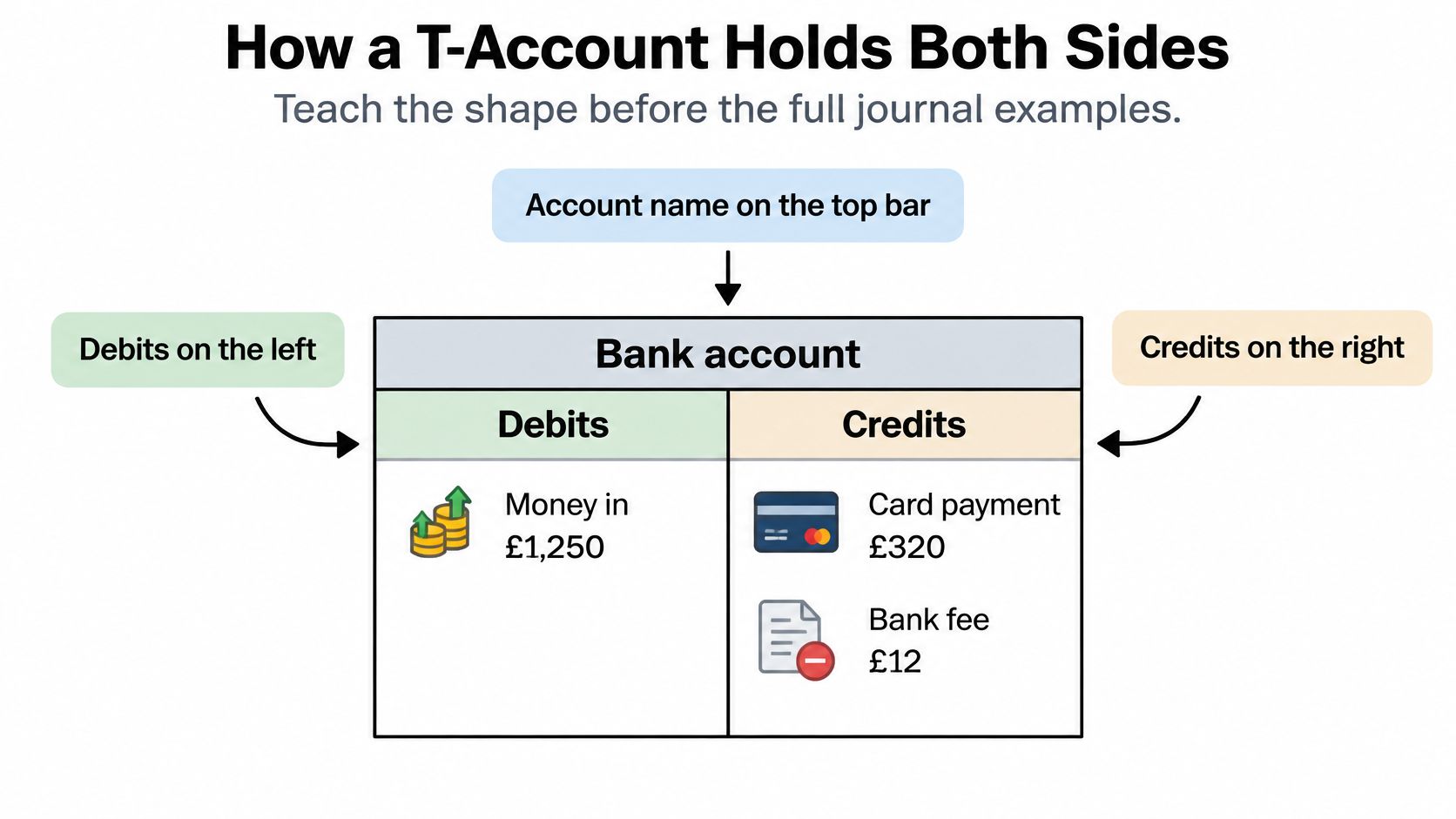
A T-account is a drawing of one ledger account. It looks like a capital T, which is the whole reason for the name. You don't need software to use one, and drawing one by hand stops the left-right rules from staying abstract.
The layout is fixed, so learn the shape once.
One Bank Account, Three Movements
Put Bank account on the top bar. Write debits on the left and credits on the right. Now post only the bank half of three transactions. The other half of each pair belongs in a different account, which we'll show fully in the next set of examples.
- Opening capital paid in: debit bank £5,000. The asset increases, so it goes on the left.
- Rent payment: credit bank £800. The asset decreases, so it goes on the right.
- Card receipt from a customer: debit bank £600. The asset increases again.
Add the left side: £5,000 plus £600 equals £5,600. The right side is £800. The difference is a £4,800 debit balance.
Don't net the sides away as you go. Keep each increase and decrease visible until you need the balance. That history is the point. When a figure looks wrong later, you can see which movement created it instead of staring at one final number.
A short visual walkthrough can help the left and right sides settle before you try full journals.
From T-Accounts to a Trial Balance
A trial balance lists every account in the ledger with its closing balance. Debit balances go in one column. Credit balances go in the other. You then add both columns and check that they match.
Use a tiny sketch with the bank figure you've just calculated. Say bank shows £4,800 debit and capital shows £5,000 credit. Those two alone leave a £200 difference. That gap is a clue, not a mystery to ignore. Some expense or income account is still missing from your little list, because the £800 rent and the £600 receipt also need their second homes.
Equal trial balance columns mean the arithmetic pairs agree. They don't mean every receipt was entered.
That's the limit to keep in one sentence for now. The six full postings next will show where each missing half lives, and a later section deals with wrong entries that still produce equal columns.
Six Everyday Transactions in Double Entry
Work through these six postings in order. Each one names the debit account, the credit account, the amounts in pounds, and what happens to the equation. Where a sale is taxable, VAT is shown at the UK standard rate of 20%. Zero-rated or exempt sales would credit no VAT.
Don't try to re-derive the rules each time. Classify the accounts, decide whether each rises or falls, then choose the side.
| Transaction | Debit | Credit | Equation effect |
|---|---|---|---|
| 1. Owner pays £5,000 into business bank | Bank £5,000 | Capital £5,000 | Assets and equity both rise |
| 2. Equipment bought for £1,200 on 30-day credit | Equipment £1,200 | Trade creditors £1,200 | An asset and a liability both rise |
| 3. Equipment bill paid | Trade creditors £1,200 | Bank £1,200 | A liability and an asset both fall |
| 4. Cash sale of £500 net plus £100 VAT | Bank £600 | Sales £500, VAT £100 | An asset rises, income rises, a liability rises |
| 5. Invoiced sale of £1,000 net plus £200 VAT, unpaid | Trade debtors £1,200 | Sales £1,000, VAT £200 | An asset rises, income rises, a liability rises |
| 6. Rent of £800 paid | Rent £800 | Bank £800 | An expense rises and an asset falls |
Transactions One to Three
1. You pay £5,000 into the business bank. Debit bank £5,000 because an asset increases. Credit capital £5,000 because equity increases. Assets and equity both rise by the same amount.
2. You buy equipment for £1,200 on 30-day credit. Debit equipment £1,200 because you've gained an asset. Credit trade creditors £1,200 because you now owe the supplier. Assets and liabilities both rise, and cash is untouched. That's the part beginners miss when they only track the bank.
3. You pay that equipment bill. Debit trade creditors £1,200 to reduce the liability. Credit bank £1,200 to reduce the asset. A liability and an asset both fall. Notice you don't debit equipment again. You already recorded owning it in step two. Payment settles the debt, it doesn't buy the equipment twice.
Transactions Four to Six
4. You make a cash sale of £500 net plus £100 VAT. The customer hands over £600 in total. Debit bank £600. Credit sales £500. Credit VAT £100.
This is a compound entry, meaning one debit and two credits. Don't panic about that. Transactions don't always have exactly two lines. They need equal totals: £600 of debits against £500 plus £100 of credits. Only £500 is income. The £100 VAT belongs in the liability account because you're collecting it for HMRC.
5. You invoice the same kind of sale and the customer hasn't paid. Say the net sale is £1,000 plus £200 VAT. Debit trade debtors £1,200. Credit sales £1,000. Credit VAT £200.
Cash doesn't move yet. Trade debtors is an asset that says, in plain English, "a customer owes us £1,200". When the customer pays, you'll make a separate entry: debit bank £1,200 and credit trade debtors £1,200. That later entry swaps one asset for another. It isn't a second sale.
6. Rent of £800 leaves the bank. Debit rent £800 because an expense increases. Credit bank £800 because an asset decreases. The expense will reduce profit, and lower profit reduces capital when the period is closed.
One Equation Check Across the Set
Take the opening capital, the equipment bought and then paid for, the unpaid invoiced sale, and the rent. Bank, equipment and trade debtors sit on the asset side. Trade creditors and VAT sit with liabilities, and capital adjusted for sales less rent gives the equity side. Add them carefully and assets still equal liabilities plus equity.
That agreement proves the arithmetic of the pairs, nothing more. Whether each pair used the right accounts, the right amount and the right VAT treatment is a separate question, and it's why HMRC expects the invoice, the receipt and the bank statement behind every posting, not just a tidy ledger.
If a side looks surprising, don't reverse it by instinct. Go back to classification: what type of account is it, and did it increase or decrease? That question resolves nearly every debit-credit mix-up before it reaches your books.
Why a Balanced Ledger Can Still Be Wrong
Your trial balance agrees. Every debit has a matching credit, the columns total, and the software shows no error. Does that mean the books are right? Not from balance alone. Balance proves only that debits equal credits.
A transaction can be posted twice, sent to the wrong accounts, entered for the wrong amount, given the wrong VAT treatment, or dated in the wrong period. The columns still match perfectly.
Three Slips That Still Balance
- Rent coded to equipment: An £800 rent payment debited to equipment instead of rent still balances against the £800 credit to bank. Assets and profit are both overstated, because a running cost now looks like something the business owns.
- A sale entered twice: A £600 sale recorded two times still balances on each entry. Income doubles, and bank or trade debtors doubles with it.
- The wrong VAT treatment: A standard-rated purchase coded as zero-rated still balances in total. The VAT account is wrong, so the return built from it is wrong too.
None of those errors breaks the pair. Each one tells a false story in balanced numbers.
What HMRC Looks For Beyond the Pair
Double entry checks symmetry. It cannot check that the right account was chosen, the right VAT code applied, or the right period used. When your records are examined, the questions go beyond the ledger to the evidence behind it: delivery notes, stock records, invoices, and bank statements that show what happened.
For a VAT-registered sole trader, records of purchases and sales, invoice details, VAT values, and adjustments matter in their own right, and they need to be retained so every entry can be traced back to a document. A tidy ledger with no evidence behind it is not a reliable audit trail.
So use controls that sit alongside double entry, not instead of it. Keep a receipt or invoice for every posting, choose a sensible category, apply the right VAT code, and complete financial reconciliation that explains every uncleared bank item rather than forcing a match. Review unusual balances too. A trade creditor showing a debit balance, for example, often signals a duplicate payment or a misposted bill.
These checks matter outside tax as well. Anyone reviewing your profit quality will test whether categories are honest, which is why it helps to understand how earnings adjustments affect valuation before a lender or buyer asks hard questions.
Separate the jobs cleanly. Double entry checks symmetry. Reconciliation and source documents check economic reality and tax compliance.
Where Xero and QuickBooks Post the Same Pairs
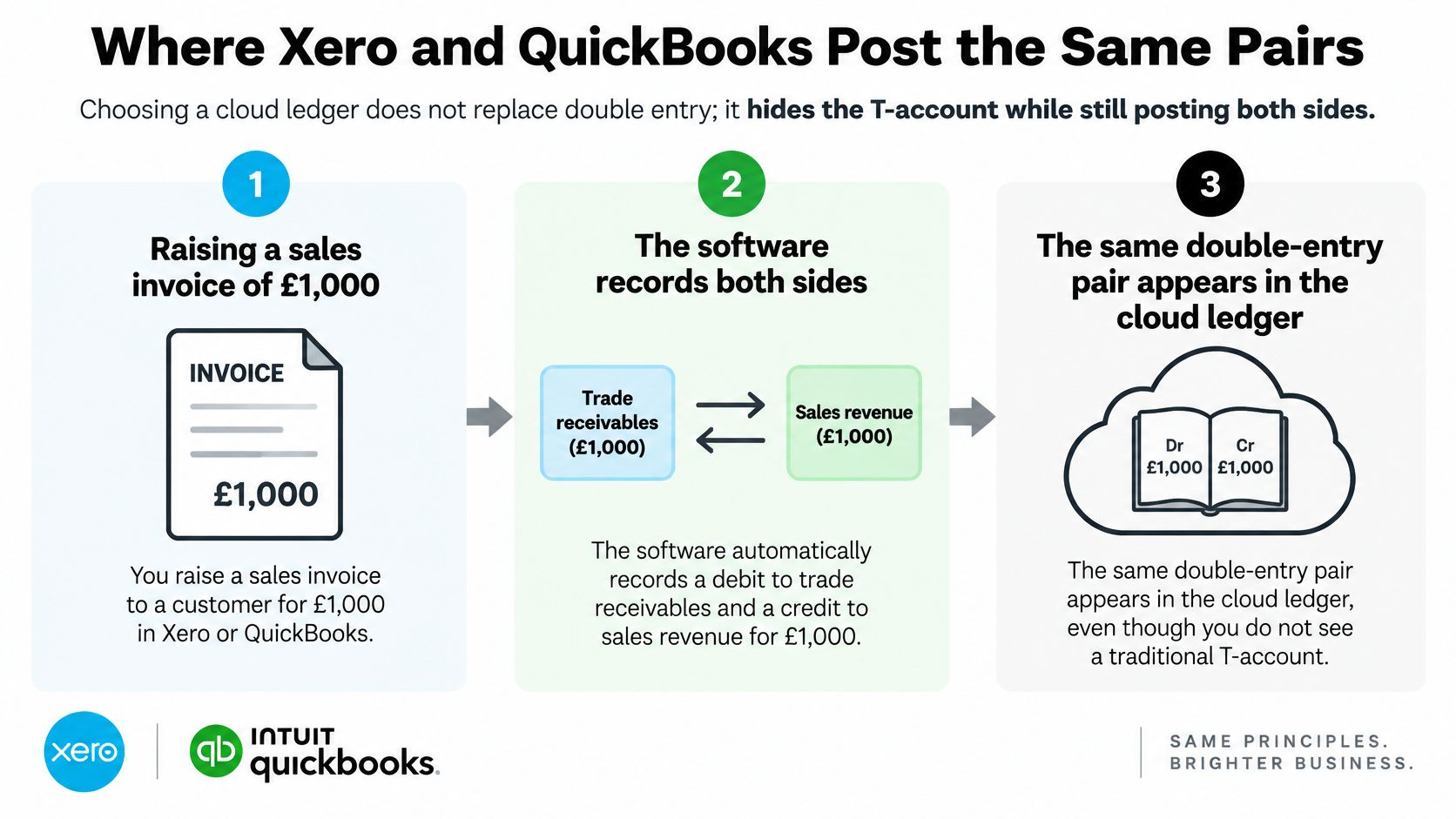
Choosing Xero or QuickBooks doesn't replace double entry. The software hides the T-account while still posting both sides. You click "save invoice" or "pay bill", and the product writes the journal you learned to draw by hand.
That hidden movement is easier to trust once you can predict it.
Three Journals the Software Writes for You
1. Raising a sales invoice. Invoice a customer £1,000 plus £200 VAT and the software debits trade debtors £1,200, credits sales £1,000, and credits VAT £200. You see an invoice screen. The ledger receives the same compound entry you'd write on paper.
2. Entering a supplier bill. Enter a bill for £1,200 and the software debits the relevant expense or asset account and credits trade creditors £1,200. The bank doesn't move, because you haven't paid yet.
3. Paying that bill. Mark it paid and the software debits trade creditors £1,200 and credits bank £1,200. Reconciliation then matches the bank statement line to that posting, so the bank account in the ledger agrees with the feed from your bank.
Most owners now meet these pairs inside a product rather than a paper daybook. In 2025, 86% of UK accounting and bookkeeping practices used cloud technology with at least one client, while 59% of their total bookkeeping work was completed in the cloud, according to the Accounting and Bookkeeping Industry Report 2025.
The Gap the Ledger Cannot Fill by Itself
Software can't post evidence it never received. A missing receipt never becomes a journal. A wrong category still balances. The screen can look finished while the underlying document is absent.
That's the capture gap Snyp, from £19 a month, is built to fill before approval. You send a photo, a WhatsApp image, a forwarded email, or a JPEG, PNG or PDF upload. It reads merchant, amount, date, tax, currency and category, then syncs a reviewable record to Xero or QuickBooks. You or your bookkeeper still approve the account and VAT code, because software can't know a personal item was mixed into a shop receipt.
What you should see at the end is simple: a bank transaction, a matched document, and a journal whose debits and credits the trial balance still adds up.
Start From the Next Receipt Not the Journal
Don't rebuild a year of bookkeeping this week. Take one live transaction instead, ideally the next supplier receipt or sales invoice that lands in your business. Write both sides on paper before you open Xero or QuickBooks.
Check only three things. First, name the account types. Second, confirm debits equal credits. Third, make sure a source document supports the date, amount and VAT, and keep that source document in your accounting records attached to the entry rather than loose in your inbox.
Then enter or approve that same pair in your ledger. When the money moves, reconcile it to the bank line. If it doesn't match, don't adjust the journal to force agreement. Find out whether the document, the amount, or the timing is wrong.
If your receipts currently live in email, WhatsApp, your phone gallery and a glovebox, choose one capture path and use it every time. Forward or snap each document on the day it arrives, review the extracted fields, and approve the category before the journal is posted. The document needs to exist before the numbers claim to describe it.
The next receipt is your unit of work: two accounts, equal amounts, and evidence that the entry describes what really happened.
Finish with the wider checks, not with relief that the trial balance difference is zero. A zero difference is a starting point. Correct categories, correct VAT, matched bank lines and retained documents are what make the balanced books believable.
Snap, forward or upload your next receipt and let Snyp extract the merchant, amount, date, tax and category, then sync a reviewable record to Xero or QuickBooks so the document is ready before you approve the debit and credit. You'll keep the evidence attached to the entry, reconcile faster, and spot wrong VAT or categories while the transaction is still fresh.