




Small Business Accounting Cost: UK Prices and Budgets
Small businesses collectively spend approximately 242 million hours and nearly £25 billion a year on tax compliance, according to the Federation of Small Businesses estimate recorded by the House of Commons Business, Energy and Industrial Strategy Committee. That figure is not just money paid to accountants. It also includes the work owners and employees must do before an accountant can prepare a usable return.
Your small business accounting cost is therefore more than a monthly fee. A useful budget includes professional charges, software, your own administrative time, correction work and the financing costs that can follow poor cash collection. The cheapest invoice doesn't necessarily produce the cheapest accounting process.
What Each UK Accounting Service Costs
| Service | How it is charged | What it includes |
|---|---|---|
| Bookkeeping, monthly package | Fixed monthly fee based on agreed workload | Transaction coding, bank reconciliation and agreed monthly reports |
| Bookkeeping, hourly rate | Per hour, with a written estimate or cap | Coding and reconciliation |
| Year-end accounts, sole trader | Fixed fee based on records and complexity | Self-employed accounts prepared from annual records |
| Year-end accounts, limited company | Fixed fee with filing responsibilities specified | Statutory accounts and agreed Companies House filing |
| Self Assessment tax return | Fixed fee based on income sources and schedules | Income tax return for a sole trader or partner |
| VAT return | Per return or included in a package | VAT calculation, submission and agreed records checks |
The Accountex Pricing Survey, based on responses from more than 197 accounting and bookkeeping professionals, found that the average UK bookkeeping rate increased from £25 per hour in 2023 to £32 per hour in 2024, according to Accountex. That's a historical pricing reference, not a current quote or a tariff for every service.
There isn't a defensible national price for each remaining row without knowing the scope. A sole trader's accounts prepared from reconciled records are a different assignment from accounts assembled from incomplete bank statements. Ask for an actual quote rather than treating an unsupported online range as your budget.
Understand the charging basis
Fixed monthly packages work well when the workload is predictable. Check whether the accountant limits transaction volumes, bank accounts, meetings or support. Also ask whether the monthly payment covers year-end work or spreads bookkeeping charges across the year.
Fixed filing fees make individual obligations easier to budget, but the fee may assume you supply a clean trial balance or completed bookkeeping. Hourly charging can suit irregular assignments, provided you agree an estimate and an approval point before extra work starts.
Practical rule: Compare the same completed job, not the headline monthly payment.
What moves a quote
- Transaction volume and quality: Missing receipts, unidentified transfers and duplicate entries create work beyond straightforward coding.
- Business complexity: Turnover, multiple accounts, foreign currency and stock can change the review required.
- Additional obligations: Payroll, VAT and tax advice shouldn't be assumed to sit inside an accounts fee.
- Experience and location: Ask who will do the work, who reviews it and whether specialist knowledge is necessary.
Before accepting, ask what's included, what happens after year-end, and whether queries cost extra. Get those answers in the engagement letter, including how the firm authorises out-of-scope work. A clear exclusion is easier to manage than an unexpected invoice.
Sample Annual Budgets by Business Type
The average small firm spends approximately £4,500 annually and 44 hours a year on tax compliance, according to Federation of Small Businesses findings reported by Credit Connect. That figure bundles staff time, HMRC contact, software and accountant payments, so use it as a whole-compliance benchmark rather than a fee target.
A useful annual budget separates those components. Business structure alone does not set the price, but it changes where the cost lands. The four worked scenarios below are illustrative: owner time is valued at £30 an hour, employed admin time at £25 an hour, and every external line should be swapped for a written quote before you rely on the total.
| Business type | Software | Accounts and tax | Illustrative annual total |
|---|---|---|---|
| Freelancer, self-filing | £120 assumed for software or receipt capture | £0 external filing fee where genuinely self-filing | £420: £120 software plus 10 owner hours at £30 |
| Sole trader with accountant | £240 assumed subscription | £600 accounts and Self Assessment, plus £300 bookkeeping checks | £1,590: software, £900 external work and 15 owner hours |
| Limited company, monthly bookkeeping | £600 assumed platform and document tools | £1,200 statutory accounts and Corporation Tax, plus £1,800 bookkeeping | £4,350: software, £3,000 external work and 25 owner hours |
| Growing firm, five staff | £900 assumed across accounting, document and payroll tools not already bundled | £1,800 company accounts and tax, £3,600 bookkeeping, £1,200 payroll, £900 VAT work | £9,400: software, £7,500 external work and 40 staff hours |
Match the budget to the handover
A self-filing freelancer keeps the checking work: expense review, bank reconciliation and the return itself. A receipt tool can reduce document handling, but the owner still has to know what belongs in the accounts.
For a sole trader using an accountant, agree whether the handover is completed bookkeeping or raw documents. A periodic bookkeeping check can surface problems before year-end, while accounts preparation and Self Assessment remain separate deliverables unless explicitly bundled.
A limited company with monthly bookkeeping needs a clean boundary between routine processing and year-end adjustments. Ask whether the package includes director's loan account review, tax computations and routine questions, because “company accounts” can mean a narrow filing job or a broader service.
A growing employer should price payroll and VAT separately even when one accountant supplies both. Employee changes, corrections and extra payroll runs need an agreed charging basis before they arrive as surprises.
Turn the model into your own budget
- Replace each component with a quote: Use the annual contractual cost, including setup.
- Remove duplicate charges: Do not count payroll software again if the payroll service already includes it.
- Keep internal work visible: Doing a task yourself removes the external fee, not the time cost.
- Separate routine and exceptional work: Historic clean-up and tax investigations sit outside an ordinary operating budget.
A total above the broad small-firm benchmark does not automatically mean you are overpaying. More transactions, employees or reporting duties push cost up. Treat unexplained clean-up charges and repeated document requests as the signal to review scope.
Hidden Costs Beyond the Invoice
HMRC estimated that tax administration cost businesses at least £15.4 billion in 2023–24, while its VAT research found that small businesses handling VAT entirely in-house spent an average of 5 hours and 18 minutes maintaining a VAT account and submitting a VAT return, as recorded in the Public Accounts Committee report on tax administration.
The practical burden often looks like an owner trying to reconstruct spending after the event.

The work behind the fee
Owner and staff time is the first hidden cost. Finding an emailed invoice, checking a card payment and asking an employee what they bought all take attention away from other work. The interruption matters even when the individual expense is small.
Correction work comes next. An accountant can't confidently classify a payment because it appears on a bank statement. Someone must establish the supplier, business purpose and relevant tax treatment, then resolve duplicates or missing evidence.
Cash-flow costs require a separate view. When staff can't distinguish unpaid invoices from unallocated receipts, they may chase customers who have paid or overlook customers who haven't. Borrowing costs and collection time belong in the wider accounting budget, even though they won't appear on the accountant's invoice.
The desk-level workload also deserves attention alongside the financial statements.
A lower subscription price won't compensate for a process that repeatedly makes someone rebuild the records.
Measure the cost without exaggerating it
Use a simple calculation: documents processed × handling time saved × the value of that time. Measure a representative batch rather than assuming every receipt takes the same effort.
Keep recovered capacity separate from cash savings. If the owner spends less time on receipts, that's useful capacity, but it only reduces cash expenditure when paid work is removed or avoided. Likewise, a bookkeeper's hourly charge isn't automatically the correct value for the owner's time.
For businesses buying many small items, document handling can deserve more attention than a modest difference between software subscriptions. The useful question is where someone repeatedly touches the same transaction without improving the record.
How Making Tax Digital Changes the Bill
Making Tax Digital should be budgeted as a workflow change, not just a software purchase. Confirm your applicable start date, qualifying-income rules and obligations with HMRC before committing to a package, particularly if you have both trading and property income.
HMRC estimates average one-off transitional costs of £320 and additional continuing costs of £110 a year per affected business in its Making Tax Digital for Income Tax impact assessment. Those are policy estimates, not a software quote or a guarantee of your individual cost.
Build separate transition and running budgets
Your transition budget should include:
- Software setup: Connecting accounts, establishing access and configuring categories.
- Data migration: Moving usable records and checking opening information without importing duplicates.
- Training: Learning the submission process and deciding who checks the underlying entries.
- Agent coordination: Agreeing what you prepare, what the accountant reviews and who submits.
The continuing budget should distinguish the subscription from update preparation, review and professional support. Ask whether your existing annual accountant fee changes and what additional work that change buys.
Compare the starting positions
Say a sole trader keeps sales in a spreadsheet and expenses across email, paper and a phone. Their first task isn't pressing a submission button. They need to consolidate documents, check the records and establish a reliable handover to the accountant.
A trader already using reconciled cloud bookkeeping has a different job. They may need to adjust permissions, review arrangements and submission procedures rather than replace their entire system. Paying for a migration they don't need would add cost without improving compliance.
Use the guide to choosing cheaper MTD software to assess the subscription alongside the work required to make it usable.
The cheapest advertised plan can become expensive if someone still rebuilds the records before every review. Even a low-volume business should assess automation against recurring preparation and correction work, rather than assuming that fewer transactions always make manual administration economical.
Accounting Software Versus Specialist Receipt Tools
Microbusinesses estimated digital invoicing and digital tax software at roughly £748 and £719 per month respectively, compared with a comparable market price of about £18 per month, according to Starling Bank's report on digital financial tools and SME growth. These are perceptions and a market comparison from that report, not current quotes for specific products.
The buying decision becomes clearer when you separate the jobs each option performs.
| Option | What it covers | Best for |
|---|---|---|
| Spreadsheet and bank export | Manual entry and reconciliation by hand; check any existing licence cost | Very low transaction volume and owners comfortable with administration |
| Cloud accounting software such as Xero or QuickBooks | Bank feeds, invoicing, reconciliation and VAT reporting; select a plan against required functions | Businesses needing full bookkeeping in a shared system |
| Receipt capture tool | Captures, categorises and transfers expense documents; check document allowances and integration terms | Businesses whose main problem is collecting usable receipt records |
| Accountant-led bookkeeping | Agreed processing and review under a service quote | Owners who want routine bookkeeping outsourced |
Choose the missing function
An accounting platform holds the books. It connects bank transactions with invoices, expenses and balances so someone can reconcile the records and produce reports.
A receipt tool addresses the evidence entering those books. Snyp is one example: it accepts documents through WhatsApp, email forwarding or direct upload, extracts expense details and syncs structured information to Xero and QuickBooks. That makes it complementary to accounting software, rather than a replacement for a ledger or professional judgement.
Before adding another subscription, test the document capture already included in your existing platform. A separate tool needs to remove a genuine bottleneck, such as receipts remaining on employees' phones or supplier invoices being scattered across inboxes.
For a wider requirements comparison, AccountShare can help you find the right small business accounting tool. Compare the required workflow first, then the subscription, rather than choosing by the longest feature list.
Check the handover before buying
- For receipt problems: Test extraction, duplicate handling, original-document access and transfer into the correct ledger.
- For reconciliation problems: Check bank feeds, matching rules and how unresolved items are reviewed.
- For invoicing problems: Examine invoice creation, payment allocation and debtor reporting.
- For outsourced bookkeeping: Confirm who handles exceptions and how quickly questions must be answered.
The UK Xero pricing guide can help you assess platform scope before paying for overlapping functions.
Choose the smallest combination of tools and professional support that completes the job reliably.
Export access also matters. Before committing, establish how you'll retrieve documents and accounting records if you change software or accountant.
How to Cut Accounting Costs Without Cutting Corners
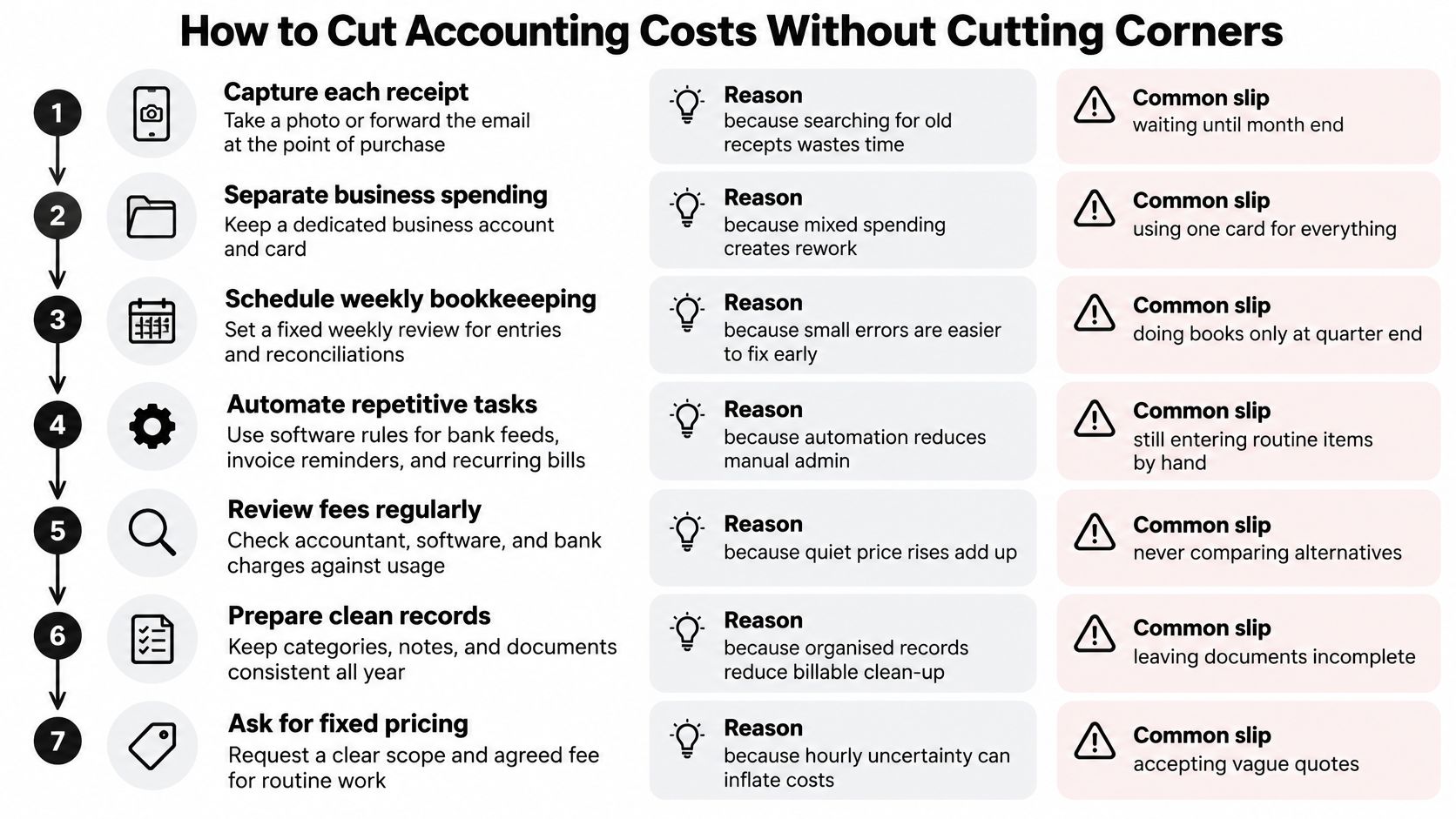
Capture each receipt at purchase. Photograph paper receipts or forward supplier emails into the agreed collection point. The reason is practical: the buyer still knows what the expense was for. The common slip is leaving a blurred photograph on a phone without uploading it.
Keep the original evidence. Retain the document alongside the extracted entry so a reviewer can check the supplier, date and tax details. A bank description isn't a substitute for the supporting invoice. Avoid saving only the captured amount while discarding the document.
Set categories and reuse them carefully. Agree recurring treatment with the accountant, then apply consistent rules. Don't let a supplier name determine tax treatment automatically when that supplier sells different kinds of goods or services.
Reconcile monthly. Match transactions, investigate unexplained balances and resolve duplicates while the detail is still accessible. A common mistake is treating an imported bank feed as completed bookkeeping.
Chase overdue invoices weekly. Review the debtor list, confirm disputed amounts and send reminders through a consistent process. Check incoming payments before contacting customers, and record who owns each unresolved query.
Request fixed-fee quotes with a clear scope. Compare the proposed package with the expected workload and hourly alternative. Ask for approval before additional work begins, rather than discovering the boundary when the invoice arrives.
Review the accountant's scope annually. Remove duplicated work, but retain reviews you still need. Taking data entry in-house doesn't necessarily mean you're ready to take responsibility for technical accounting adjustments.
Keep the routine visible to everyone who submits or checks expenses.
Protect cash as well as administrative time
Government late-payment research records that 35% of affected small businesses spent an average of 1.2 whole days per month chasing overdue invoices, while at least 30% used an overdraft to address the problem. Those findings explain why collection work deserves attention alongside bookkeeping charges.
Good records help staff identify what's unpaid, but they don't settle disputes or enforce payment terms. Assign collection responsibility and an escalation route so reminders don't become an unattended automated sequence.
When evaluating accounting automation software, test exceptions as carefully as successful entries. Check what happens to a duplicate invoice, an unreadable receipt or an expense requiring approval.
Automation doesn't replace approval controls, payment terms or credit management. Keep a named person responsible for reviewing uncertain classifications and authorising payments, especially after changing software or staff responsibilities.
Set Your Accounting Budget for the Year Ahead
Build your budget from the work your business requires, not a headline price for another firm. Use recent invoices, subscription statements and your accountant's engagement letter to identify what you're already buying.
Separate cash expenditure, internal time and exceptional work. This prevents an apparently cheap self-managed arrangement from concealing a large administrative commitment, while keeping a temporary clean-up project out of the recurring budget.
Create a usable budget sheet
| Budget line | What to record |
|---|---|
| Software and document tools | Renewal price, billing basis, included functions and cancellation terms |
| Bookkeeping | Routine fee, volume assumptions and responsibility for unresolved entries |
| Accounts and tax | Deliverables, filing responsibilities and excluded advice |
| Payroll and VAT | Service scope, correction charges and software already included |
| Internal administration | Time spent by task and the value assigned to that time |
| Transition and exceptional work | Migration, training, historic corrections and other separately approved projects |
| Collection and financing | Invoice-chasing effort and identifiable borrowing charges |
Estimate internal time by task, rather than entering a single administrative allowance. Receipt handling, reconciliation and chasing invoices call for different fixes. Use your own realistic time value, not an accountant's charge-out rate by default.
Then obtain comparable written quotes. Give each firm the same description of your transaction volumes, records, employees, accounts and required support so differences in price are meaningful.
Make a decision you can test
Choose the least disruptive change that addresses the measured problem. Keep a spreadsheet if it remains suitable and compliant, add document capture if evidence collection is the obstacle, or assess a full platform if reconciliation and invoicing need improvement.
For a receipt-tool trial, use a representative period containing ordinary purchases, refunds and awkward documents. Judge the result by what reaches the accounting system correctly, what needs intervention and whether your accountant can review it efficiently.
Budget discipline: Keep a saving only when the work has genuinely disappeared, not when it has moved unnoticed to the owner.
Record any applicable MTD requirements and agree the preparation timetable with your accountant. Keep setup work separate from the ongoing fee so you can see the expected steady-state cost.
Finish by setting a review date and a monthly accounting budget line. Assign someone to compare actual charges, unresolved records and administrative time against that budget, then authorise changes deliberately rather than allowing overlapping subscriptions and unclear responsibilities to accumulate.
Snyp captures receipts from WhatsApp, forwarded emails and uploads, then sends structured expense details to Xero and QuickBooks. Visit Snyp to try it with a representative batch of receipts and assess whether it reduces document handling before adding it to your accounting budget.