




Help Starting Small Business: A UK Launch Checklist
Only 38.4% of UK enterprises born in 2019 survived to 2024, according to the Office for National Statistics business demography bulletin. If you're looking for help starting a small business, that changes the priority: don't build your launch around getting registered. Build it around winning paying customers and keeping enough cash to deliver the work.
Your first administrative setup should be a cash-control system. The bank account, receipts, payment terms and forecast need to work together, so you can see what you've earned, what you've spent and what you can safely commit.
Your Launch Checklist at a Glance
| Task | Where to do it | Typical cost | When |
|---|---|---|---|
| ☐ Test demand for the offer | Your prospective customers | Your time and any pilot delivery costs | Before committing to substantial overheads |
| ☐ Register as a sole trader, if appropriate | HMRC online | Free to register; budget for an accountant or bookkeeper if you use one | Establish the registration requirement when you begin trading |
| ☐ Incorporate a limited company, if appropriate | Companies House | Government incorporation fee, plus any adviser charges | Before entering contracts in the company's name |
| ☐ Open a business bank account | Your bank or a business banking provider | Account tariff, transaction and payment charges | Before receiving business payments |
| ☐ Set up accounting and expense capture | Xero, QuickBooks or a suitable alternative | Subscription and any setup support | Before transactions become scattered |
| ☐ Register for Self Assessment, where required | HMRC | Free to register; budget for bookkeeping or tax-return support if needed | Confirm your applicable registration deadline |
| ☐ Register as an employer, where required | HMRC PAYE | Payroll software or payroll service costs | Establish your obligations before running payroll |
| ☐ Register for VAT, where required | HMRC | Free to register; budget for VAT software, bookkeeping or filing support if needed | Monitor taxable turnover and check the current registration rules |
Choose the rows that apply
Sole trader registration and company incorporation are alternative starting routes, not consecutive tasks everyone must complete. Choose your legal form first. Self Assessment can form part of the sole trader registration process, so check what you have already completed before treating these as separate applications.
Many founders will not need payroll or VAT registration immediately. Others need extra permissions before delivering anything, particularly if their work involves regulated activities, premises or specialist trades.
Small businesses employed 47% of total UK private-sector employment at the start of 2024, according to the Department for Business and Trade's business population estimates. These basics apply to freelancers, contractors and businesses run entirely by their owners.
Budget for operation, not just registration
A filing fee is only one part of the launch budget. Include insurance, accounting support, software, equipment and deposits. Then forecast the gap between paying suppliers and collecting from customers: receipt capture records what has left the account, while payment terms and a rolling cash forecast help show what you can safely commit to.
The timing traps are signing commitments before testing demand and assuming that registration completes your compliance work. An accepted application does not organise your records, establish suitable insurance or put future returns in your calendar.
If your launch includes an online presence, use Operosus's checklist to prepare your website to go live. Test the enquiry form and payment journey before spending money attracting visitors.
Mark each applicable row, set a completion date and save evidence that the task is done. Keep confirmations somewhere easy to find, so you can check what has been registered without searching your inbox.
Test the Idea Before You Register
Registering a business proves nothing about demand. A prospective customer who likes your idea hasn't necessarily agreed to buy it at a price that covers your costs.
The government's Backing Your Business evidence annex reports that only 47% of UK start-ups registered in 2020 survived to 2023. Treat your first offer as a commercial experiment rather than a commitment to a fully equipped business.
Ask for evidence, not encouragement
Start with a narrow customer and a recurring problem. A freelance copywriter could offer product-page updates to independent retailers rather than general writing services to anyone.
Use a staged test:
- Define the deliverable. State what the customer receives, what you need from them and when the work finishes.
- Ask for commitment. Offer a paid pilot, a properly documented deposit or a signed purchase commitment. Interest alone doesn't demonstrate willingness to pay.
- Check the contribution. Subtract direct materials, subcontractors, travel and payment charges from the selling price.
- Set a stopping condition. Decide what would make you change the offer or abandon it before you spend heavily.
Your break-even calculation is straightforward: fixed operating costs divided by contribution per sale. Then test whether you can realistically sell and deliver that volume without overlooking unpaid sales work and administration.
Find Startup Idea's guide can help you test your startup idea with experiments. Choose an experiment that exposes a buying decision, not merely a preference.
Test without creating unnecessary overheads
Say an electrician wants to buy a van before launching. Testing demand through appropriately insured work using suitable existing or hired transport could establish whether customers will book. A copywriter might offer paid retainers to existing contacts before creating a company.
Sole trader testing can be proportionate because it avoids company-specific administration while you learn. The trade-off is personal liability, and testing isn't an exemption from tax, licensing, insurance or consumer obligations.
Decision rule: Don't borrow to fund a version of the business that customers haven't yet agreed to buy.
Write down what would prove the offer works and what would tell you to stop. Include repeat purchases, delivery effort and contribution, not just initial sales.
Choose a Structure and Register It
| Structure | Set-up cost | Personal liability | Filing duties | Best when |
|---|---|---|---|---|
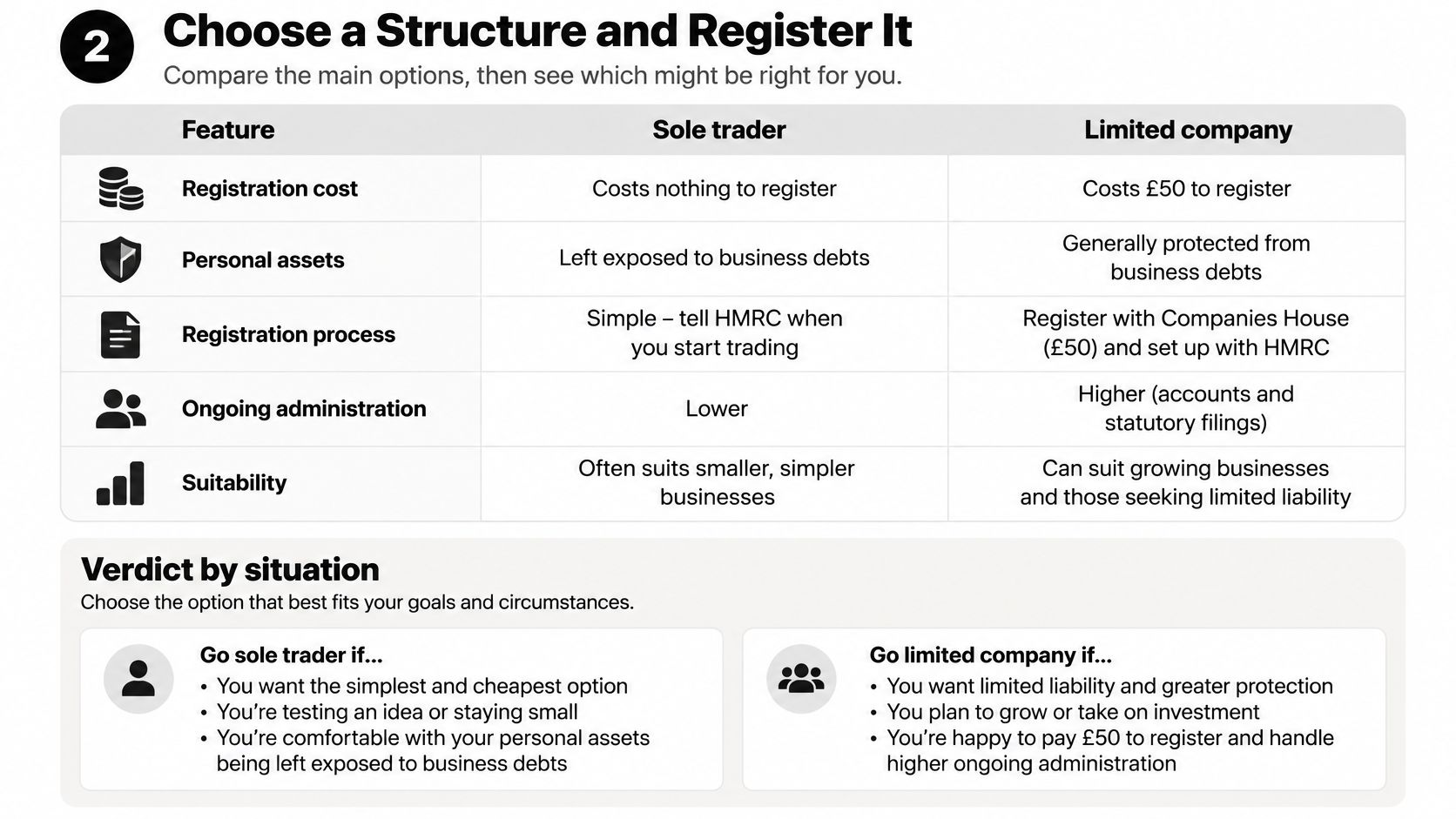
| Sole trader | No fee to register as self-employed with HMRC; budget separately for accountant advice | You remain personally responsible for business debts | Self Assessment and appropriate business records | You're testing straightforward freelance or low-risk work |
| Limited company | Companies House incorporation fee, plus any professional setup charges | Company debts are generally separate, subject to guarantees and other exceptions | Company accounts, Corporation Tax obligations and confirmation statements | Contracts, ownership arrangements or commercial risk justify the additional administration |
| Partnership | Allow for advice and a written partnership agreement | Partners in an ordinary partnership can face personal exposure to business debts | Partnership reporting and individual partners' tax obligations | Owners want to operate together and understand their shared exposure |
The comparison below shows the main structural differences. Companies House charges a fee to incorporate, so check the current amount before you apply.
Choose for the work you're actually doing
Sole trader status can suit an owner selling their own services with limited overheads. The administration is less involved than running a company, but you and the business are not separate legal entities. You remain personally responsible for business debts, so keep that exposure in view when setting payment terms and deciding which work to accept.
A limited company can suit work where clients require a company contract, ownership needs formal shares or operating risks justify separation. It brings director responsibilities and recurring filings. Don't choose it solely because the business name looks more established.
Consider a web developer taking small, ad hoc assignments. Starting as a sole trader may be proportionate. A later contract requiring a company, specialist insurance and subcontractor commitments could justify reviewing that choice.
A partnership needs more than agreement about the work. Put contributions, drawings, decision-making, ownership of customer relationships and exit arrangements into a written agreement.
Check what protection you're really getting
Limited liability isn't a substitute for reading contracts. A personal guarantee can make you personally responsible for a company obligation, and incorporation doesn't protect a director from every kind of liability.
Check insurance against the actual activity. Site work may call for public liability cover; advice or design work may call for professional indemnity cover. Check exclusions, subcontractor cover and contractual requirements, not just the premium.
A company structure and an insurance policy solve different problems. Neither replaces a clear contract.
For an additional introduction to business setup, use this video alongside advice specific to your circumstances.
Before registering a name, check Companies House restrictions, existing trading names and potential trade mark conflicts. A name being available on a register doesn't settle every branding issue.
Switching structure later is possible, but contracts, assets, banking and tax treatment need attention. Ask an accountant to assess the change using your expected profit, drawings and payment arrangements, rather than assuming incorporation will save tax.
Set Up Banking and Expense Capture
Use a separate account for business activity and make business spending through it your default. That's a practical control, not a claim that every sole trader must buy a particular banking product.
Choose an account whose terms permit your activity. Compare transaction charges, cash deposits, overseas payments, bank-feed reliability and access for your bookkeeper. A low headline fee isn't helpful if routine payments create extra charges or manual work.
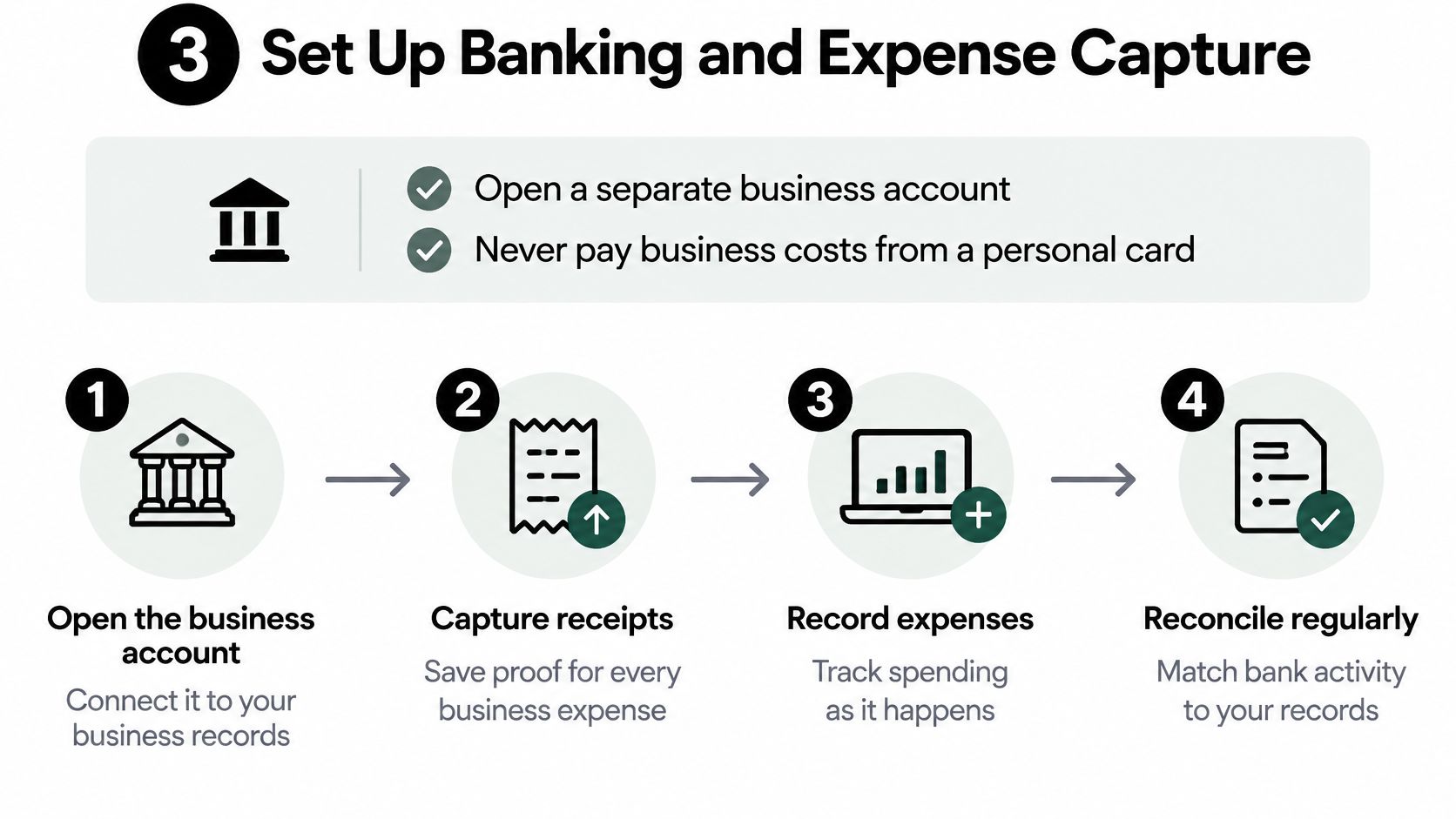
The workflow below shows how banking and supporting documents fit together.
Give every transaction a route into the books
- Connect the account to your accounting records. Xero or QuickBooks can provide the central ledger. Check imported transactions against the bank statement, especially when first connecting a feed.
- Capture the receipt at purchase. Photograph paper receipts while they're readable. Forward email receipts into a dedicated capture process rather than leaving them mixed with correspondence.
- Review extracted details. Check the merchant, amount, date, currency and category. Don't assume an extracted tax amount means you're entitled to reclaim it.
- Resolve exceptions promptly. Missing documents, duplicates, personal purchases and unclear business purposes need an owner and a resolution date.
- Reconcile on a fixed weekly appointment. Match payments to supporting records and investigate differences while you can still remember the purchase.
If you accidentally use a personal card, record the expense and the corresponding owner or director transaction correctly. Don't hide it or import it again as a separate expense.
For a more detailed setup, use this guide to tracking business expenses. The aim is a reliable audit trail, not a folder full of receipt photographs.
Turn the records into a cash decision
Maintain a rolling 13-week cash forecast, as recommended in the operating approach described by the British Business Bank's small-business finance market spotlight. Use a spreadsheet if that's what you'll reliably maintain.
Separate committed overheads from costs that rise with delivery. Enter supplier payments, payroll, borrowing repayments, tax provisions and realistic customer receipts. Compare the forecast with what happened, then extend it as time passes.
Your early-warning trigger should relate to the cash needed to keep operating, not an arbitrary comfortable-looking bank balance. Decide in advance which spending you'll pause and which customers you'll contact when the forecast breaches that trigger.
Cash warning: An unpaid invoice isn't money available to pay a supplier, and a positive bank balance can include money you'll need for tax.
Keep the dashboard short:
- Forecast variance. What arrived or left later than expected?
- Receipt completeness. Which payments lack supporting documents?
- Unreconciled transactions. What remains unmatched?
- Exception ageing. Which unresolved items are being carried forward?
- Administrative effort. Is the process reducing corrections and review work?
Measure clean records and resolved exceptions alongside time saved. Faster entry isn't useful if the books still need rebuilding at year end.
Tax Registrations and Deadlines
| Registration | Who needs it | Threshold or deadline | Where |
|---|---|---|---|
| Self Assessment | Sole traders, partners and others who meet HMRC's filing criteria | Register when required. Online returns and tax payments are generally due by 31 January after the tax year ends | HMRC |
| VAT | Businesses meeting compulsory registration conditions, or choosing voluntary registration | Compulsory registration can be triggered when taxable turnover exceeds the threshold in a rolling 12-month period, or when you expect it to exceed the threshold in the next 30 days | HMRC |
| PAYE | Employers and companies whose payroll arrangements require registration | Register before the first payday when you need to operate payroll | HMRC |
| Corporation Tax | Companies within the Corporation Tax regime | Tell HMRC the company is active within three months of starting business activity. Corporation Tax is generally due nine months and one day after the accounting period ends; the return is due within 12 months | HMRC |
| Making Tax Digital for Income Tax | Sole traders and landlords brought within the qualifying-income rules | From April 2026, qualifying income over £50,000 brings a person into the rules; the threshold is scheduled to fall to over £30,000 from April 2027 | HMRC |
Keep company registration and tax obligations separate. Companies House handles company registration and filings; HMRC handles tax. Completing an action with one organisation does not complete your obligations to the other.
Deadlines depend on the relevant tax year, accounting period and date a business starts an activity. Record the applicable dates in a calendar, rather than relying on a generic software reminder.
Walk through your first trading year
A freelance designer starting with occasional projects should establish whether Self Assessment registration is required, record the trading start date and retain income and expense evidence from the outset.
As sales rise, monitor taxable turnover, not profit or the cash left after expenses. VAT registration can be triggered by turnover across a rolling 12-month period, so check the position regularly rather than waiting for an annual accounts appointment.
If the designer incorporates, the company has its own records and tax obligations. If it pays wages, PAYE may also apply. Paying yourself as a director does not remove the need to check employer rules.
Build a usable compliance calendar
For each obligation, record:
- The trigger. Starting to trade, meeting a turnover condition, running payroll or entering a filing regime.
- The action. Registration, submission and payment are separate tasks.
- The evidence. Save acknowledgement references and copies of submitted information.
- The owner. Agree whether you or your accountant will complete each task.
Making Tax Digital for Income Tax affects when and how qualifying sole traders and landlords report income. Use the Making Tax Digital threshold guide to understand the income tests, then confirm which rules apply to you.
Voluntary VAT registration needs a commercial check. Weigh customer pricing and recoverable input tax against the added filing work.
Add confirmed deadlines to your calendar with advance reminders. Ask your adviser to review the calendar, not just prepare the eventual return.
Price the Work and Get Paid on Time
Your pricing floor starts with the income you need and the costs of delivering it. Add operating overheads to your owner-income target, allow for the relevant tax and business structure, then divide by the billable work you can realistically sell.
Don't divide by every working hour. Marketing, quoting, travel, bookkeeping, holidays and unpaid revisions all reduce selling capacity. Check project fees and day rates against the same underlying calculation.
Late collection deserves equal attention: Financial Accountant's report on late payments states that 70% of small firms experienced late payments in the first quarter of 2025. A profitable quote can still create a cash shortage if you finance the customer's materials and labour while waiting for payment.
Agree the payment process before delivery
Use AmaJova's guidance to test and refine your service rates, then make the commercial terms explicit:
- Scope and acceptance. Define the deliverable, revision limits and how the customer approves completion.
- Deposit. Request enough upfront funding to cover meaningful commitments, with clear cancellation and refund provisions.
- Milestone billing. Invoice against agreed stages rather than leaving all payment until the end.
- Payment terms. Agree the due date before work starts and display it clearly on the invoice.
- Purchasing requirements. Obtain purchase orders, billing contacts and supplier onboarding approval early.
A deposit isn't automatically profit available for drawings. You may still owe the customer delivery, materials or a refund under the agreed terms.
Chase consistently and protect the next job
Send invoices promptly and confirm they reached the right person. A QuickBooks invoicing workflow can help organise issue dates, due dates and payment status.
Start collection with a factual reminder and a request for a firm payment date. Escalate unresolved invoices through a documented process, checking contractual and legal options before threatening interest, compensation or suspension.
Commercial boundary: Don't keep accepting new work from a late-paying customer without deciding how you'll fund it.
Any pause in delivery should follow your contract and appropriate advice. Keep the message specific: identify the overdue invoice, the required action and the conditions for resuming work.
Forecast receipts using agreed payment dates and realistic collection expectations. Treat unconfirmed sales opportunities as opportunities, not spendable cash.
Your First Week Before Trading
Make this a week of decisions and working systems, not a week spent polishing a logo. Your objective is to establish that someone will buy, that you can deliver responsibly and that you'll recognise a cash problem early.
Complete the practical checks
- Confirm the commitment. Gather the pilot agreement, accepted quote or other buying evidence. If the customer hasn't committed, defer avoidable purchases and investigate the objection.
- Check the contracting party. Make sure the name on the quote, bank details and eventual invoice matches the person or entity doing the work. Don't sign as a company that hasn't been incorporated.
- Test the payment route. Check that customers can pay using the instructions you'll provide and that you'll recognise the payment in your records.
- Practise the bookkeeping process. Put a genuine setup expense through capture, categorisation and reconciliation. Resolve any duplicate import before adding more transactions.
- Confirm permissions and cover. Check trade-specific licensing, insurance, premises restrictions and client requirements before accepting work you can't lawfully or safely deliver.
- Assign compliance responsibility. Save the registration confirmations you already have and identify outstanding actions for your accountant or yourself.
Rehearse an awkward month
Use your forecast to test a customer paying late or a supplier requiring advance payment. Decide what you'd defer, what deposit you'd request and when you'd decline a job that you can't finance.
Test your receipt-capture process with documents you receive: a faded paper receipt, an emailed PDF and a purchase requiring an explanation. Count unresolved items and note where you still need manual entry.
Don't add another subscription until you've identified the specific gap it will fill. A modest setup that you maintain is more useful than a collection of connected tools nobody checks.
Finish the week with a written launch decision: proceed, revise the offer or delay. Keep the reason concrete, such as insufficient contribution, missing cover or a delivery commitment you can't fund.
Snyp offers receipt capture through WhatsApp, email forwarding and file upload, extracting expense details and syncing structured records with Xero or QuickBooks. Visit Snyp to explore the workflow and test whether it can keep your new business's receipts ready for review and reconciliation.