




Expense Report Business Purpose: How to Write It Well
You've uploaded the receipt, checked the amount and reached the box labelled business purpose. Writing “travel” feels too vague, but you don't want to turn a train ticket into a report. The useful middle ground is a short explanation that connects the purchase to identifiable work, with enough evidence for someone else to check it.
What Business Purpose Means on an Expense Report
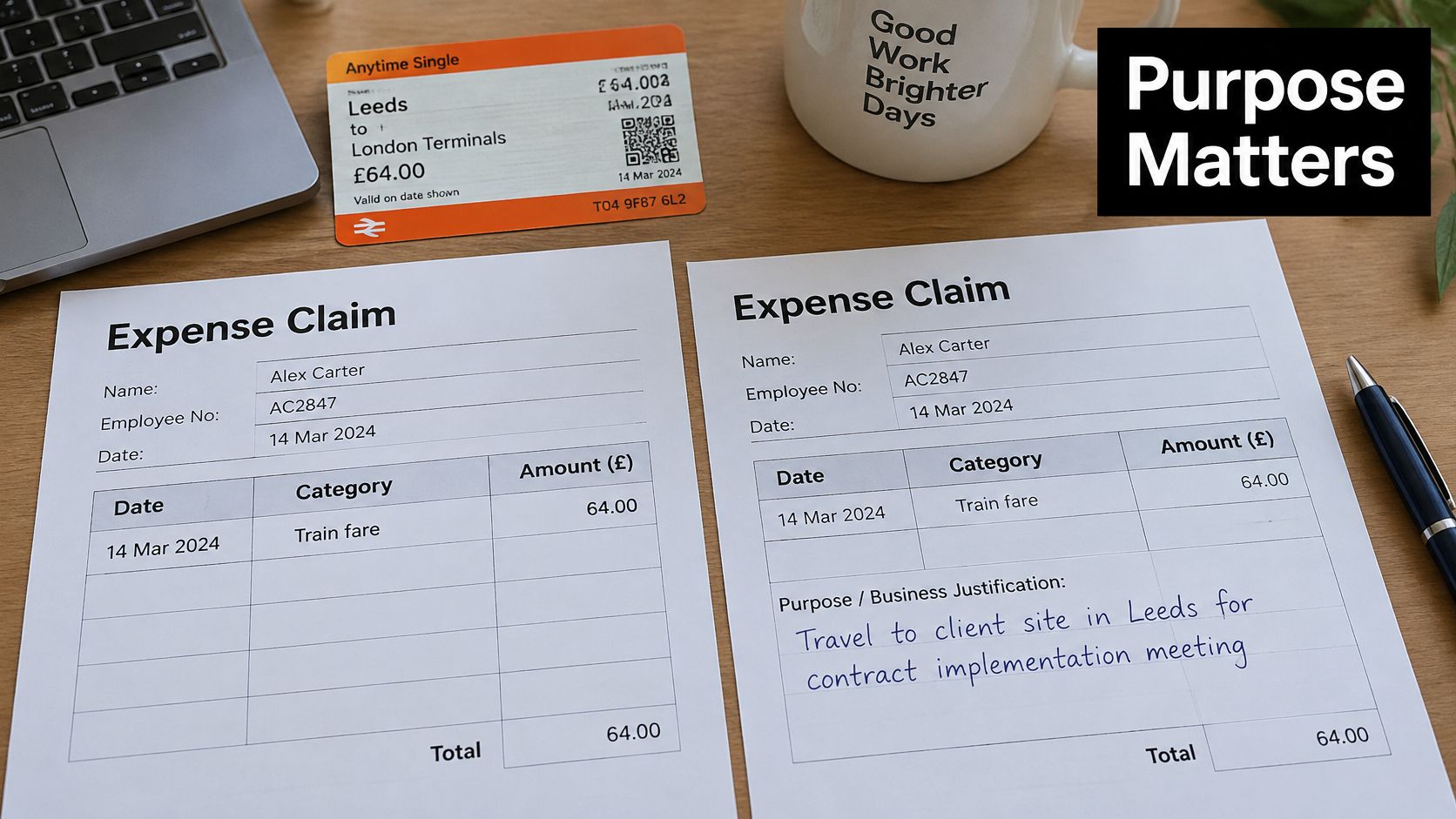
Say two employees submit the same train fare. One writes travel. The other writes Travel to client site in Leeds for contract implementation meeting. The category is identical, but only the second explanation tells the reviewer what the journey was for.
An expense report business purpose is the work reason behind a cost. The category answers what kind of expense is this? The purpose answers what business activity did it support? A receipt establishes what the supplier charged, while the purpose connects that transaction to work. Think of a parcel label: the package exists without it, but the label tells someone where it belongs.
The UK record-keeping basis
HMRC's employer record-keeping guidance requires records of expense dates and details, says reimbursed travel records should explain when and why the employee travelled, and generally requires employers to retain records for 3 years from the end of the relevant tax year. That retention period concerns employer expense and benefit records, not every kind of business record.
Tax treatment is a separate question. HMRC's employment expense guidance explains the “wholly and exclusively” requirement for expenses incurred in performing employment duties. A clear note supports the work connection, but it doesn't override other eligibility conditions or turn personal spending into a deductible expense.
Build the claim around these practical fields:
- Transaction details: Date, amount, currency and supplier.
- Claimant: The person who incurred the expense.
- Purpose: A concise sentence identifying the activity and its work objective.
For help organising the transaction side, Bookkeeping and Accounting of Florida Inc.’s expense tracking guide for Jacksonville SMBs offers a bookkeeping resource. Its US context doesn't replace UK tax guidance, but keeping transactions organised is useful whichever accounting system you use.
The key distinction: A category classifies the purchase. A purpose explains why the business should bear the cost.
Before submitting, ask: could someone who has never met you understand why this cost belonged to the business?
Purpose Notes That Work for Common Expenses
Use these illustrative purpose notes as patterns, not automatic confirmation that an expense qualifies for tax relief.
| Expense | Weak note | Strong note | Evidence to keep |
|---|---|---|---|
| Client lunch | Lunch | Lunch with Sarah Adams of Harlow Ltd to agree renewal terms | Receipt and names of attendees |
| Train to client site | Train ticket | Travel to Harlow Ltd site in Leeds for contract implementation meeting | Ticket and meeting invitation |
| Mileage on own car | Mileage | Drive to Harlow Ltd site in Leeds for contract implementation meeting | Mileage log with date, route and purpose |
| Mobile phone | Phone bill | Business share of mobile contract used for client calls, 60% per usage log | Bill and usage split |
| Home broadband | Internet | Business share of home broadband used for client video calls, 30% of usage | Bill and written basis for the share |
| Software subscription | Software | Project management tool used to run delivery for client project Apex | Invoice and account statement |
| Hotel stay | Hotel | Two nights in Manchester for client data workshop conference | Itemised hotel invoice and event booking |
| Job materials | Materials | Timber and fixings bought for project Apex site installation | Supplier invoice with job reference |
The percentages and duration in the table are hypothetical examples, not standard allowances. Use your actual journey, attendance, usage evidence and applicable expense rules. In particular, identifying business use doesn't establish that a share of an existing household bill is deductible for every claimant.
Adapt the pattern, not just the names
The strong-note column supplies context that the weak note leaves out. A reviewer can connect Harlow Ltd to a meeting invitation, project Apex to a job record, and a phone allocation to a usage log. The evidence column tells you what to retain alongside the explanation.
Keep the category in its own field. If you're unsure whether an item belongs under travel, software or supplies, use the guide to expense report categories to organise that decision. Repeating the category in the purpose field doesn't add useful information.
- Keep the sentence short: Aim for a readable line rather than a diary entry. Put longer allocation calculations in an attached note.
- List hospitality attendees separately: Include names and business roles without crowding the main sentence. Routine materials purchases don't need a list of everyone who might use them.
- Reuse existing project references: Match the wording or project code on calendars, purchase orders and invoices so the reviewer can find supporting records.
A meeting doesn't have to produce a signed contract to have a genuine purpose. “To discuss renewal terms” is more accurate than claiming terms were agreed when negotiations are still open.
The test is whether someone who didn't attend the lunch or make the journey can understand the note and locate its support. Specificity matters more than length.
How to Write a Purpose Note in Four Steps
Write from the activity outward, rather than starting with a tax conclusion. HMRC's guidance on identifying business purpose considers the underlying aim of expenditure alongside corroborating evidence, including documents, agreements and other records. Your explanation should describe what you intended to do and agree with those records.
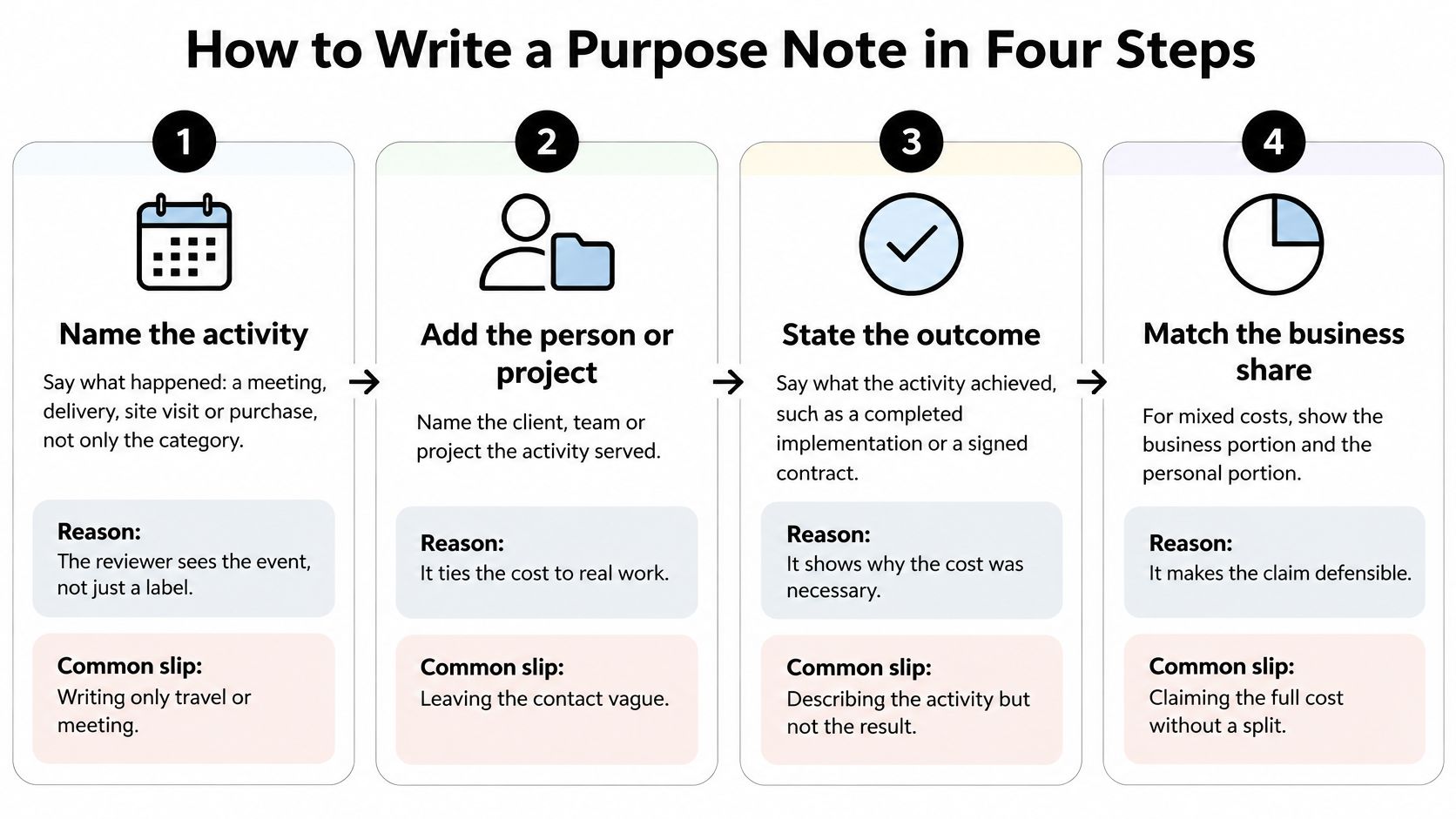
Name the activity. Start with something identifiable, such as travelling to a site, buying installation materials or attending a workshop. For the train example, begin with Train to Leeds for implementation meeting, rather than stopping at the category travel.
Add the person, client or project. Identify whose work the activity served so a reviewer can match it to a booking, job or invoice. Extend the example to Train to Leeds for Harlow Ltd's project Apex implementation meeting; a client name alone may not distinguish between several concurrent jobs.
State the work objective or actual outcome. Explain what the activity was intended to advance, without inventing a successful result. The finished example becomes Train to Leeds for Harlow Ltd project Apex meeting to agree the implementation schedule.
Record any business share and its basis. Where a cost includes separable private spending, identify the business component and attach the calculation or usage evidence. The common mistake is to write “business use” while claiming everything, leaving the reviewer unable to reproduce the allocation.
Keep objectives honest
An objective explains why you incurred the cost. An outcome records what happened afterwards. You can write “to investigate installation faults” even if the visit didn't resolve them, because the attempted diagnosis was the work activity.
Don't replace concrete information with phrases such as “business development” or “for company purposes”. Those expressions can fit almost any transaction and give a reviewer little to verify.
Write enough to identify the work, then let the supporting records carry the detail.
Read the completed sentence aloud. If it leaves an obvious question about the client, destination or job, add the missing detail before submission. If the missing explanation requires a calculation rather than a sentence, attach the calculation instead of making the purpose field unwieldy.
Splitting Purpose on Mixed-Use and Hospitality Costs
A receipt isn't enough when the purchase serves both work and private life. It records the transaction, not the allocation. Charlton Baker's guidance on evidence for business expense claims highlights the need to document why spending was needed and how the business-use proportion was calculated.
Splitting a cost isn't permission to deduct it. A definite, identifiable business component may be separable, whereas an inseparable dual-purpose cost can't be made allowable by choosing a percentage. The relevant rules also differ between employees and sole traders.
Hospitality and extended trips
For hospitality, retain the attendees' names, their business roles and the reason for meeting. Say you pay for dinner with clients and a partner who has no business involvement. Identify the partner's private spending separately, but don't assume the remaining client entertainment is tax-deductible merely because it has a commercial purpose.
The expense report should distinguish what the employer will reimburse from what the accountant will treat as deductible. A well-documented business lunch may still need a tax adjustment.
For a Monday client visit followed by a private stay through Friday, identify the client journey and separately record private accommodation, meals and additional travel. Don't label the whole trip “client visit”. Equally, don't assume that the return fare becomes wholly private because you returned later; flag the itinerary for review.
A decision path for shared costs
- Work only: Record the full business amount for review, subject to the normal eligibility rules.
- Separable business component: Identify that component and show the calculation, supported by itemisation, journey records or usage logs.
- Inseparable business and private purposes: Don't invent an allocation. Flag the cost for your accountant.
- Uncertain treatment: Keep the complete receipt, describe both uses and seek advice before submitting a tax claim.
Phones, broadband and vehicles need particular care. A usage log can support a proposed allocation, but a convenient measure such as days worked at home doesn't automatically establish the correct deductible amount. Record the method that fits the expense.
Practical rule: Separate what you can substantiate. Flag what you can't, rather than presenting an estimate as an established entitlement.
A useful mixed-use note states the activity, the proposed business component and the evidence behind it. The accountant can then assess the treatment without having to reconstruct your intentions.
Evidence and Approval Needed for Each Role
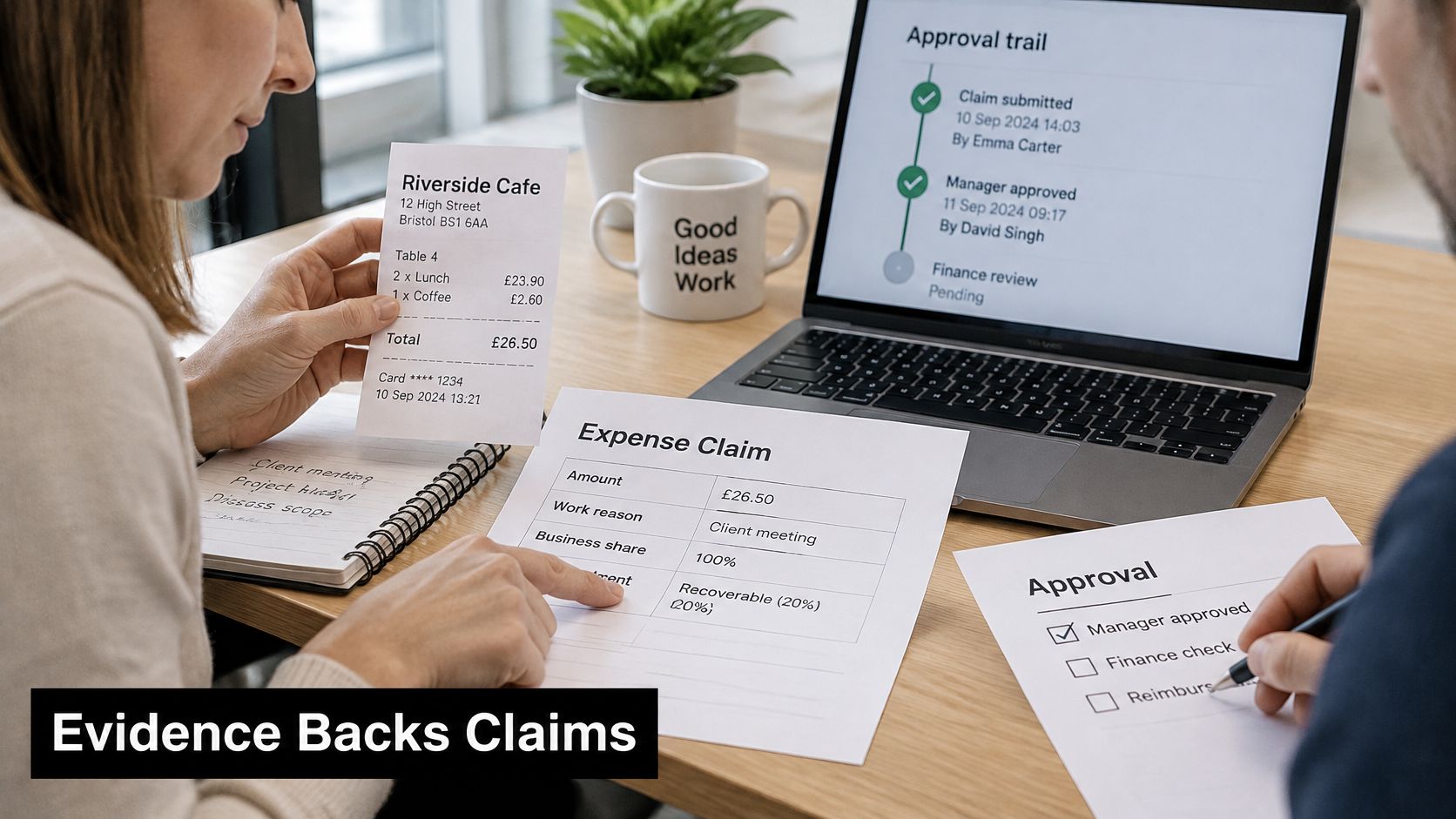
A reviewer should be able to establish the amount, work reason, business share and proposed VAT treatment, then see who approved the claim. HMRC's employer further guide to PAYE and National Insurance identifies supporting evidence such as receipts, credit-card records, mileage or telephone logs and work diaries. Substantial, estimated or unusual claims need particularly careful support.
A card statement can help confirm payment, but it doesn't necessarily explain what was purchased. A calendar entry can support a meeting, but it doesn't establish the restaurant bill. Keep complementary records rather than expecting one document to answer every question.
Give each reviewer a clear responsibility
The following is a suggested control model, not a mandatory organisational structure. A smaller business may combine roles, but it should still make each check explicit.
| Role | Must record | Who checks | Evidence to keep |
|---|---|---|---|
| Sole trader or freelancer | Date, amount, supplier, purpose and business share | Self, then accountant at year end | Receipt, card statement and own log |
| Employee claimant | Date, amount, supplier, claimant, activity, location and purpose | Line manager against policy | Receipt, mileage or phone log and calendar entry |
| Line manager | Budget code, attendees where relevant and approval date | Finance team at month end | Approval record and attendee list where relevant |
| Bookkeeper or accountant | Nominal code, VAT amount and business share | Internal finance reviewer; HMRC may examine records if an enquiry is raised | Receipt, VAT invoice and bank statement |
Sole traders need notes that stand independently because there's no separate manager confirming the event. Employees should provide the work context themselves, rather than assuming their manager will fill in missing information.
Managers check whether the activity fits the employee's role, authorisation and budget. Bookkeepers and accountants match the evidence to the nominal code and assess the accounting and tax treatment. Manager approval isn't a tax determination.
Keep approval and accounting checks distinct
A defined expense approval process helps prevent a claim being passed around without anyone owning the unresolved question. If the purpose is vague, send it back to the claimant; if the tax treatment is uncertain, route it to the accountant.
For owners establishing operations abroad, renn's renn's guide to Spanish business setup provides separate setup context. Don't assume a UK expense workflow settles another jurisdiction's obligations.
The final check is consistency: the note, receipt and calendar should describe the same activity, while the approval record shows who accepted it.
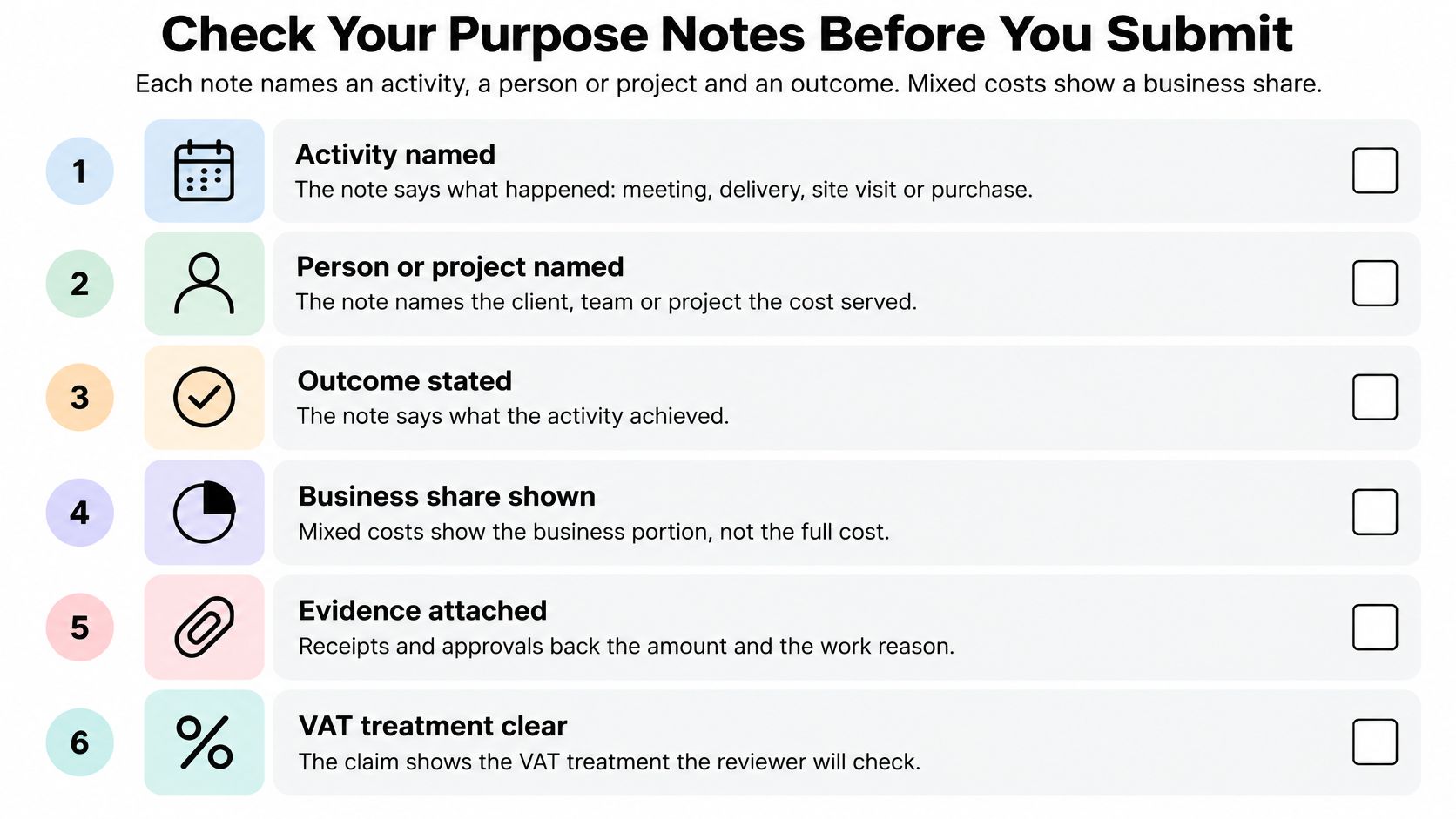
Check Your Purpose Notes Before You Submit
Run this checklist while the transaction is still familiar. It's easier to correct an incomplete note before submission than to explain an unfamiliar purchase at year end.
- Identify the work: Each note names an activity, a person or project, and an intended objective or actual outcome.
- Support mixed spending: Any proposed business share includes its basis, with uncertain treatment flagged.
- Identify hospitality attendees: Names and business roles accompany the meeting reason.
- Match the evidence: Every receipt has a corresponding note, and the reviewer has the information needed to assess VAT.
- Align project references: Use the same codes and descriptions as your calendar, invoices and job records.
- Meet your business's deadline: Submit within its stated claim period, with required approvals attached.
Capture the context while it's fresh
Write the purpose when you photograph or forward the receipt. Keep allocation notes and approvals with the supporting documents, and use the guide to HMRC record-keeping when organising your records.
A capture tool is one option for the transaction details. With Snyp, you can upload receipts on the web, forward them by email or send them through WhatsApp. Our AI extracts the details and assigns the most appropriate category from your chart of accounts; you review and confirm the data before approved records sync to Xero or QuickBooks, and your accountant can review through a link without needing an account.
Apply the checklist to your next five claims. Replace vague wording, attach missing support and resolve uncertain allocations before submitting.
Snyp captures receipt details and prepares approved expense data for Xero or QuickBooks, leaving you to supply the work context only you know. Visit Snyp to bring receipt capture into your routine, and use the checklist above to make each claim easier to review.