




CLP on Bank Statement Explained and Verified
CLP on a UK bank statement is usually a bank-specific transaction reference or payment label, not a universal code, so you need to read it with the surrounding description, amount and payment type to verify it. One reason this trips people up is that UK banks publish their own payment-code guides, and Bank of Scotland's 2026 guide lists named statement labels such as Bank Giro Credit, showing how much these short references depend on the bank's own wording.
You're probably here because you opened your banking app, saw CLP, and paused. Is it a charge, a currency, a direct debit, a processor code, or something you should worry about?
That uncertainty is normal. Bank statements are full of compressed labels, and three letters on their own rarely tell the whole story. For a freelancer or sole trader, that matters because the difference between “mystery payment” and “properly identified receipt” often comes down to the rest of the line: who sent it, which payment rail carried it, whether it was money in or out, and what paperwork you can match to it.
Introduction What Seeing CLP Really Means
A common scene goes like this. You're checking transactions between client work, scanning for expenses, and one line interrupts your flow: CLP. You can't tell whether it belongs under income, fees, subscriptions, or something you need to query with the bank.
That's the wrong moment to guess.
In UK banking, short statement codes are often used to identify transaction types, and banks publish guides because the same kind of abbreviation can mean different things depending on the institution. Bank of Scotland's payment-code guide shows that banks use named labels such as Bank Giro Credit on statements, which is a practical reminder that statement wording is bank-led rather than universal (Bank of Scotland payment codes guide).
Why the letters alone aren't enough
Think of CLP as a clue, not a conclusion. On its own, it's incomplete. Next to a card transaction from an overseas merchant, it may point you in one direction. Next to a domestic bank transfer with a familiar payer name, it may mean something very different.
Practical rule: Never categorise a short bank reference from the letters alone. Read the whole transaction line first.
That's especially important if you keep books for tax, VAT, or year-end accounts. Short references are often the first hint you use to match a payment to an invoice, membership, refund, or fee. If you misread that hint, the wrong category can follow all the way into your accounts.
What to look at before you react
When you see CLP on bank statement entries, start with four simple checks:
- The amount: Does it match a known invoice, subscription, transfer, or refund?
- The direction: Is it money in or money out?
- The transaction type: Was it a card payment, Faster Payment, BACS item, or something else?
- The counterparty details: Is there a recognisable name beside the abbreviation?
If you treat CLP as context-dependent from the start, the line usually becomes much easier to decode.
How Bank Statement References and Codes Work
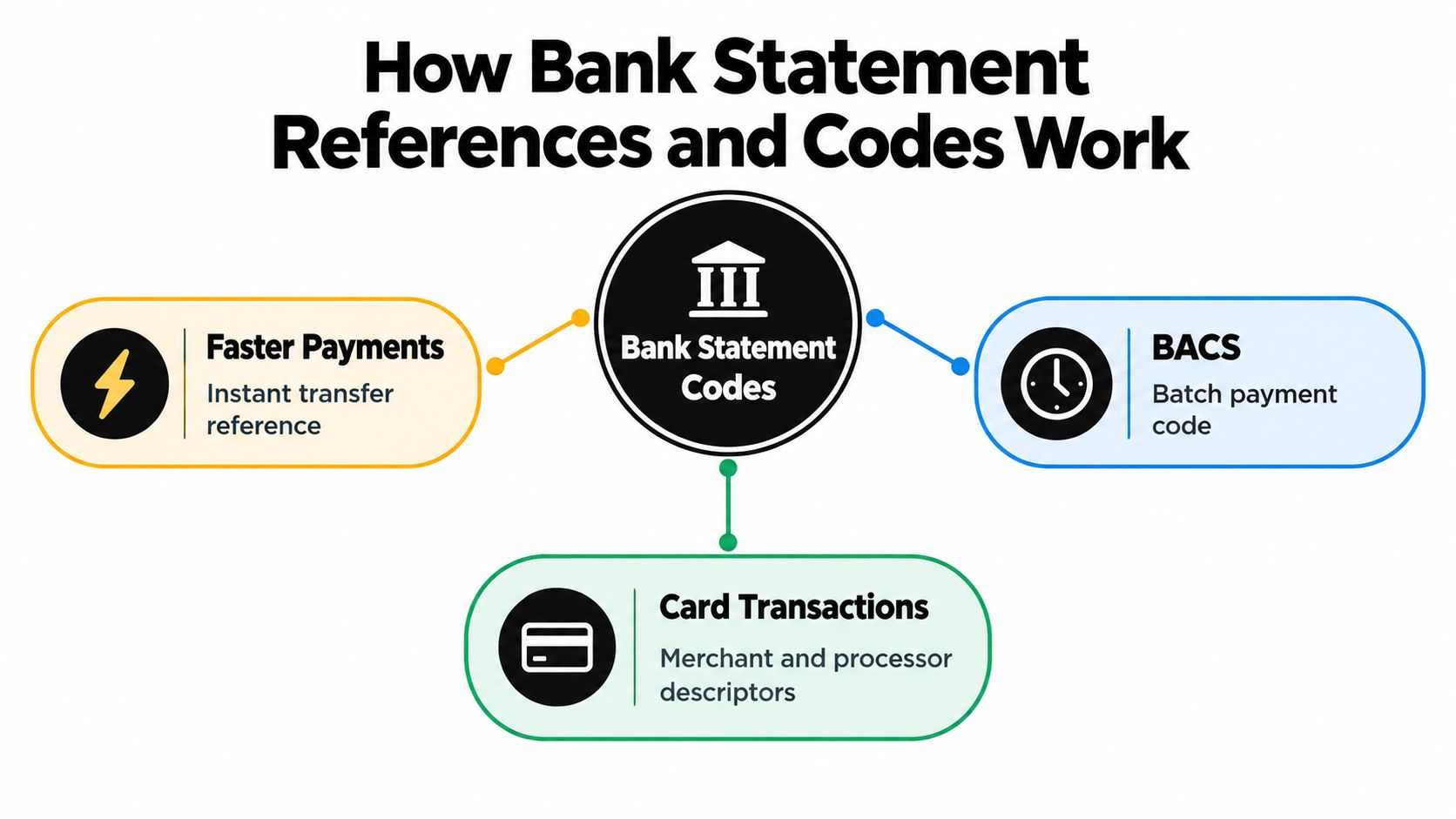
Bank statements aren't written for perfect readability. They're built from banking systems that attach labels to transactions as they move through different payment channels. That's why one line might show a clear merchant name, while another looks like a small puzzle.
Each payment rail adds its own label
A card payment, a bank transfer, and a batch payment don't arrive on your statement in the same way. Each route carries different metadata. Some show merchant descriptors. Some show sender references. Some carry internal wording that only makes sense when paired with the rest of the line.
A helpful way to think about it is a luggage tag. The payment is the suitcase. The reference is the tag attached to it. The tag helps route and identify the item, but the tag isn't the item itself.
If you want a broader grounding in how transaction labels are built, this guide on bank transaction meaning gives a useful overview.
Why the same abbreviation can mean different things
Banks publish code lists for a reason. One abbreviation can map to different payment types depending on the provider, statement format, or internal processing system. That's why trying to force a single universal meaning onto CLP often leads to errors.
Here's the safer mental model:
| What you see | What it usually tells you |
|---|---|
| Short code only | You need more context |
| Code plus known payer | Likely a reference attached to that payer |
| Code plus card merchant info | Likely processor or merchant-side wording |
| Code plus foreign currency clue | Could relate to international processing |
The four fields that matter most
When you're decoding a shortened statement reference, these fields usually do the heavy lifting:
- Date. It anchors the transaction to something you did or received.
- Amount. It often narrows the list fast.
- Payment channel. Card, Faster Payment, BACS, and credits all describe money differently.
- Counterparty name. This is often more useful than the code itself.
A short reference is rarely the identity of the transaction. It's usually one label inside a larger record.
That's why CLP on bank statement should be read as one fragment of a full transaction record, not as a standalone definition.
What CLP Most Commonly Means on Your Statement
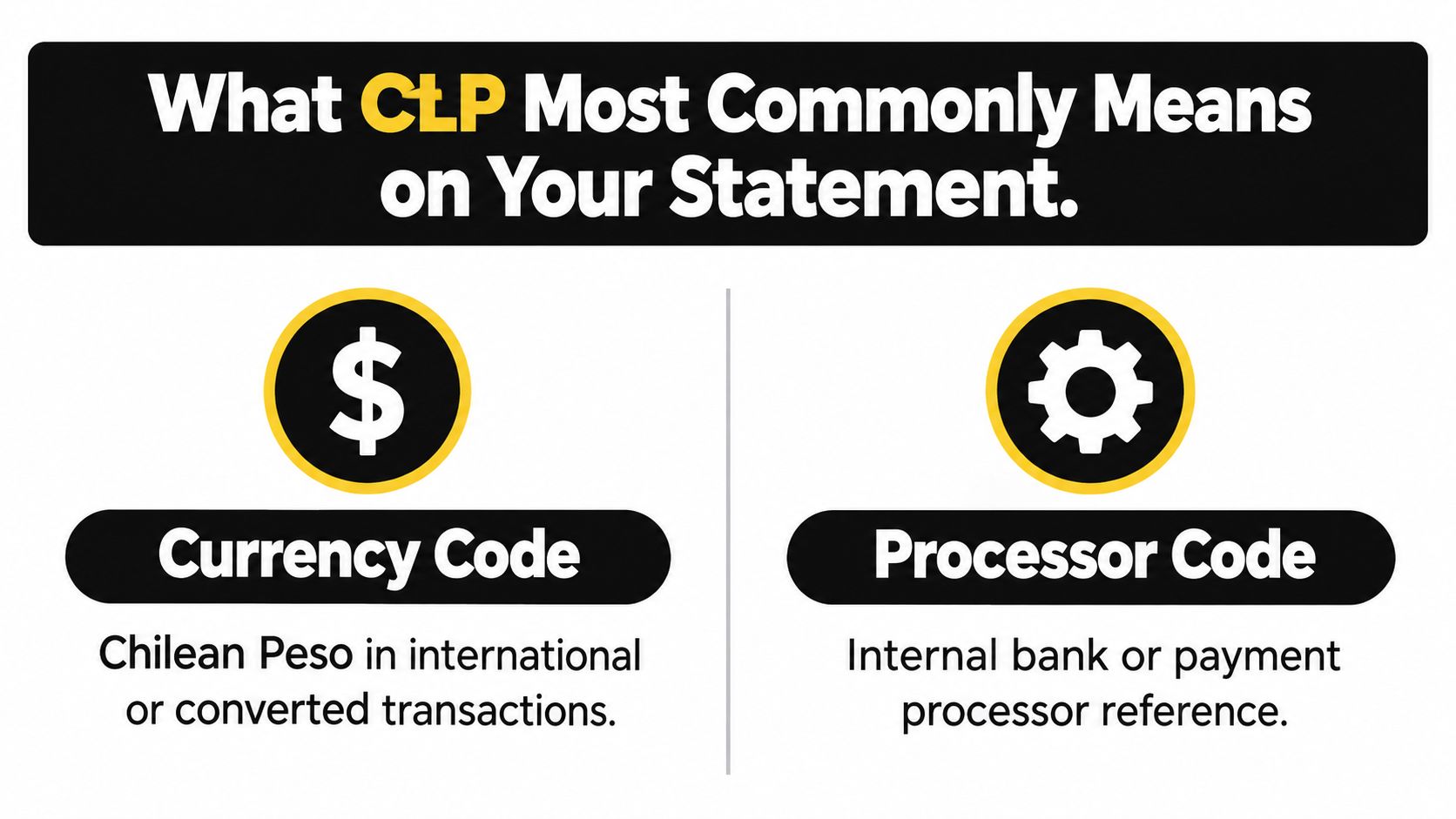
For those searching for CLP on bank statement, a clear, direct answer is typically desired. In practice, there are a few common possibilities, and the quickest route is to compare them side by side.
Possibility one is a currency clue
In some contexts, CLP can refer to the Chilean peso. If your transaction involved an overseas merchant, travel booking, international card processor, or foreign exchange conversion, this becomes more plausible.
Signs that point in that direction include:
- A merchant based abroad
- An online purchase with international processing
- Extra wording about conversion or card scheme processing
- A receipt that shows a foreign amount and a sterling charge
This interpretation makes sense only if the rest of the transaction supports it. If the entry is a routine domestic bank payment to a UK organisation, the currency explanation is less likely.
Possibility two is an internal processor or bank label
This is often the most practical explanation. The verified UK banking evidence behind this article points to a broader rule: short references are commonly part of a bank's own transaction narrative rather than a universal regulated code. That's why the sending bank, payment rail, and counterparty name matter more than the letters on their own.
If the line sits beside a normal domestic payment and no foreign currency clues appear, CLP may be part of the internal wording generated by the bank or processor.
For a related example of how short banking abbreviations can confuse people, this article on FPI on bank statement shows the same pattern.
Possibility three is confusion with organisation names
Search results often make this harder, not easier. Verified UK material shows that searches for “CLP on bank statement” are frequently crowded by unrelated uses of CLP, especially Constituency Labour Party documents and general statement guides rather than a direct explanation of the bank reference itself (Electoral Commission related document context).
That doesn't mean your transaction has anything to do with politics. It just means the same three letters appear in very different places.
Here's a simple comparison:
| If you see this | Most likely reading |
|---|---|
| Overseas merchant or conversion detail | Currency-related use may fit |
| Domestic transaction with sparse narrative | Internal bank or processor label may fit |
| Recurring payment to a named organisation | Organisation-related reference may fit |
Don't ask, “What does CLP always mean?” Ask, “What does CLP mean on this exact line?”
That one shift saves a lot of unnecessary worry.
How to Verify a CLP Transaction Step by Step
Once you stop trying to decode the letters in isolation, verification becomes much calmer. The goal isn't to be clever. It's to build enough evidence to classify the transaction correctly.
Start with the full statement line
Open the transaction details, not just the summary view. Many banking apps show a shortened line first and a fuller narrative only after you tap into it.
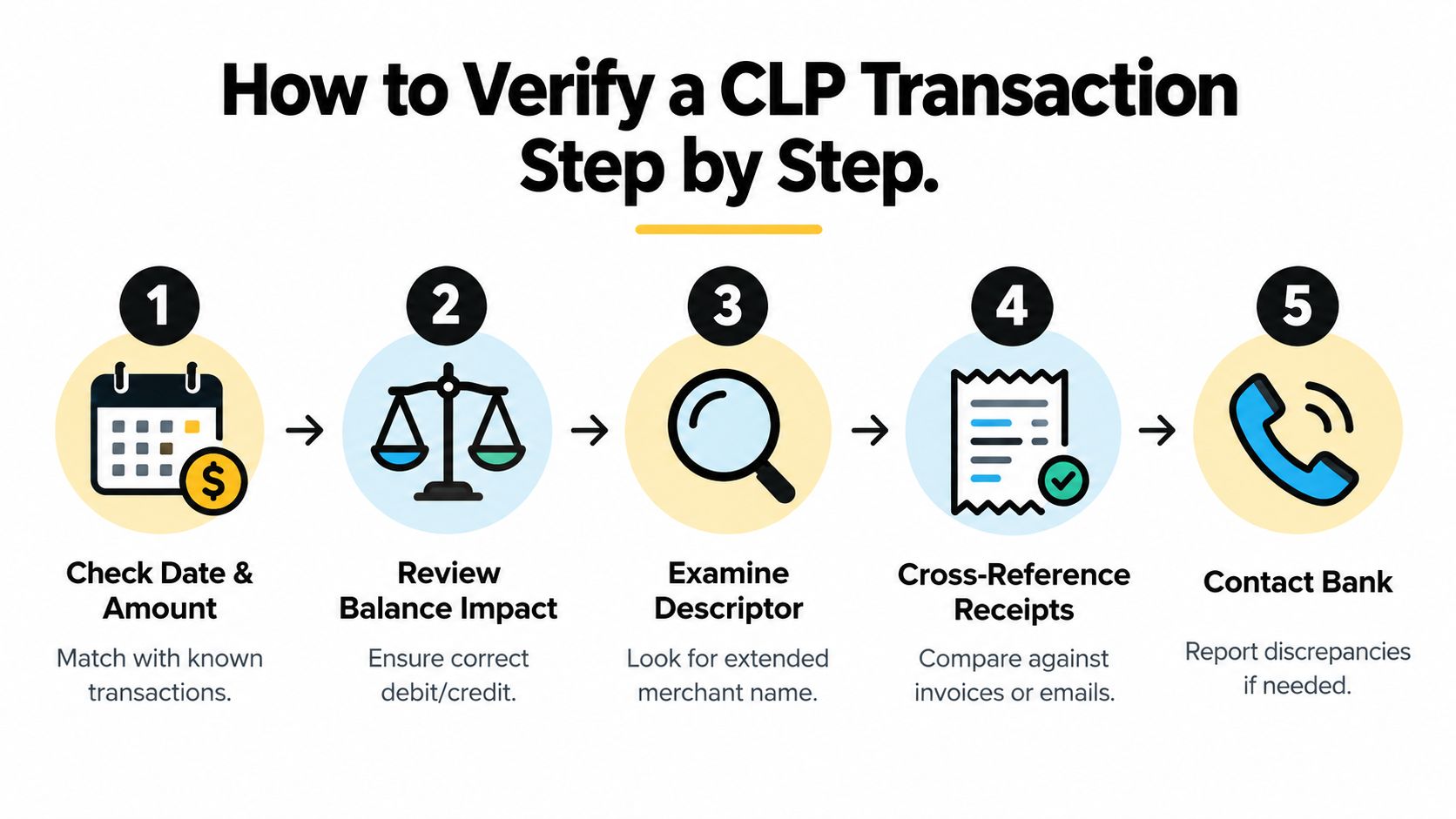
Check these in order:
- Date and amount. Do they match a known purchase, transfer, payout, or invoice payment?
- Debit or credit. Is the transaction money out or money in?
- Extended description. Look for merchant name, sender name, or payment wording.
- Payment type. Card, Faster Payment, BACS, bank credit, and transfer labels all matter.
Cross-check your own evidence
If the line still looks unclear, leave the bank app for a moment and check your records.
- Email inbox: Search by amount, date, or likely merchant name.
- Receipts folder: Look for matching totals and supplier names.
- Invoices sent: If it's money in, see whether it matches a client payment.
- Subscription records: Recurring software or membership payments often hide behind shortened descriptors.
If the amount and date line up with your own paperwork, the code usually stops being mysterious.
Confirm whether it's domestic or international
A lot of confusion comes from assuming a code must be a merchant name. Sometimes it's a processing clue instead. If you suspect currency conversion or international processing, look for signs that the merchant location or receipt differs from what appears in sterling on the statement.
If the transaction is domestic, focus more heavily on the payment rail and counterparty. If it's international, focus more heavily on merchant location and conversion records.
Preserve the raw wording for compliance and audit
This part matters for bookkeepers and anyone handling regulated checks. UK AML guidance tells practitioners to review whether funds are consistent with a client's declared means, whether unusual transactions can be explained and evidenced, and whether the statement details match identity information (UK AML webinar question response document).
That means you shouldn't overwrite a vague statement description too early. Keep the raw statement text, then add your own note beside it. “CLP” on its own may be ambiguous, but “CLP, matched to invoice and client remittance email” is much more useful.
Contact the bank only after these checks
If the transaction still doesn't make sense after checking the full narrative, your receipts, invoices, and merchant emails, then it's sensible to contact the bank. By that stage you'll have the exact date, amount, statement wording, and likely category ready, which makes the query much easier to handle.
Categorising and Reconciling CLP Entries With Confidence
Once you've verified the transaction, the next job is simple but important. Put it in the right category and keep enough evidence so you won't have to solve the same puzzle again later.

Don't dump unclear entries into a generic bucket
A common bookkeeping mistake is to file a shortened descriptor under something vague like “miscellaneous” and move on. That feels fast today and creates work at year end.
A better approach is to map the transaction based on what you verified:
- Known supplier expense if the amount and receipt match a business purchase
- Client receipt if it ties to an invoice or remittance advice
- Bank charge if the line is clearly a fee
- Membership or subscription if it recurs and matches a known organisation
Keep the original statement format
Verified UK guidance on downloading bank statements shows how fragmented statement access still is across providers, with banks often offering monthly PDFs and archives rather than one normalised feed. That's why preserving the original export or PDF matters when you're checking abbreviations and shortened narratives (UK bank statement download workflow guide).
For reconciliation work, that means keeping both:
- The raw bank record
- Your interpreted category with supporting evidence
If you want a practical walkthrough of the wider process, this article on bank statement reconciliation is a useful companion read.
Small entries still need clean categorisation
Even tiny statement items need proper treatment. Labour Party accounts offer a good real-world reminder that small organisations still track bank charges as distinct, auditable entries. One CLP account reported £18.75 for 2023 and £25.00 for 2022 in bank charges, while another set of accounts recorded £271.90 in 2024 and £247.11 in 2023, all tied to formal reporting periods (party accounts document).
That's useful because it shows how statement labels end up inside controlled year-end records. A small line item isn't too small to matter if it affects your books.
Build a repeatable rule for future abbreviations
If you handle lots of statement cleanup, tools can help. Some businesses use document capture and categorisation systems alongside bookkeeping rules. For example, striveX Ltd automated bookkeeping discusses ways to reduce manual coding and reporting friction. In the same workflow category, Snyp captures receipts and related documents, extracts fields such as merchant, amount, date, tax and category, and syncs them into Xero or QuickBooks, which can make it easier to support a verified bank entry with matching evidence.
The key habit isn't the tool. It's the rule: keep the original descriptor, attach proof, and only then assign the category.
Next Steps for Disputes Corrections and Clean Records
After you've checked the line, you usually end up in one of three situations. The transaction is fine and just needed a note. The transaction is real but miscategorised. Or the transaction still looks wrong and needs to be challenged.
When to annotate and file it
If the date, amount, payment type, and your supporting paperwork all line up, add a short note in your bookkeeping system and file the evidence with the transaction. That's enough in most cases.
A plain note works well. Something like: “CLP reference verified against supplier receipt” or “CLP entry matched to client transfer and invoice.” Short, factual, searchable.
When to correct the category
If you first logged the item as generic admin, unknown expense, or uncategorised, fix it while the evidence is still easy to find. Don't leave “I'll tidy that up later” jobs until quarter end.
Recent UK guidance also highlights how statement access and transaction labelling vary by bank, which is why consumers and small businesses still have to interpret abbreviations across different formats rather than one shared standard (Nationwide statement access guidance). That's another reason to maintain your own clear notes.
Clean records come from repeated small decisions, not one big tidy-up at year end.
When to raise a dispute
Raise the issue with the bank if the transaction can't be matched to any receipt, invoice, email, subscription, or known transfer, or if the amount and narrative don't fit your records. Before you do, gather the statement line, screenshots, merchant correspondence, and any account notes.
If the issue turns into a wider documentation or payment disagreement, specialist help can be useful. For businesses dealing with evidence-heavy financial queries, smes dispute resolution solutions can give useful structure to the paperwork side.
The practical goal is simple. Match every figure to evidence, correct mistakes early, and don't treat a short code as proof of anything by itself.
If you're tired of chasing receipts every time a vague bank reference appears, Snyp gives you one place to capture receipts, invoices, and related documents from email, WhatsApp, or file upload. That makes it easier to match unclear statement labels like CLP to real evidence, keep categories accurate, and move through reconciliation without the usual back-and-forth.