




Support for Entrepreneurs: Types, Access and Next Steps

The British Business Bank helped £6.8 billion of finance reach approximately 28,000 UK smaller businesses in 2024/25, according to its Impact Report 2025. That scale challenges the idea that entrepreneurship is a test of individual resourcefulness. Useful support for entrepreneurs connects money, advice and reliable administration, so a founder can make decisions without relying on family wealth or well-placed introductions.
The difficulty is choosing the right help in the right order. A loan won't repair unprofitable pricing, a mentor can't assess margins from missing records, and software won't decide whether expansion makes commercial sense. Start with the risk you need to reduce, then assemble the support around it.
What Entrepreneur Support Covers and Who Provides It
Of 325,811 UK startups registered in 2020, only 47% survived to 2023, according to evidence cited in the government's small-business evidence annex. Starting a business and sustaining one are different jobs. Support needs to address both, rather than stop when registration is complete.
Entrepreneur support means practical help that reduces financial risk, administrative work or a gap in knowledge. Think of it as a toolkit: borrowing, mentoring and bookkeeping serve different purposes, and buying more tools doesn't automatically solve the problem.
Match the help to the problem
Public business services and local councils can help you identify suitable routes. Accountants and solicitors handle specialist questions, while mentors and peer networks help you test commercial decisions. Software providers support the recurring work underneath those decisions.
Types of entrepreneur support, what they cover and what they cost
| Type | What it covers | Typical cost |
|---|---|---|
| Mentorship | Strategy, pricing, hiring and confidence from experienced founders | Public or charity-funded places may be free; private advisers charge agreed fees |
| Funding | Loans, grants, guarantees and equity for working capital and growth | Interest, fees, project conditions or equity given up |
| Legal and tax | Registration, employment status, VAT, Self Assessment and filing duties | Official guidance is free to access; specialist advice carries professional fees |
| Technology and tools | Software for sales, operations and admin | Free plans or subscriptions priced by features and usage |
| Accounting workflows | Receipts, bookkeeping, reconciliation and reporting | Software subscriptions, bookkeeping fees or a combined service |
A founder with customers but no cash needs a different starting point from someone who's unsure how to price a service. Likewise, paying for strategic advice is premature if you can't yet explain what each sale costs to deliver.
Practical rule: Choose the support that addresses your biggest current risk, not the programme with the most attractive description.
Keep jurisdiction and scope clear
Advice must fit where you operate. For founders considering overseas expansion, Founder Connects' guide to starting a business in the UAE offers a separate starting point for that jurisdiction, rather than a substitute for UK guidance.
Before accepting help, ask what the provider delivers: a referral, a review, an application or ongoing implementation. A useful engagement ends with an agreed action and someone responsible for completing it. Otherwise, you can collect advice while the underlying problem remains untouched.
Funding Routes and How to Size the Need
Since its launch in 2012, the government-backed Start Up Loans programme had delivered more than £1 billion in loans to small and medium-sized enterprises, according to the government's February 2024 programme announcement. Delivered through the British Business Bank, the programme combines finance with mentoring. That pairing matters because access to money and the ability to deploy it sensibly aren't the same thing.
Funding should match the use of the money and the source of repayment. A cash-flow timing gap is a bridge: you cross it when a customer pays. Growth capital is an engine: you need sufficient demand, capacity and margin to keep it running.
Funding routes compared by fit and cost
| Route | When it fits | What it costs |
|---|---|---|
| Grants | Specific projects with clear eligibility and deliverables | Usually no repayment if conditions are met, but competitive and often conditional |
| Bank loans and overdrafts | Timing gaps in cash flow with a clear repayment source | Interest and fees |
| Asset finance | Buying equipment or vehicles | Repayments, financing charges and rights over the asset |
| Guarantee schemes | Viable proposals a lender is reluctant to support without additional backing | Interest and applicable fees; the lender still makes the decision |
| Equity | Growth capital where scheduled repayment isn't suitable | A share of ownership and potentially some decision-making control |
Compare the obligations, not just availability
Grants can suit defined projects, but check eligible expenditure, payment timing and any requirement to contribute your own money. An award paid after expenditure won't solve an immediate cash shortage.
Bank borrowing needs an identifiable repayment source. An overdraft can accommodate fluctuating receipts, while an agreed loan schedule may suit a planned investment. Asset finance links funding to equipment, but compare the total payable and what happens if you need to exit early.
Guarantees support a lender's decision; they aren't a grant and don't remove the borrower's obligations. Equity avoids scheduled loan repayments but introduces ownership negotiations and investor expectations. If US investor research is relevant to your expansion, you can browse American entrepreneurship investors through Gritt.io, then check each investor's actual geography, sector and investment criteria.
Calculate the cash requirement before applying
Build a month-by-month forecast covering a full operating cycle. Separate fixed commitments, delivery costs, tax payments, founder drawings and proposed investment. Use expected payment dates, not invoice dates, and include a downside case with slower customer payments.
The funding requirement is the forecast cash shortfall plus a defensible contingency, less cash available. The small-business accounting tips guide can help you organise the underlying figures.
Don't borrow just because a product is available. Pause if:
- Sales lose money: More turnover would increase the loss after delivery costs.
- Repayment is speculative: It relies on an unsigned contract or hoped-for investment.
- The shortfall keeps returning: You're financing recurring losses without changing pricing, costs or demand.
Finding and Applying for Support Step by Step
Where to find each type of support and how to start
| Route | Who it suits | How to start |
|---|---|---|
| Business Support Service | Early-stage and established small firms needing advice | Enquire through the GOV.UK business support pages |
| Start Up Loans | Founders exploring government-backed startup finance | Check current eligibility through the programme, which includes mentoring |
| Local council business teams | Founders seeking local grants, workshops or premises advice | Contact the council business support team |
| Accountant or bookkeeper | Founders needing tax, filing and payroll support | Request a fixed-fee quote for the services you need |
| Chambers of commerce and peer networks | Founders wanting mentors, introductions and sector knowledge | Check membership terms or attend an introductory event |
The government's Business Support Service supported nearly 25,000 businesses in 2023 through advice and guidance, according to its small-business access-to-finance consultation. An advice service is a sensible entry point when you can describe the problem but don't know which organisation owns the solution.
The application process is easier to manage when you separate route selection from document preparation.
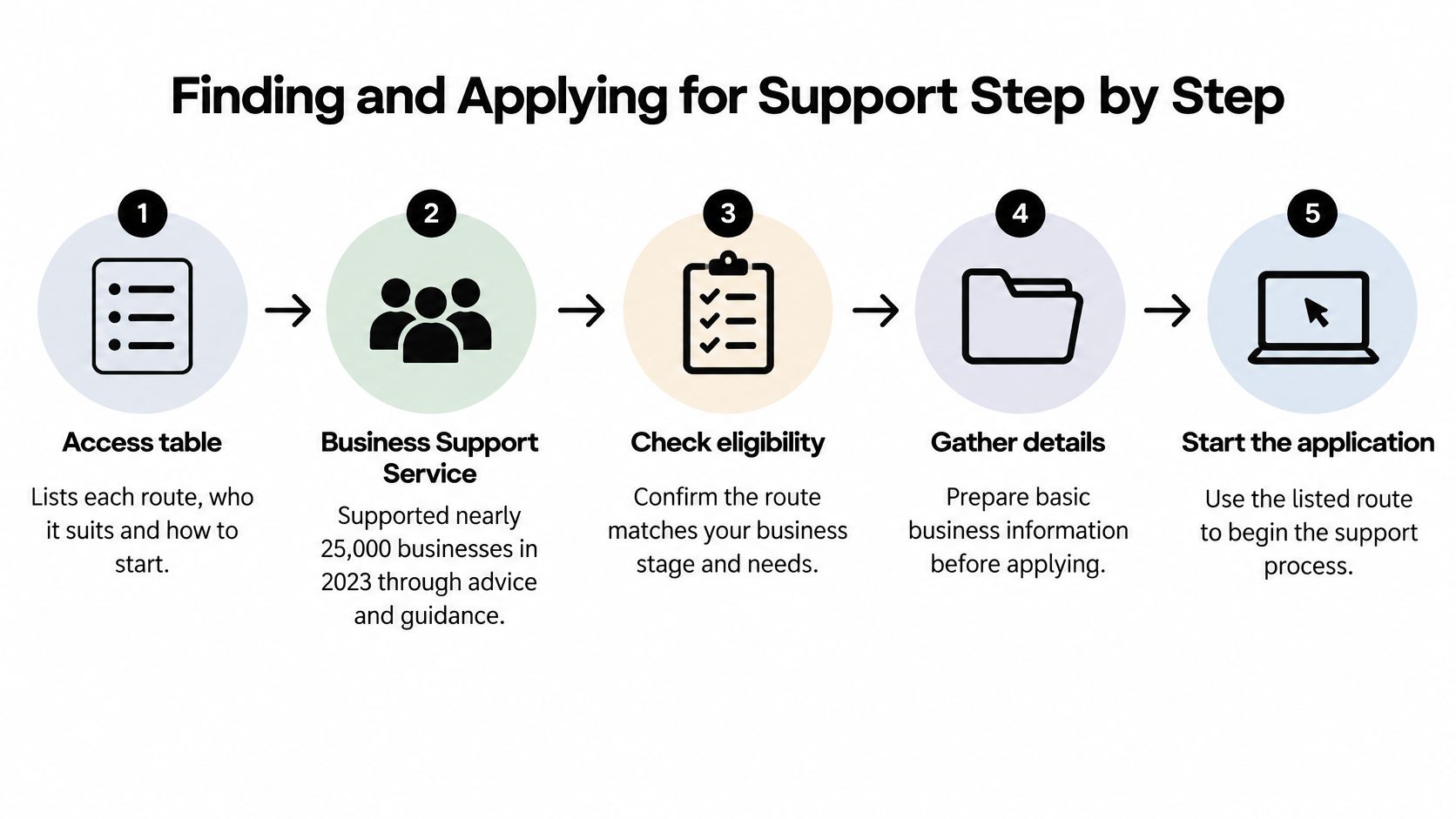
Build an application someone can assess
Define the problem in a sentence. Say whether you need working capital, help with compliance, a growth decision or a particular skill. “We need to cover supplier payments until contracted customers pay” is more useful than “We need funding”. The common slip is applying widely before establishing what success would look like.
Shortlist routes that solve that problem. Compare the service offered, likely obligations and application effort. Don't treat a directory entry as proof that a scheme is open or suitable. A grant for equipment won't pay unrelated operating bills.
Confirm eligibility before preparing the full submission. Check location, trading history, sector, applicant conditions and permitted use of funds directly with the provider. Ask about unclear requirements in writing. The avoidable mistake is relying on an old summary instead of current programme terms.
Gather evidence that supports the forecast. Prepare bank statements, current accounts or bookkeeping reports, expense documents and a cash-flow forecast for the period requested. Tie projected income to contracts, orders or clearly labelled assumptions. A spreadsheet with unexplained sales growth isn't persuasive evidence.
Submit and manage the follow-up. Save the application, supporting files and acknowledgement together. Log the expected decision date, your own response deadlines and any missing information. Applicants can undermine an otherwise sound case by overlooking a clarification request.
Record the outcome and its reasons. Keep approval conditions or rejection feedback alongside the submission. Correct the specific weakness before applying elsewhere, rather than sending the same unsupported case again.
Where mentoring accompanies finance, use it to challenge assumptions about customer demand, pricing and capacity. The money may enable the purchase; the adviser should help you decide whether that purchase makes sense.
Tax Records and Evidence Lenders Expect
The 2025 Administrative Burdens Advisory Board annual report highlights a revealing contrast: 76% of small businesses said managing tax affairs was easy, while 57% of respondents to the board's survey believed the legislative burden of tax compliance had worsened. These aren't interchangeable measures. Finding a task manageable doesn't mean it consumes little time or carries little uncertainty.
For founders, the practical question is whether another person can follow a transaction from the original document to the accounts. A bank payment proves money moved; it may not explain what you bought or how the expense should be treated.
Receipt review is part of that evidence chain, whether you work at a kitchen table or in an office.

Make each transaction traceable
- Capture the original document: Photograph the complete receipt while it's readable, or save the supplier's digital invoice. Include the supplier details and item breakdown rather than just the total.
- Explain gaps: Request a replacement for a missing receipt. If that's unavailable, preserve alternative evidence and record what happened; ask your accountant whether the expense and any tax treatment are supportable.
- Review sensitive fields: Check VAT treatment, business versus personal use, foreign currency and potential duplicates. Extracting text accurately doesn't establish the correct accounting treatment.
- Reconcile the payment: Match the document to the bank or card entry, including refunds and supplier credits. Keep an audit trail when correcting an entry.
Keep records for the retention period applicable to your business and tax obligations, with longer retention where required by an unresolved issue. The HMRC record-keeping guide provides a practical starting point; confirm the current rules for your circumstances before deleting anything.
Preserve control with or without automation
A folder-and-spreadsheet process can work if you apply it consistently, back it up and reconcile it. Accounting software can reduce copying and make review easier, but it won't rescue an unattended queue of uncertain transactions.
Treat your records like a flight log. Nobody should have to reconstruct the journey from memory when someone asks what happened.
For a lender, a coherent expense trail helps explain historical costs and forecast assumptions. For an accountant, it reduces unanswered questions before filing. Neither needs a polished dashboard as much as they need records that are complete, accessible and internally consistent.
Where Automation Fits in Your Support Stack
Automation belongs underneath professional advice, not above it. An accountant needs usable transaction records, and a mentor needs a credible view of spending before discussing capacity or pricing. The administrative layer should make that information available without creating another system you struggle to maintain.
The everyday test is whether documents get captured while you're doing the work.

Automate collection and preparation
Snyp is one option for this record layer. It accepts receipts and related documents through WhatsApp, email forwarding or direct upload in JPEG, PNG and PDF formats. Its context-aware extraction identifies merchant, amount, date, tax, currency and category, then syncs results with Xero and QuickBooks for reconciliation and review.
Say a contractor buys materials during a site visit and receives a supplier invoice later by email. They photograph the shop receipt, forward the invoice, and review the extracted entries before approval. The useful change is more than faster typing: both documents enter an organised workflow instead of remaining in a van or inbox.
When comparing accounting software for startups, check where document capture ends and bookkeeping begins. Confirm whether your chosen tools transfer attachments, handle corrections and preserve enough detail for your accountant to review the result.
The workflow demonstration gives a more concrete basis for assessing fit.
Keep judgement with the right person
Receipt automation doesn't replace tax advice, a mentor's commercial judgement or a funder's assessment. Personal expenditure, unusual tax treatment and ambiguous supplier documents still need a human decision. Assign someone to resolve exceptions rather than letting uncertain entries accumulate.
The service includes safeguards for documents and account data throughout the workflow. Before adopting any connected tool, also review permissions, staff access, export options and what happens when you disconnect an accounting integration.
Use the available trial to test a representative batch of your own documents. Judge the result by extraction quality, correction effort and the usefulness of the accounting sync, not by how impressive the demonstration looks. If your real bottleneck is collecting receipts from staff, test that behaviour too.
Choose Your First Support Action
First actions and checkpoints for each business stage
| Stage | First action | Support to use | Check by |
|---|---|---|---|
| Idea and pre-launch | Forecast costs and identify the cash needed to launch | Business Support Service advice | Before registering or borrowing |
| Launch | Open a separate account and establish receipt capture | Accountant, plus Start Up Loans if suitable and eligible | At a scheduled monthly review |
| Growth | Track margin per product or service and monitor VAT registration obligations | Mentor or peer network | At a scheduled monthly review |
| Scale-up | Build an investment or borrowing case from reliable accounts | Finance adviser and relevant British Business Bank routes | At a scheduled quarterly review |
These are suggested review habits, not programme rules. The right first action protects you from the most immediate risk at your stage: committing money before testing demand, losing track of transactions, selling unprofitable work or expanding without a defensible financing case.
A stage-based checklist can help you keep that choice focused.
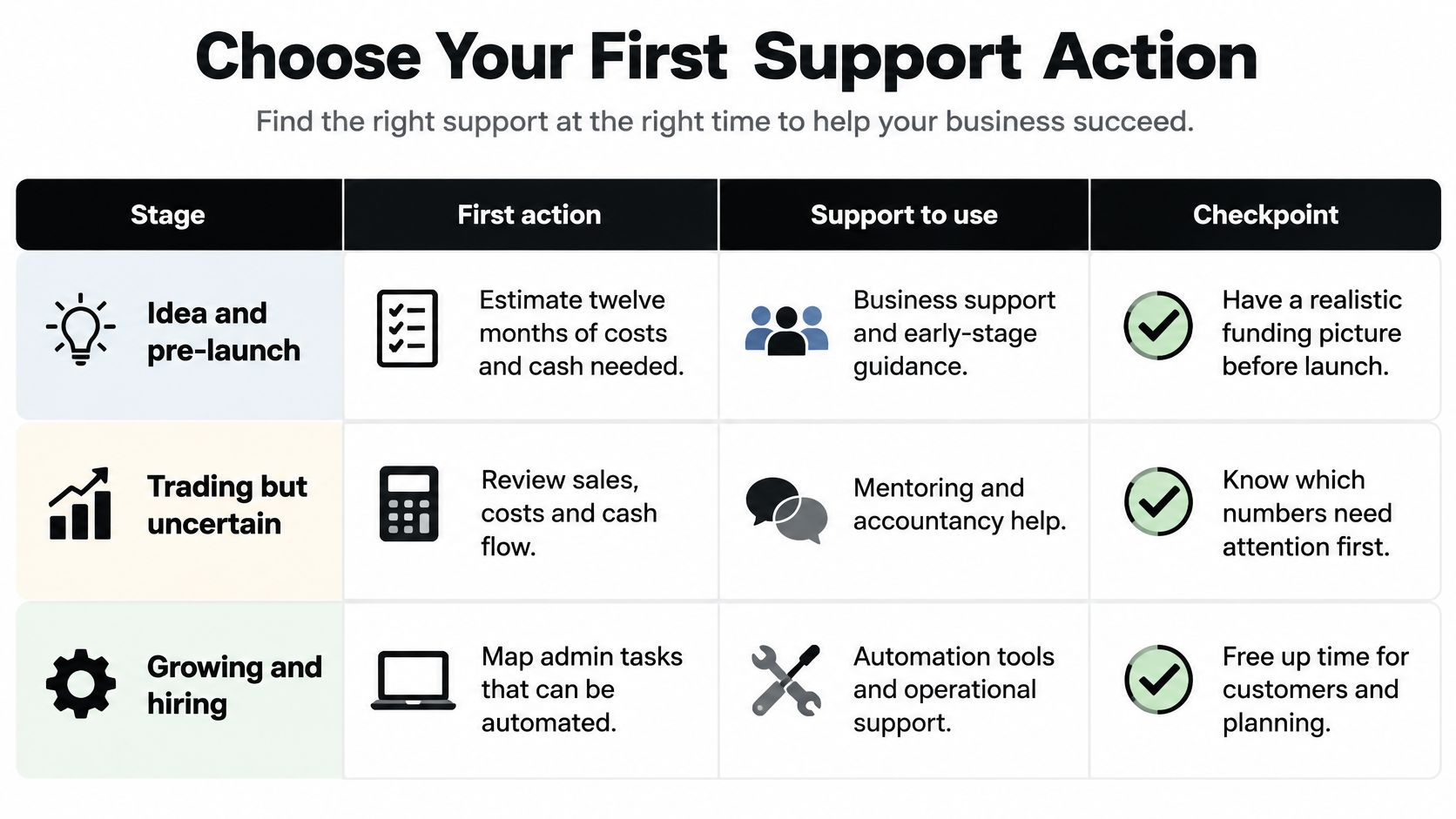
Build access deliberately when you lack introductions
Access isn't equal. Parliamentary evidence discussed in the GEM UK entrepreneurship report reports that 17% of women-led businesses were discouraged from applying for finance, compared with 7% of male-led businesses. Better documents can strengthen an application, but they can't eliminate structural discrimination or replace access to useful networks.
If you don't have family money or an experienced founder to call, treat public advice and mentoring as deliberate sources of practical access. Ask for a named adviser and describe the decision you need help making. Request an introduction to the relevant specialist rather than a general list of organisations.
After rejection, ask for written reasons and distinguish between an eligibility problem, an affordability concern and missing evidence. Each requires a different response. Don't assume a rejection means every route is closed, but don't keep applying without understanding what would need to change.
A useful adviser doesn't merely suggest another application. They help you decide whether applying again is sensible.
Choose an action you can finish
I would start with the cheapest action that removes uncertainty. That could mean requesting a mentoring appointment, confirming eligibility for a funding route or establishing a reliable receipt habit. Set a completion date and define the result you expect.
Use clear triggers to change course:
- Cash won't cover upcoming commitments: Contact an adviser before payments are missed, update the forecast and prioritise essential obligations. Don't wait for a lender's decision to investigate the shortfall.
- A rejection remains unclear: Ask the provider to explain its reasons, then review them with someone independent before submitting another application.
- Sales approach the VAT registration threshold: Check current GOV.UK rules with your accountant, including how turnover is measured, and assess the effect on prices, cash flow and records.
At your chosen checkpoint, ask whether the support reduced the original risk. Did you identify an affordable funding route, clarify a tax obligation or make records available without a weekend of reconstruction? If not, change the service or narrow the task rather than renewing the same arrangement automatically.
Support works when it changes what you can decide or do. You don't need every programme, adviser and application at once. You need a clear problem, appropriate evidence and someone accountable for the next move.
Snyp offers receipt capture through WhatsApp, email and file upload, with structured expense data synced to Xero and QuickBooks. If scattered documents are delaying your accounts or finance preparation, visit Snyp and use the trial to test the workflow with your own receipts.