




UK Small Business Accounting and Bookkeeping Services
62% of UK small businesses surveyed were owed money from unpaid invoices, according to the QuickBooks Small Business Late Payments Report 2025. That makes bookkeeping more than a tax chore. It's how you distinguish money you've earned from money you can spend.
Good small business accounting and bookkeeping services should give you reliable records, clear responsibilities and enough warning to act before cash gets tight. The right package isn't necessarily the most extensive. It's the one that matches your transactions, your reporting obligations and the decisions you need help making.
What Each Accounting and Bookkeeping Service Covers
| Service | What it covers | Typical frequency | Who usually buys it |
|---|---|---|---|
| Bookkeeping | Recording, categorising and reconciling transactions | Weekly or monthly | Sole traders and microbusinesses |
| Receipt and expense capture | Collecting receipts and turning them into structured expense records | Continuous | Contractors and field service businesses |
| VAT returns | Calculating VAT from ledger data and submitting through MTD-compatible software | Quarterly for businesses on quarterly reporting | VAT-registered businesses |
| Payroll | Pay runs, PAYE and National Insurance records | Each pay run or monthly | Businesses with employees |
| Management accounts | Monthly profit and loss and balance sheet with commentary | Monthly | Growing companies that need a current view |
| Year-end accounts and tax returns | Statutory accounts where applicable, plus Corporation Tax or Self Assessment | Annually | Limited companies and self-employed owners |
| Advisory and fractional finance | Forecasting, pricing reviews and cash planning | Monthly or ad hoc | Scaling firms without a full-time finance lead |
HMRC's customer-group figures identify approximately 5.1 million small businesses in the 2024–25 tax year, representing around 93% of all UK businesses. Their needs range from keeping a sole trader's expenses organised to running a growing company's finance function.
Start with the records
Bookkeeping produces a clean ledger, the organised record of your business transactions. The bookkeeper categorises payments, records sales and reconciles accounts, meaning they check that the ledger agrees with supporting bank and other account records.
Receipt and expense capture supplies the evidence behind those entries. Your deliverable should be more useful than a folder of photographs: each document should be retrievable and connected to the relevant expense.
VAT work turns reviewed records into a return for approval and submission. Ask whether the service includes checking VAT treatment and resolving queries, rather than pressing submit.
Payroll produces payslips, payroll calculations and associated reporting records. You still need to supply approved information about starters, leavers, pay changes and working arrangements.
Add interpretation and planning
Management accounts give you a current profit and loss report, balance sheet and explanation of significant movements. A useful commentary explains why margins changed or customer balances increased, not merely whether sales rose.
Year-end services produce annual accounts and the relevant tax return. Limited company statutory accounts and a sole trader's business accounts aren't interchangeable, so make sure the engagement describes your business structure correctly.
Advisory or fractional finance support adds forecasts, pricing analysis and financial leadership without employing a full-time finance director. Expect recommendations and decisions to discuss, not just another dashboard.
For a straightforward sole trader, recurring bookkeeping and annual accounts and tax support are a sensible starting point. Growing firms may need management accounts before they need senior financial advice. Buying a service doesn't determine who performs every task: you can keep work in-house, outsource it or share responsibility.
In-House, Outsourced and Hybrid Delivery Compared
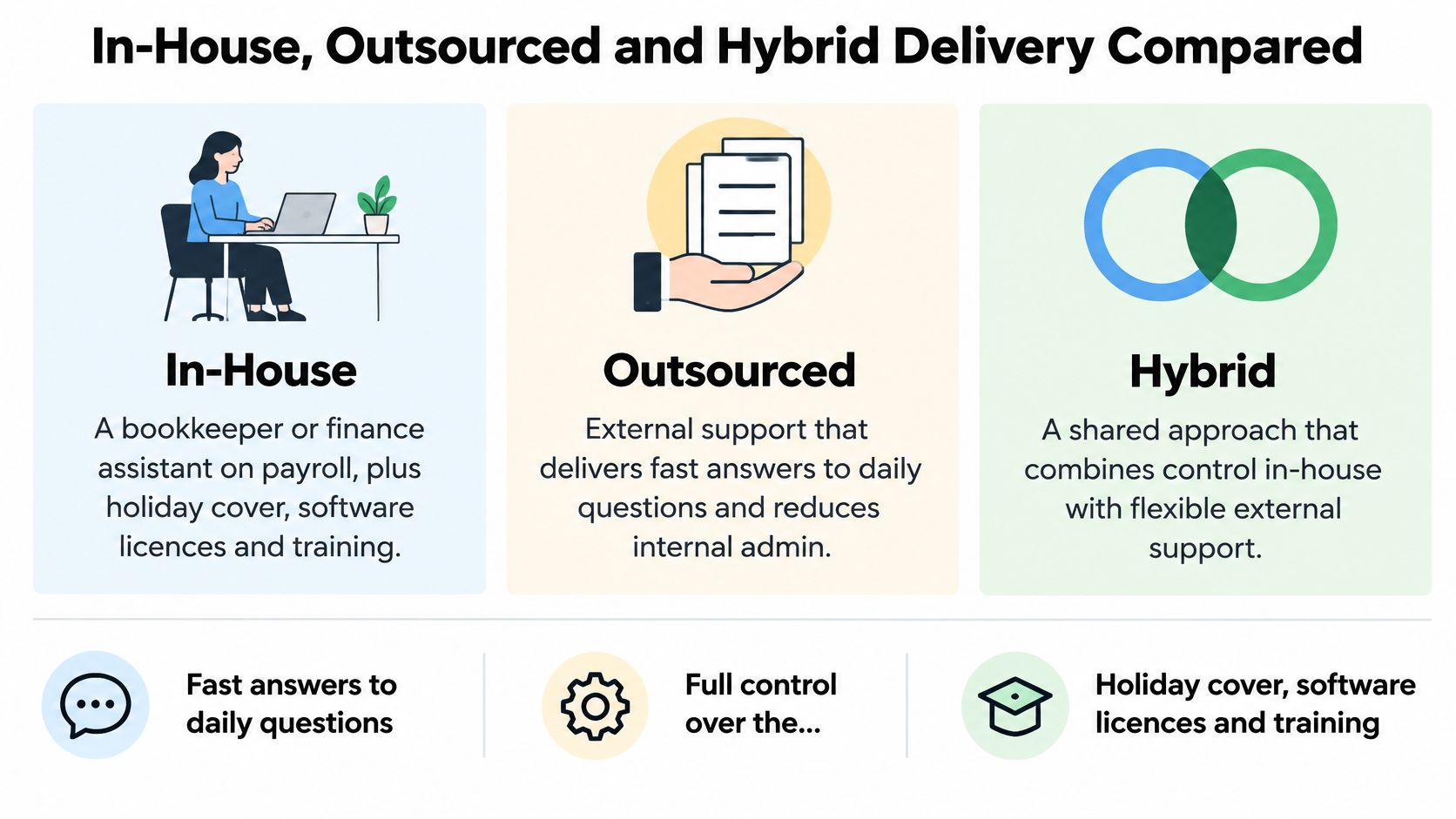
An in-house bookkeeper or finance assistant works within your business and can answer everyday questions quickly. They can investigate a supplier query alongside the person who placed the order and maintain close control over the ledger.
The commitment goes beyond salary. You'll need holiday cover, software licences, training and supervision, and employment costs continue through quiet trading periods.
The main delivery choices look like this:
What you gain and give up
Outsourced delivery means engaging an accounting firm or freelance bookkeeper for an agreed scope. You can buy specialist payroll or VAT support without creating an internal role, although minimum commitments and notice periods can limit flexibility.
External support doesn't guarantee immediate answers. Response times depend on the engagement and the provider's workload, while late documents from you can delay completion regardless of their capacity.
Hybrid delivery divides the work deliberately. An owner or office manager captures documents and approves unusual purchases, while an external bookkeeper maintains the ledger and an accountant reviews reporting and handles year-end work.
This often suits businesses that want operational control without employing an entire finance team. It fails when both parties assume the other is investigating missing information.
Payroll also needs a boundary between calculating pay and advising on employment matters. If you're deciding which people-related responsibilities to retain, HR Management 365's guide to outsourced HR options for small businesses provides a separate resource for that decision.
Pay for judgement, not repeated typing
In HMRC's Making Tax Digital evaluation, 67% of UK businesses using compatible software believed it reduced the likelihood of mistakes in at least one record-keeping area, while 80% found it easy to use. Those are reported experiences, not a guarantee that software makes every entry correct.
With linked digital records, a professional can spend less time re-keying receipts and more time resolving exceptions: an unexplained transfer, missing supplier evidence or uncertain VAT treatment.
Practical rule: Automate routine processing, but assign a person to every unresolved exception.
Before agreeing a model, establish:
- Ledger access: Who can view, enter and amend transactions?
- Approval authority: Who approves unusual entries and submissions?
- Correction history: Can you see who changed an entry, when and why?
- Cover arrangements: Who takes responsibility when the usual contact is unavailable?
How Pricing Models Work and What Drives the Bill
| Pricing model | How you are billed | Best suited to | Watch for |
|---|---|---|---|
| Hourly rate | Per hour of bookkeeper or accountant time | Owners with irregular, low volumes | Open-ended bills when records are messy |
| Fixed monthly package | Flat fee tied to a volume band | Sole traders and steady microbusinesses | Overage charges once volume passes the band |
| Per transaction or per document | Fee per bank line or receipt processed | Businesses with predictable receipt flows | Costs climbing in receipt-heavy months |
| Project fee | One fee per task, such as year-end accounts | Owners who only need annual filing | Backlog and corrections billed separately |
| Retainer with named accountant | Monthly fee for ongoing support, VAT review and advice | Growing firms that want forecasting | Scope creep unless deliverables and response times are written down |
Compare scope before comparing price. An annual filing service and a monthly bookkeeping package solve different problems, even when both are sold as accounting support.
Hourly billing can suit occasional help, provided the provider gives an estimate and seeks approval before exceeding it. Fixed packages offer budget certainty only when the transaction allowance and exclusions are clear.
What increases the workload
Additional bank accounts create more balances to reconcile. More receipts create more documents to process, and payment platforms can introduce fees, refunds and settlement differences that need separate attention.
VAT work adds review and submission tasks. Payroll costs reflect not just headcount but changes such as new starters, variable pay and corrections. Historic records can require a separate clean-up project before routine work begins.
Say a contractor has sales flowing through a bank account, card processor and online marketplace. The workload isn't captured by counting customer invoices alone: someone must also account for processor deductions and match settlements.
A low headline package may exclude Xero or QuickBooks subscriptions, year-end accounts, VAT returns or clearing unreconciled items. Use this guide to how much bookkeeping costs to frame the comparison, then obtain a written quote based on your own records.
A fixed fee is only predictable when the provider defines what sits inside it.
Questions to put in writing
- Transaction definition: Does a transaction mean a bank line, an invoice, a receipt or each accounting entry?
- Software inclusion: Which subscriptions and document allowances are included?
- Historic work: Are backlog clearance and corrections quoted separately?
- Volume changes: What happens to the fee if activity doubles?
- Advice allowance: What support is included before an additional charge applies?
Also ask who owns the software subscription. A convenient bundled licence can become an awkward handover if access arrangements aren't agreed before you leave.
How Receipt Capture Feeds Xero and QuickBooks
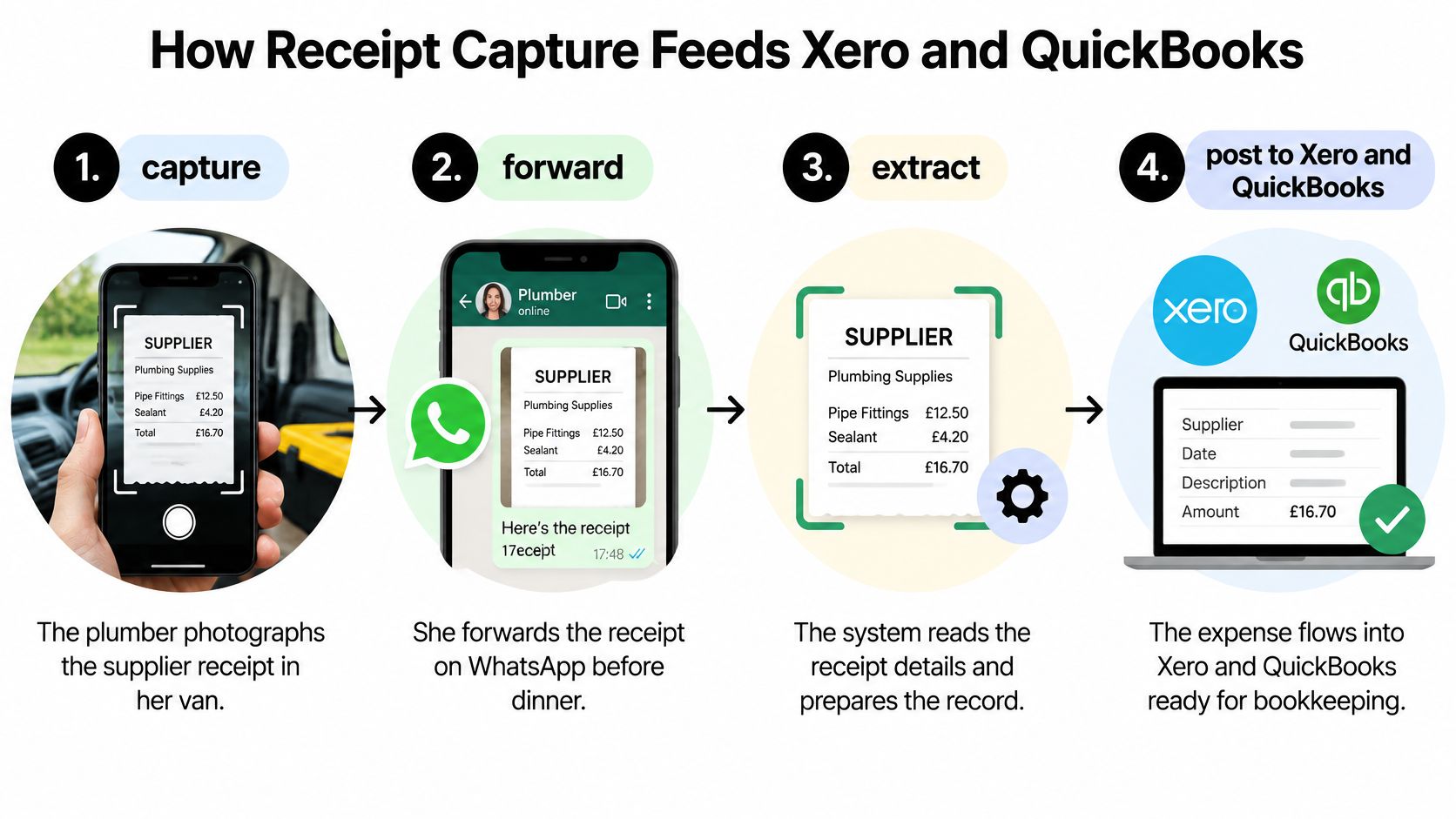
Say a self-employed plumber photographs a supplier receipt in her van and forwards it through WhatsApp before dinner. Instead of asking her accountant to interpret an isolated photograph later, she uses a capture workflow that prepares a structured record for review.
The visual below shows the broad journey from receipt to accounting platform:
Follow the document through the ledger
- Capture the evidence. Send the receipt through a supported WhatsApp route, forward the email or upload a JPEG, PNG or PDF.
- Extract the fields. The capture tool reads the merchant, amount, date, tax, currency and proposed category.
- Review uncertain details. The owner checks an unclear total, mixed-use purchase or unfamiliar supplier before approval.
- Sync the record. Send it to Xero or QuickBooks as the appropriate expense or bill, using the supported integration settings.
- Match the payment. The bookkeeper connects the entry with the bank-feed transaction and reconciles it, avoiding a duplicate expense.
- Review exceptions. At month end, the accountant checks unresolved items and significant accounting treatments.
The distinction between a bill and a payment matters. A bill records what you owe a supplier; the later bank payment settles that liability rather than creating another purchase.
The accompanying video offers a further look at the workflow:
Measure the work saved
HMRC's wider-benefits assessment estimates that UK VAT businesses using fully compatible MTD software save between 26 and 40 hours per business each year on business-finance and record-keeping activities; it also reports that 58% of businesses experienced faster VAT-return completion. Those findings concern the wider software workflow, not a promised saving from a particular receipt tool.
When evaluating a capture option, check how documents and categories reach your ledger. This explanation of receipt integration with Xero can help you identify what to test with your accountant.
Keep the review stage. An incorrectly treated equipment purchase can distort reported profit, while an unsupported VAT entry can require correction. Track unresolved receipts, duplicate entries and time spent reconciling, rather than treating a successful sync as proof that the books are right.
Making Tax Digital Thresholds and Estimated Costs
Making Tax Digital for Income Tax requires qualifying sole traders and landlords to use compatible software, maintain digital records and send quarterly updates. Don't confuse the tax year used to assess qualifying income with the date mandatory reporting begins.
For deadline decisions, use HMRC's eligibility guidance and confirm your position with your accountant. Historical implementation cost estimates are useful for budgeting, but they aren't a substitute for checking your actual commencement date.
Understand what HMRC estimated
HMRC's Income Tax policy assessment estimated average transitional costs of approximately £285, with £115 in additional annual costs, for businesses above £50,000 qualifying income; for the £30,000 to £50,000 cohort, it estimated approximately £350 initially and £110 annually.
The table separates those historical cost cohorts from commencement information so that an assessment year isn't mistaken for a filing deadline.
| Qualifying income band | Phase start | Estimated set-up cost | Estimated annual cost |
|---|---|---|---|
| Above £50,000 | Confirm commencement through HMRC's eligibility guidance | Approximately £285 in the cited HMRC assessment | Approximately £115 in the cited HMRC assessment |
| £30,000 to £50,000 | Confirm commencement through HMRC's eligibility guidance | Approximately £350 in the cited HMRC assessment | Approximately £110 in the cited HMRC assessment |
| £20,000 to £30,000 | Confirm commencement through HMRC's eligibility guidance | Not stated for this cohort in the cited assessment | Not stated for this cohort in the cited assessment |
These are estimated compliance costs, not accounting-service quotations. They shouldn't be presented as a provider's fee, a software price or a guaranteed ceiling on your expenditure.
Transition work can include selecting software, setting up records and learning a different reporting routine. Continuing work includes maintaining the records and preparing updates, with professional fees determined by your agreed service scope.
Compare the whole reporting arrangement
Ask a prospective provider to distinguish initial onboarding from recurring bookkeeping and submission work. If quarterly updates are included in a monthly package, don't automatically add an estimated compliance cost on top as though it were a separate invoice.
Equally, don't assume a software subscription includes professional review. Someone must still resolve uncertain business expenses and verify that the records are ready for reporting.
Use this guide to Making Tax Digital thresholds to organise your questions. Ask the accountant to confirm the relevant income measure, your start date and who will authorise and submit each update.
Bookkeeping as Cash Flow Control
Unpaid invoices aren't available cash. A business can record a profitable sale and still lack the money needed to pay a supplier because the customer hasn't paid.
That's why bookkeeping should support decisions throughout the trading cycle, not merely produce tidy records after it ends. The useful question is whether your finance support helps you act on overdue income, approaching commitments and unexpected spending.
| Task | Who handles it | How often | Owner approves |
|---|---|---|---|
| Chasing unpaid invoices | Bookkeeper flags, owner chases | Weekly | Write-offs and payment plans |
| Matching incoming payments to invoices | Bookkeeper | Weekly | Partial or unexplained payments |
| Categorising receipts and expenses | Bookkeeper | Weekly or as received | Unusual or high-value items |
| Mixed personal and business purchases | Owner, with bookkeeper review | Monthly | Every disputed item |
| Rolling cash forecast | Accountant | Monthly | Assumptions on income and costs |
| VAT and quarterly MTD submission | Accountant or bookkeeper | Quarterly where applicable | Final submission |
Separate balances from spending decisions
Your bank balance shows the money currently in that account. It doesn't, by itself, tell you what's safe to spend after supplier commitments, wages and tax provisions.
A bookkeeper should identify unmatched receipts and overdue customer balances. An accountant can use those records to prepare a rolling forecast, while you supply information about likely customer delays, planned purchases and work that may not proceed.
Say a design studio expects a customer payment before its next payroll. The forecast should show what happens if that payment arrives late, rather than treating the invoice due date as a certainty.
Cash-control test: Can you explain which expected receipts will fund the next set of committed payments?
Keep commercial judgement with the owner
Automation can create false confidence when a dashboard looks complete but contains unreconciled entries. A customer receipt matched to the wrong invoice may leave the wrong customer on the chasing list, while an unrecorded supplier bill understates commitments.
The owner must approve write-offs, payment plans and disputed personal purchases. Those choices involve customer relationships, recoverability and business purpose, not just categorisation.
Agree an escalation route too. If a missing payment threatens an important commitment, the bookkeeper shouldn't wait for the next routine report to tell you.
How to Choose a Provider That Fits Your Records
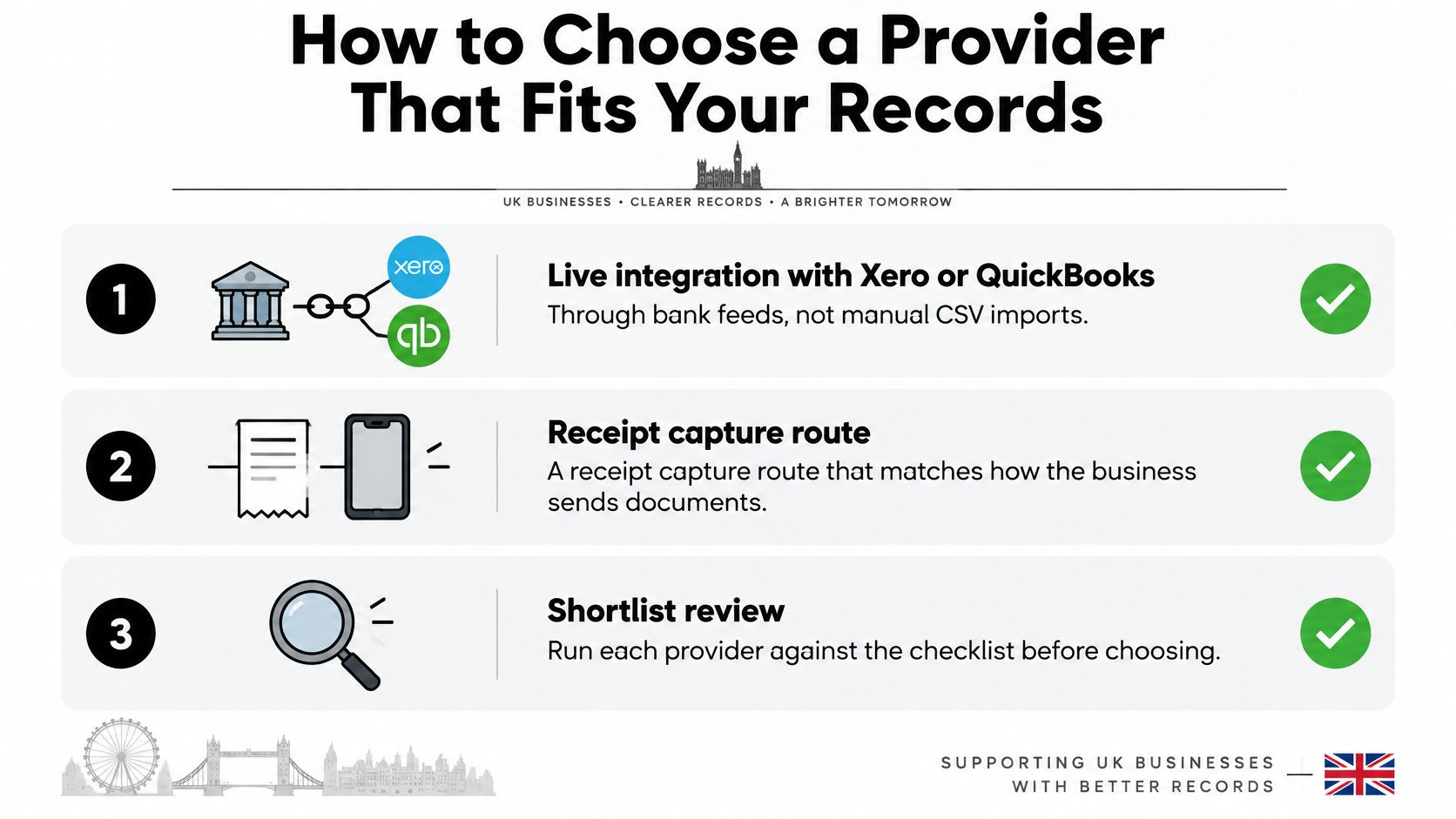
Choose a provider by testing how they handle your actual records, not by comparing polished dashboards. A tradesperson sending receipts from a phone needs a different collection process from an office team raising purchase orders.
Use the following visual as a starting point for your shortlist:
Test the working relationship
- Live integrations: Ask them to demonstrate bank feeds and Xero or QuickBooks connections, explaining where manual imports remain necessary.
- Document collection: Choose a supported WhatsApp, email-forwarding or upload route that matches how you already send receipts.
- Audit trail: Confirm you can inspect changes and their authors so corrections remain understandable.
- Named contact: Get a primary contact, cover arrangements and a written response expectation.
- Professional credentials: Verify relevant ICAEW, ACCA or AAT membership and the experience of the person responsible for your work.
- Tax capability: Ask who handles VAT and MTD for Income Tax, including difficult queries outside routine processing.
- Security and exit terms: Check access controls, document storage, data ownership and the ability to export your ledger and supporting records.
- Complete pricing: Require explicit treatment of software, onboarding, backlog clearance, annual work and additional advice.
Membership is a useful check, but it doesn't replace assessing relevant experience. A provider familiar with straightforward consultancy businesses may need additional expertise for stock, overseas transactions or complex payment platforms.
Look for practical red flags
Be cautious if there's no written scope, if the quoted price covers only a basic tier that excludes your requirements, or if you can't access your own ledger. Reluctance to explain how records leave the system is another warning sign.
Ask the provider to demonstrate how they would resolve an unclear transaction. Their questions will tell you more about their working method than a promise of hands-off accounting.
Start Your Readiness Plan This Quarter
A photograph in a camera roll is evidence waiting to be organised, not a complete reporting process. HMRC's MTD for Income Tax eligibility guidance explains the requirements for compatible software, digital records and quarterly updates, alongside how to establish whether and when you must join.
Turn preparation into assigned work
- Map the incoming records. List WhatsApp photos, email attachments, paper receipts, customer invoices and bank statements, including documents held by other people.
- Choose a capture route and reviewer. Give routine documents a consistent destination and name the person responsible for checking incomplete entries.
- Agree approval boundaries. Leave routine categorisation and reconciliation with the bookkeeper, while reserving disputed personal purchases, write-offs and significant spending decisions for the owner.
- Test providers on your records. Ask shortlisted firms to process a representative month and explain missing evidence, unresolved items and the proposed handover.
Preparation and mandatory participation are separate decisions. You can improve your records voluntarily before you're required to use MTD, but check your own position rather than assuming that another business's deadline applies.
Keep the document map, responsibilities, approval rules and provider questions together. That gives your chosen professional a usable handover instead of another collection of scattered messages.
Snyp offers receipt capture and categorisation through WhatsApp, email forwarding and file uploads, with structured expense data sent to accounting platforms including Xero and QuickBooks. Visit Snyp to explore whether it fits the document-collection stage of your bookkeeping process, then agree with your bookkeeper who will review and reconcile the results.