




Pricing and Promotion: How They Work for Small Businesses
A UK government review of grocery pricing found that promotions accounted for approximately 40% of retail grocery market expenditure, measured using Kantar Worldpanel data (the review of supermarket pricing). Four pounds in every ten spent at the till moved through a temporary price cut, a multi-buy or some other offer. Discounting wasn't an occasional event layered on top of normal trade. It was the normal trade.
Small businesses run the same experiment at a smaller scale, usually without analysts. A discount feels like a marketing decision. It's a cash decision: how much arrives, when it arrives, and whether the person who paid it comes back at the full rate.
Treat pricing and promotion as one system and the questions sharpen. What does each sale contribute before the offer? How many extra sales does the discount need just to stand still? And what does a customer learn about your prices once the offer disappears?
Pricing Sets the Baseline, Promotion Changes the Deal
Think of a shelf in a shop. The number on the label is a promise about what the item costs on any ordinary Tuesday. A promotion amends that promise for a fixed window and attaches a reason to buy now: a launch, a quiet fortnight, stock that needs to move. The shelf price is the baseline. The offer is the deviation. Both come out of the same pocket.
Pricing and promotion act on the same profit line, which is why changing one without looking at the other causes trouble. A base price change is permanent until you reverse it. A promotion ends by design, so its cost is spread over a short period and hides easily inside a monthly total.
Five levers standing side by side
Most owners believe they have one pricing decision. They have five, and the five interact.
| Lever | What it sets | Typical small-business use | Main risk |
|---|---|---|---|
| Base price | The normal rate customers expect to pay | The core offer, every day | Undercharging for good work |
| Promotion | A temporary change to the offer | Launches, quiet weeks, clearing stock | Customers learn to wait for offers |
| Bundle | Several items or services at one price | Raising average order value | The per-item price becomes hard to see |
| Member or loyalty price | A lower rate for repeat or registered customers | Retaining recurring clients | Non-members feel they are paying more for the same service |
| Payment terms | A discount or surcharge linked to when cash arrives | Speeding up invoice payment | Margin lost on early payment discounts |
Read the table as a chain rather than a menu. The base price sets the ceiling on what a single sale can contribute. Every promotion draws down from that ceiling, so the deeper the cut, the more sales you need before you're level. A bundle lifts the average order value without a visible reduction on any single line, which is why productised services often bundle better than they discount. A member price buys repeat behaviour and locks in a lower rate for people who already buy. Payment terms don't touch the headline number at all, yet a 2% early-settlement discount on a £4,000 invoice costs £80 whether or not the job made a profit.
The habit worth building: before you change any number on a price list, name the lever you're pulling and the result you expect. "Cut the retainer by 20% to win back two dormant clients" is a decision you can review. "Run an offer" isn't.
If you sell in tiers, the shape of the published list does as much work as the price. BonusQR's pricing plans show one approach, where each level adds features and the entry price stays visible, so the conversation stays on what's included rather than what's been cut.
Setting the Base Price a Promotion Draws From
Start with what a job costs, not with what you'd like to charge. A base price is only useful if it survives an ordinary month.
Take a service you sell for £100. Materials, delivery, card processing and the hours on the job come to £60. You keep £40 of contribution, a 40% contribution margin. That £40 is the ceiling. Every discount you run is paid out of it, and nothing else in the business can absorb the cost for long.
The VAT question decides what you keep
Consumer prices are usually quoted VAT-inclusive, while business buyers often expect a net figure. A price list has to state which one it shows, because the net amount is the money the business holds. Charge £100 including VAT at 20% and the sale is £83.33 plus £16.67 of tax. Cut the gross price by 20% and you keep £66.67, while your direct cost stays exactly where it was. If you're unsure how to present both versions on the same list, this guide to adding VAT to a price walks through the conversion.
Checking the margin against real overheads
Contribution isn't profit. Rent, tools, insurance, software and your own target hourly rate all come out of it. If a £40 contribution on a two-hour job leaves £20 an hour before overheads and your target is £30, the base price is wrong, and no promotion fixes a wrong base price.
Retainers make the arithmetic visible at small numbers. Charge £60 a month with £35 of direct cost and you keep £25, about 42%. Apply a 20% promotion and the fee falls to £48, contribution falls to £13, and the margin drops to roughly 27%. Twelve clients go from £300 a month of contribution to £156. The customer sees a fifth off. You lose nearly half your cash per client.
Set a review trigger in advance, such as a supplier increase that pushes direct costs past the point where contribution no longer covers overheads, and update the base price then. If printed or branded items sit inside your direct costs, how bulk discounts scale with quantity shows where the per-unit price steps down as order size grows, which beats guessing at a figure.
A promotion should never be the reason a base price is wrong.
Promotion Formats Ranked by Cash Risk
Two promotions can offer the same 20% saving but put different amounts of cash at risk. The format affects when you pay and what you give up: a referral credit is earned after a sale, while a blanket discount cuts the price on every eligible purchase.

From safest to riskiest
- Referral credits. You issue the credit after a referred sale, so the reward follows revenue. The trade-off is timing: referrals arrive when customers remember to recommend you, not necessarily when you need work.
- Prepayment incentives. A modest reduction on a retainer paid upfront brings cash in earlier. Compare the discount with the value of receiving that money sooner.
- Bundled services. A package can sell spare capacity alongside work customers already want. Set a clear package price and check that the combined workload still leaves enough contribution.
- Limited-capacity offers. Offer a lower rate for a defined number of slots during a quiet period. State the dates and limit, so the offer fills spare capacity without resetting the price for every customer.
- Partner promotions. A complementary business can share the cost and reach. Agree in writing who pays for the discount or added work before the promotion starts.
- Reactivation offers. A past client already knows your work, so an offer can encourage a new booking. Tie it to a clear start date and compare the reduced fee with the contribution you keep.
- Blanket percentage discounts. These reduce revenue on every eligible sale, including purchases that might have happened at full price. That makes them the highest-risk format.
Fixed-amount discounts depend on the job size. £25 off a £400 job is a smaller percentage cut than £25 off a £60 job, so compare the remaining contribution, not just the pounds saved. An introductory offer also needs a break-even point: it pays only if the customer's later purchases cover the cost of the trial discount.
What a small budget can actually buy
A UK marketing price analysis reports that 58% of small businesses spend less than £250 per month on marketing, while the median published price of one managed channel ranges from £358 to £799 per month (Whito's UK marketing prices report). For a small business, that gap makes it especially important to set a cash limit before choosing a promotion.
Set the ceiling before the offer: estimate the profit a new customer could bring in their first year, then decide how much of it you can spend to win them. If that profit is £600, a £150 acquisition budget leaves £450 before allowing for customers who do not return.
Choose the least generous format that can meet your goal. A business with spare capacity might prefer a time-limited offer; one seeking earlier cash might consider a prepayment incentive. For examples of value-add promotions for multi-site restaurants, see the restaurant-focused guide. Apply the same cost discipline described in small-business cost control measures: set a limit for the offer and track what it costs. Repeated discounts have another price, too. If customers learn to wait for the next deal, future full-price sales may become harder to win.
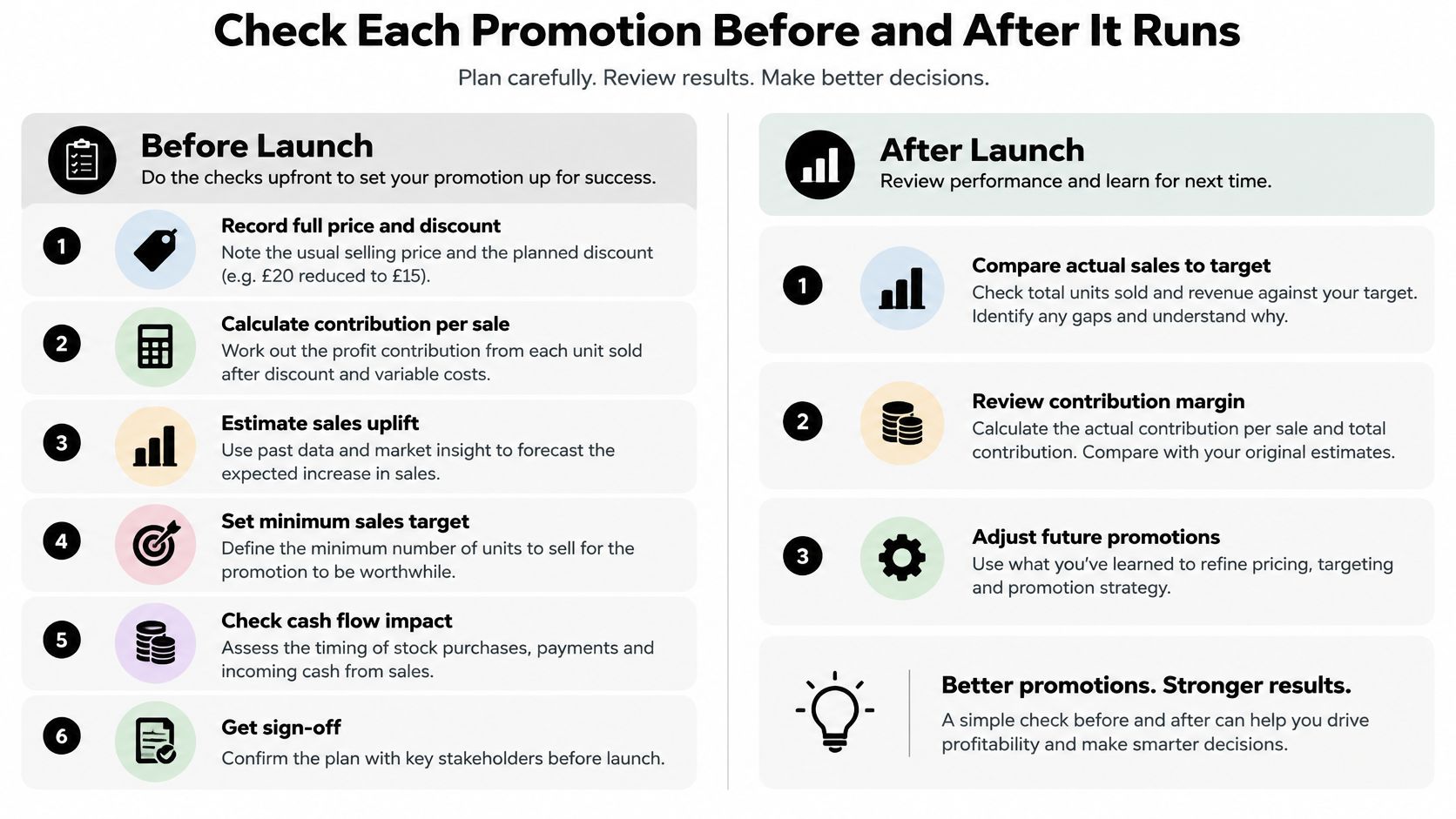
Check Each Promotion Before and After It Runs
82% of senior consumer-goods leaders believed their latest promotion was profitable, yet more than 60% of those assessments relied on personal judgement or partial analysis rather than formal, event-level profit-and-loss measurement (IPA on kicking the promotion habit). That gap hurts a sole trader more than a large brand, because there's no finance team to catch it.
Set the numbers before launch
One: write down the full price and the contribution per sale, meaning price minus direct costs. Two: list the variable costs for each sale, including payment fees, delivery, materials and staff time. Three: confirm the VAT treatment of the discounted price, because the net figure is what you keep. Four: calculate the volume rise you need to stand still. The figures below assume a 40% contribution margin and must be recalculated for your own.
| Discount | Contribution left per sale | Extra units needed to match full-price profit |
|---|---|---|
| 10% | 30% | 33% more |
| 15% | 25% | 60% more |
| 20% | 20% | 100% more (double the units) |
| 25% | 15% | 167% more |
| 30% | 10% | 300% more (four times the units) |
At a thinner margin, every discount demands a bigger rise. A business running an 80% contribution margin can fund a 20% cut far more comfortably than one running 30%.
Close the loop once it ends
Set an end date and a comparison group of customers who won't see the offer, so you can compare their sales with the offer group rather than guessing at what the discount caused. After the promotion ends, log every cost against its original receipt, including refunds and acquisition costs. Receipts can be uploaded through WhatsApp, forwarded by email, or uploaded as a file, and Snyp's receipt categorisation is built around UK expense categories and VAT rules, so the review takes minutes instead of an evening.
Keep five numbers apart: volume, revenue, gross margin, contribution and customer lifetime value. Conversion uplift isn't success on its own. A promotion that doubles orders while halving contribution per order is a loss dressed as growth. A promotion reviewed from a bank balance three weeks later is guesswork, which is why real-time financial reporting matters: it lets you stop a losing offer while it's still running.
Keeping Full-Price Customers from Waiting
Repeat discounting teaches a customer one lesson fast: your first price isn't your real price. Wait a fortnight and it'll move. Once that belief settles in, every full-price sale costs you an argument.
The warning signs show up before the bank balance does. Sales cluster almost entirely inside discount windows. Long-standing customers start asking for a code before they'll confirm a booking. The share of revenue billed at full price falls quarter after quarter, even in months with no offer running.
The sharpest test is counterfactual. If the offer vanished tomorrow, how many of last month's customers would still buy?
Four controls that protect the future price
Cap the calendar. Decide how many promotions you'll run per quarter and treat that number as fixed. Rarity is what makes an offer read as an event rather than a standing policy.
Only claim a was-price you charged. Customers who spot an inflated reference price stop trusting every future offer, and the scepticism spreads faster than the discount. The CMA's 2024 review of grocery loyalty pricing found that 40% of shoppers did not trust loyalty prices to represent genuine savings and 43% considered it unfair that members pay less than non-members, even though 69% believed loyalty pricing offered good savings (Competition and Markets Authority review). Transparency is what separates the 69% from the 40%.
End on the stated date, every time. An extension "because it's going well" tells every fence-sitter that the deadline was theatre.
Track the full-price share monthly. One number, one line in a spreadsheet. A steady decline is evidence the promotion calendar is too busy, not evidence that customers are price-sensitive.
Loyalty and member pricing need the same clarity. Say who qualifies, what the standard rate is and when the member rate is reviewed, so the discount looks like a benefit rather than a penalty for everyone else.
Pick one control and start with it this quarter. The cap is usually the easiest to hold.
Pick One Promotion and Set Its Break-Even
Choose a single promotion, not a calendar of several. One clean test teaches you more than four overlapping offers, because you can attribute what happened.
Write down the full price and the contribution per sale. Find the break-even volume rise in the table above and ask whether the offer can plausibly produce it. If the answer is no, the format is wrong, and a smaller fixed-amount discount may move the same customer.
Set the end date now, before launch. Decide which control applies, such as a cap on offers per quarter, so the next promotion can't arrive three weeks later. Name the comparison group of customers who won't see the offer.
Then record each promotion cost against its receipt as it happens, not in a panic at the end of the quarter. If receipts arrive across inboxes, WhatsApp threads and folders, a tool such as Snyp keeps promotion costs sitting next to the documents that justify them. Snyp costs £19 per month and turns a photo, a forwarded email or a file into a categorised expense, which means the review is already half written when the offer ends.
State the decision in one sentence and keep it where you'll see it: choose one promotion, set its break-even, set its end date before it goes live.
Running a promotion without the paperwork behind it is how a busy month turns into a mystery at year end. Snyp captures receipts from WhatsApp, email or a file upload and files them under UK expense categories with the VAT treatment already handled, so the costs of every offer are waiting when you sit down to review it. New accounts start with a 30-day free trial, which is enough time to test one promotion properly. Set up your next offer with the numbers already tracked at Snyp.