




On Bank Statement: What It Means and How to Use It
It's late November, your accountant is asking for the missing records, and your banking app appears to offer a simple answer. Every payment and receipt sits in a tidy list, so you download the bank statement and assume the job is finished.
Then the questions start. A payment to an unfamiliar merchant descriptor might relate to software, stationery, a personal purchase, or a supplier trading under a different name. A refund may sit several lines away from the original card payment. A transfer between your own accounts can look like sales income until you identify it as owner funding. The statement shows movement, but it rarely preserves the full commercial context.
That distinction matters for UK freelancers, sole traders and small companies. A bank statement is valuable evidence, but it isn't usually a complete receipt or expense record. The reliable approach is to connect each statement line to the document that explains it, retain the original record, and make exceptions visible before year-end.
The End of Month Reconciliation Reality Check
The last working day of the month often begins with a reassuring export. You download the business account statement, import the transactions into your bookkeeping software and watch the balance agree. On the surface, everything looks organised.
A closer review tells a different story. One card payment has a shortened merchant name. Another transaction is a round-sum transfer from a personal account. A supplier invoice arrived by email but never made it into the bookkeeping folder. The bank app shows a refund, yet the original purchase and return note are missing. None of these issues prevents the statement from balancing, but each one can weaken the evidence behind a tax entry.

What the statement does and doesn't tell you
Suppose the statement shows a debit of £217.50 to a generic descriptor. The amount and date establish that money left the account. They don't establish whether the purchase was wholly for the business, whether it included VAT, or which goods or services you bought. Those answers usually sit on the receipt or invoice, not on the bank record.
The same problem appears with money coming in. A credit might be customer income, a loan, a refund, a transfer from another account, or an injection of personal funds. Treating every credit as turnover creates a bookkeeping error before the tax return is even prepared.
Practical rule: A statement line is the starting point for reconciliation, not the finish line.
The UK's move towards electronic statements hasn't removed this problem. Research published in 2018 found that 80% of UK consumers received at least one electronic bill or statement for a financial product or utility, while 73% specifically received bank statements electronically. Earlier research still found that 42% received paper utility bills and bank statements, so businesses may need to retrieve evidence from PDFs, banking portals and physical mail (Credit Connect's review of paperless billing).
By the end of a sound reconciliation, every material line should have a classification and an explanation. Supplier payments should point to invoices or receipts, transfers should have a clear purpose, payroll should agree to payroll records, and unexplained items should remain flagged rather than being forced into a convenient category.
Reading a Bank Statement Like a Bookkeeper
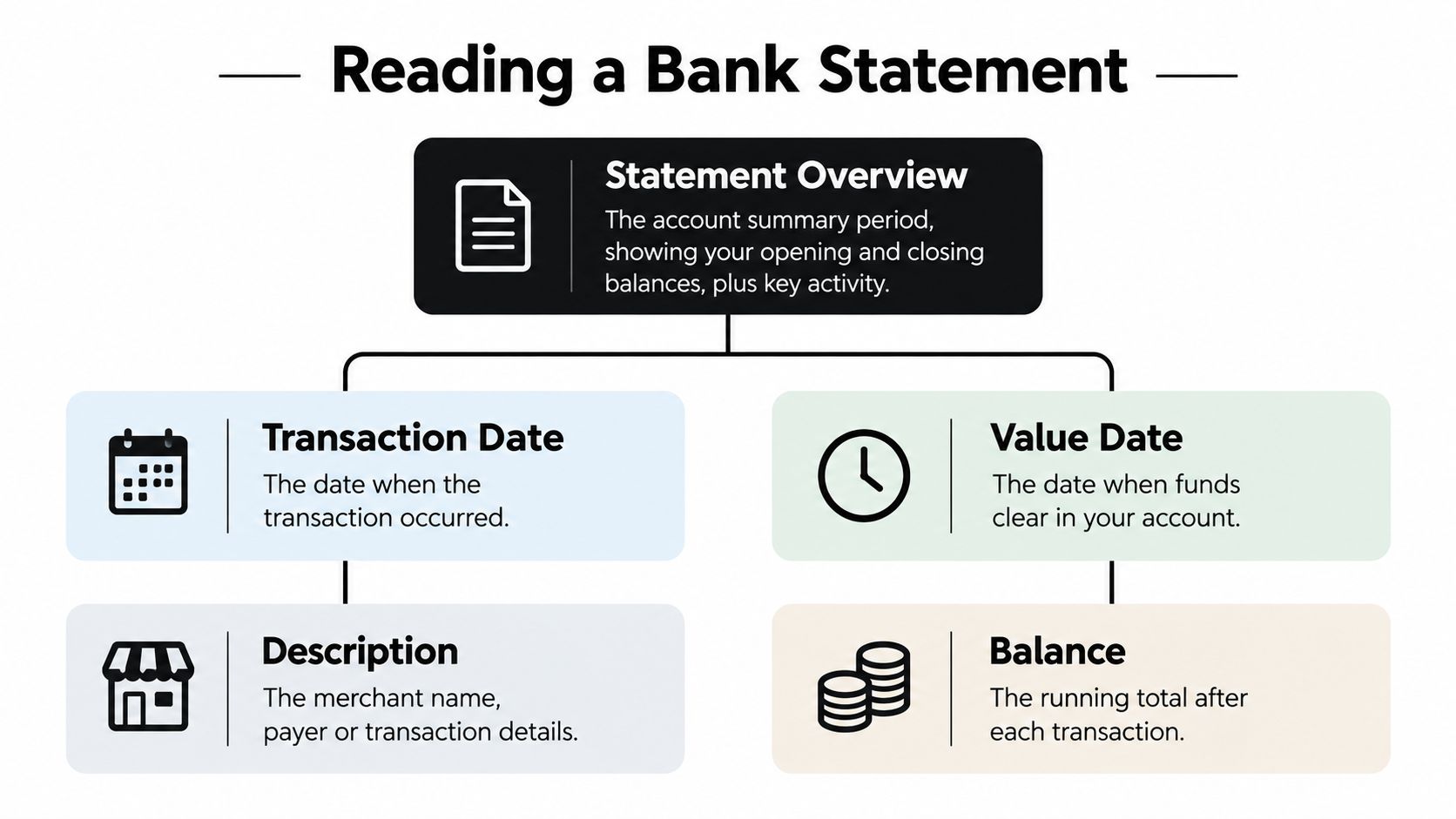
A bank statement becomes useful when you stop reading it as a list of descriptions and start reading it as a control document. Each column answers a different question, but none answers every question.
Start with the fields that establish movement
The transaction date usually tells you when the bank recorded the event. The value date indicates when funds were treated as cleared or effective for balance purposes. Those dates can differ, which matters when you're checking a month-end cut-off or matching a payment to an invoice.
The description or merchant descriptor identifies the reference supplied by the payment network, bank or merchant. Treat it as a clue. A card processor may appear instead of the retailer, a trading name may differ from the legal entity, and a recurring subscription may use an abbreviated label.
The debit and credit columns show money leaving or entering the account. The running balance helps confirm that the statement is complete and that the sequence of entries makes sense. The transaction reference can help trace a payment, particularly for BACS, Faster Payments and transfers, but it still doesn't prove the underlying business purpose.
Decode the less obvious entries
Monthly account fees, cash withdrawal charges and international transaction fees may appear under bank-specific descriptions. A BACS reference may identify the payment route rather than the supplier. Faster Payments can show a recipient reference that was entered by the sender, not a verified description of the purchase.
Card activity can be particularly misleading. A bank may display a pending authorisation, then a settled debit, or show a card processor and a later clearing entry. Do not post both entries as separate expenses just because they look different. Check the final settled amount and investigate duplicated or reversed entries.
For a more detailed explanation of the phrase FPI on bank statement, see this guide to FPI references. The practical scan is simple:
- Check the date pair: Compare transaction date and value date with the invoice, receipt or payroll record.
- Read the descriptor cautiously: Use it to locate evidence, not to replace evidence.
- Confirm the direction: Decide whether the line is income, an expense, a transfer, funding, a refund or a reversal.
- Test the balance: Look for missing pages, unexpected gaps and duplicated movements.
- Open the source document: Don't approve a category until you know what the payment represents.
Why a Bank Statement Is Not Enough for HMRC
A sole trader may reconcile every payment at month-end and still have an incomplete tax file. A bank statement proves that money moved, but rarely proves what was purchased, why it was purchased for the business, or how VAT should be treated. HMRC expects accurate, sufficient records supported by receipts, invoices, bank slips and other evidence, as set out in HMRC's record-keeping guidance.
Accounting software can make the gap harder to spot. It may suggest a category from the merchant name, amount and previous transactions, yet it cannot reliably separate a business subscription from a personal one or identify mixed-use spending. The descriptor may belong to a payment intermediary rather than the actual supplier, and the same descriptor can appear for different businesses.
The evidence gap in everyday claims
A payment to a hardware retailer confirms the debit, not the item bought. The receipt may show whether the purchase was trade tools, household goods or equipment requiring different treatment. A travel payment may need a ticket, mileage record or written business explanation. A software charge may require the supplier invoice to confirm the billing period and VAT details.
Personal accounts create another risk. HMRC may examine an account used for business activity when checking whether declared transactions are complete and credible. Using a personal current account does not remove the evidence requirement. It makes clear separation and explanation more important.
A clean bank feed can still support a weak tax file if the source documents are missing.
For HMRC's retention and format expectations, see HMRC record-keeping requirements.
Limited companies also need a durable audit trail. UK companies must retain accounting records, including relevant bank statements and supporting correspondence, for six years from the end of the relevant financial year, subject to limited exceptions, according to GOV.UK guidance on company and accounting records. A PDF stored without its invoices, receipts or explanations leaves a future reviewer reconstructing the transaction from a description that may no longer be clear.
The working standard is simple: another person should be able to trace each bank movement to its source document, accounting treatment and business purpose. A statement shows payment evidence. The supporting record establishes whether the expense can withstand an HMRC review.
Matching Statement Lines to the Right Evidence
The most dependable reconciliation process assigns an evidence type to each transaction before anyone approves the category. The document depends on the transaction, not only on whether the line is a debit or credit.
A normal supplier payment should link to the supplier's invoice or receipt. Keep the VAT breakdown where relevant, because the statement amount alone won't establish the tax treatment. If the payment covers several invoices, attach the payment allocation or mark the invoices as settled.
| Statement transaction type | Required evidence | Common mistake |
|---|---|---|
| Supplier payment | Invoice or receipt, with VAT details where relevant | Treating the merchant descriptor as the invoice |
| Card refund or chargeback | Original receipt, return note or dispute record, plus refund evidence | Recording the refund without linking it to the original purchase |
| Transfer between business accounts | Transfer reference and internal note showing origin, destination and purpose | Posting the receiving entry as sales income |
| Payroll payment | Payroll run, payslips and payment report | Categorising the bank debit as a generic wages expense |
| Owner drawing or capital injection | Director or owner record explaining the movement | Mixing personal spending with company costs |
| Loan repayment | Loan agreement or lender statement separating principal and interest | Posting the full repayment as an expense |
| Mileage or travel payment | Mileage log, ticket, receipt or business-purpose note | Relying on the bank line to prove the journey |
| Mixed-use purchase | Receipt or invoice plus a written allocation of the business share | Claiming the whole payment because it came from the business account |
| Subscription covering multiple periods | Supplier invoice and period allocation | Expensing the full charge in the payment month |
| Bank charge or foreign transaction fee | Bank advice or statement detail identifying the fee | Treating a fee and the underlying purchase as one transaction |
Transfers deserve particular care. A movement from a sole trader's personal account may be owner funding, while a transfer out may be drawings. In a limited company, money moving between the company and a director needs a clear description and the right supporting records so company finances remain separate from personal finances.
Refunds create another common trap. Match the refund to the original transaction, confirm whether the supplier issued a credit note or return confirmation, and check that the accounting software hasn't retained the original expense without adjustment. Reconciliations that only look for a matching amount often miss partial refunds and chargebacks.
For a wider view of the controls involved, this practical guide to financial reconciliation with agentcentral is useful context. In day-to-day bookkeeping, the strongest system is the one that makes the evidence relationship obvious without relying on memory.
Bookkeeping test: If you can't explain a line to someone who wasn't present at the purchase, the line isn't ready for final approval.
Reconciling Statements with Snyp and Accounting Software
A supplier asks about an old payment, but the bank feed shows only a descriptor and amount. If the invoice is still buried in email, reconciliation becomes a memory exercise. A dependable routine separates capture, matching and approval, so payment evidence and expense evidence stay connected.
Open or export the statement for the period being reviewed. Mark each line without a matched invoice, receipt, payroll record or clear explanation. Work monthly, not at tax-year end, while the purchase, supplier and business purpose are still familiar.
A repeatable capture process
- Identify the unmatched line: Record the date, amount, descriptor and account.
- Find the source: Search email, WhatsApp, cloud storage or paper files for the invoice or receipt.
- Attach the pair: Keep the statement reference and source document in the transaction record.
- Review the extraction: Compare merchant, amount, date, tax, currency and category with the original.
- Approve or flag: Approve only when the evidence supports the treatment. Leave unresolved exceptions visible.
Snyp captures receipts and related documents from WhatsApp, email forwarding or direct upload. It extracts merchant, amount, date, tax, currency and category for review, then can synchronise the structured information with platforms such as Xero and QuickBooks through its Xero integration workflow. The practical benefit is a shorter route from payment line to supporting document. The statement confirms money moved. The invoice or receipt supports what was bought and how it should be treated.
What good looks like at review time
A proper review should show matched statement lines, retained originals, flagged exceptions and consistent VAT treatment. It should identify transfers, refunds, payroll, drawings and mixed-use spending instead of hiding them under a generic expense category.
For sensitive client documents, a controlled workflow such as secure client PDFs keeps files together for review. At period-end, export the final statement PDF and lock the matched evidence pack in the accounting platform. That preserves an accessible audit trail for the applicable retention period without making the statement carry proof it cannot provide.
Automation can extract and suggest. The owner or bookkeeper must still confirm the business purpose, allocation and unusual activity before approval. A clean reconciliation is therefore more than a feed with no unmatched lines. It is a statement line linked to evidence that supports the accounting decision.
The Open Banking Reconciliation Risk Most Guides Miss
Open Banking makes account data easier to connect and import. It doesn't make every transaction self-explanatory, and it doesn't remove the risk that an authorised payment was wrong.
UK Open Banking data recorded open-banking payment fraud at 0.013% of transactions by volume in the first half of 2025, compared with 0.045% across the wider payments industry (Open Banking Limited's financial crime report). The lower rate is reassuring, but it shouldn't lead a small business to abandon review controls. The same report states that authorised push payment fraud represented 74% of open-banking fraud cases, meaning a genuine account holder can be manipulated into approving a payment.
Connectivity isn't commercial proof
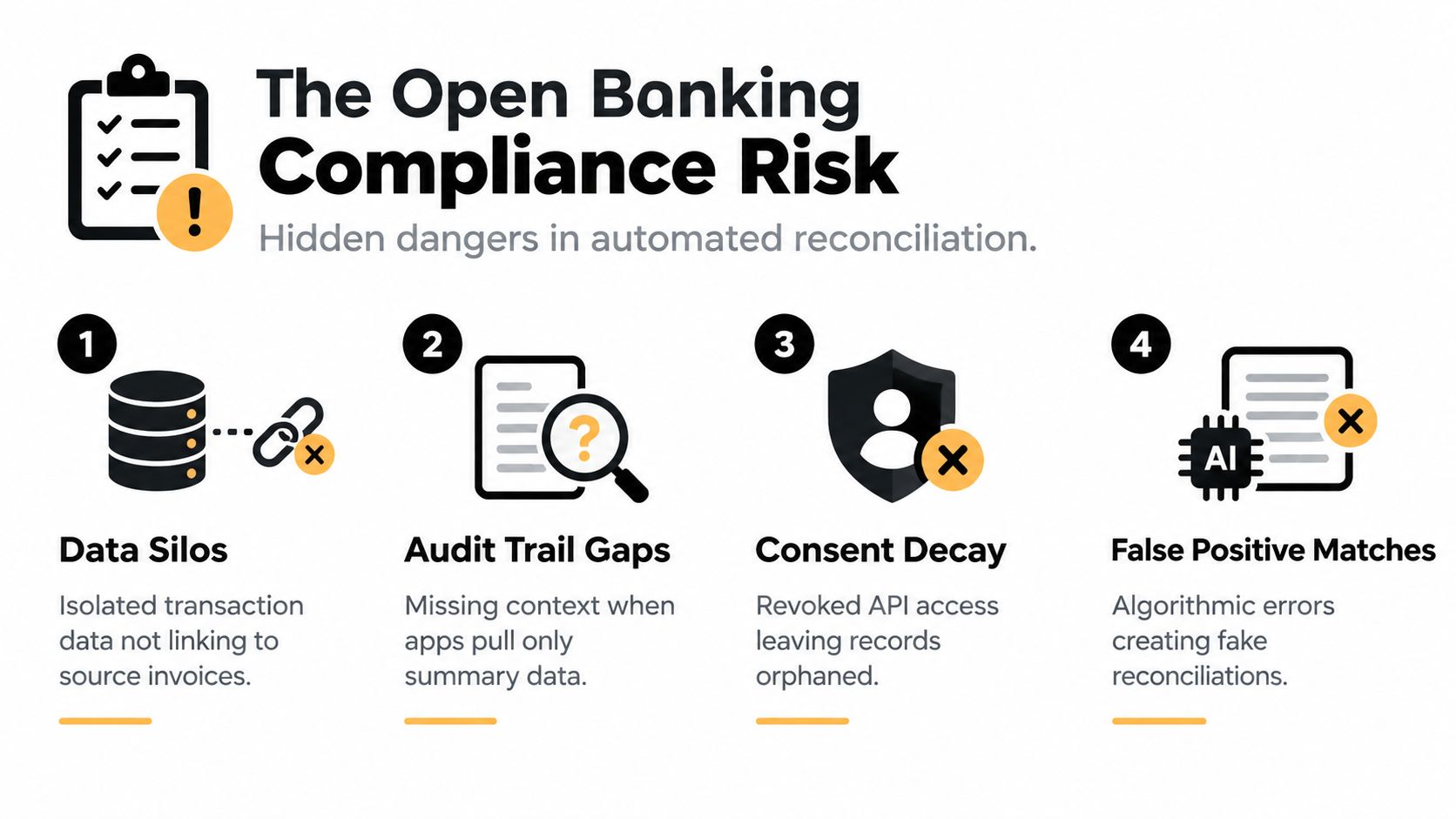
An imported transaction can still have the wrong payee, an altered supplier reference, a duplicate, a reversal or no supporting invoice. Read-only aggregation and payment initiation also carry different operational risks, so a business should know which access it has granted and who reviews the resulting activity.
A lightweight control framework works better than treating every line as a high-risk investigation:
- Review unusual transfers: Check round-sum payments, new payees and unexplained movements against invoices or written explanations.
- Watch supplier changes: Confirm a changed supplier name or bank detail independently before approving a payment.
- Check duplicates and reversals: Compare imported entries with the final settled bank activity and supplier records.
- Preserve originals: Store invoices, receipts and explanations alongside the imported transaction data.
- Escalate suspicious activity: Pause categorisation and payment approval when the payee or commercial purpose can't be verified.
Consent can also decay operationally. An account connection may be revoked, fail to refresh or leave a business with incomplete historical context. A statement export and its source documents provide a more durable record than relying on a live connection alone.
The useful question isn't whether an entry appears on bank statement data. Ask whether you can identify the payee, explain the purpose, match the amount, confirm the tax treatment and retrieve the original evidence. That chain is what makes a reconciliation defensible.
Snyp captures receipts and related documents from WhatsApp, email forwarding and file uploads, extracts the details needed for review, and syncs structured records with Xero or QuickBooks. Visit Snyp to bring your statement lines and supporting evidence into a more consistent reconciliation workflow.