




Invoice vs Receipt: What UK Businesses Must Keep
You've got a shoebox, a phone gallery, and an inbox full of PDFs, and your VAT return is due. Some files say invoice, some say receipt, some just show a total and a card payment. You know you paid for everything, but you don't know which document lets you reclaim the VAT.
That's the practical problem behind Invoice vs Receipt. One purchase often needs both pieces of paper, because they prove different things. Keep only the wrong one and you can still record the cost, yet lose the input VAT you thought you were claiming.
Invoice and Receipt Compared at a Glance
An invoice asks for payment and, when it's a full VAT invoice, supports the tax calculation. A receipt shows payment has already been made. That's the whole distinction, and everything else flows from it.
For VAT-registered businesses supplying standard or reduced-rate goods or services to another VAT-registered business, a VAT invoice is generally required, and HMRC guidance on what invoices must include states the invoice normally must be issued within 30 days of the supply date. A receipt doesn't carry that obligation. It's evidence of settlement, not a formal request with a prescribed tax layout.
Invoice and receipt compared at a glance
| Aspect | Invoice | Receipt |
|---|---|---|
| Main purpose | Requests payment and records what was supplied | Confirms that payment has been made |
| Issued by | Supplier, usually before or at the point of supply | Seller, at or after payment |
| Typical timing | Within 30 days of the supply date for a VAT invoice | At the moment of payment |
| Payment status | Often unpaid when issued | Paid by definition |
| VAT evidence for input-tax recovery | Yes, when it is a full VAT invoice | Generally not on its own |
| Retention | At least 4 years as part of the transaction record | At least 4 years where it is an authenticated receipt or supports a claim |
The confusion is understandable. A till receipt and a VAT invoice can look almost identical on screen, both may arrive as a PDF or a photo, and both may show a supplier name, a date, and a total. The difference isn't the format. It's the information the document contains and the job it was issued to do.
Why one purchase often needs both
Say a freelance designer invoices a client £1,200 plus £240 VAT at the 20 percent standard rate, with the invoice issued within 30 days of the supply date. That invoice sets out what was supplied, who supplied it, the net amount, the VAT rate, and the gross total. At that point, nothing has been paid.
The client then pays by bank transfer. The bank confirmation is the receipt in practical terms, because it demonstrates settlement. Neither document alone tells the full story. The invoice establishes the supply and the tax calculation, while the receipt proves the money moved.
A payment confirmation alone may not support input-VAT recovery when the transaction requires a valid VAT invoice.
That sentence is where small businesses lose money. You file the card slip or bank screenshot, assume the VAT is covered because you can prove you paid, and reclaim input tax on the strength of it. Payment isn't the test for VAT recovery. The test is whether you hold acceptable evidence of the supply and the VAT charged.
HMRC also recognises authenticated receipts in certain arrangements, but they're an exception, not a general replacement for invoices. Don't build your routine around an exception you haven't agreed. For freelancers, sole traders, and small companies, capturing both document types preserves the transaction trail from supply to settlement.
I would use this rule of thumb. Request a full VAT invoice for any business purchase where VAT recovery matters, and keep the receipt alongside it as proof of settlement. If the supplier won't issue one and the amount is material, decide before you pay whether losing the VAT changes whether the purchase is still worth it.
There's also an accounts difference worth keeping straight. An unpaid invoice you've issued sits in your books as money owed to you, and an unpaid invoice you've received sits as money you owe. A receipt closes that position. If you file receipts where invoices belong, your receivables and payables stop reflecting reality, and month-end reconciliation becomes guesswork about what's outstanding.
Pro Forma Invoices, Credit Notes and Simplified Invoices
Four other documents get mixed up with this pair, and each one causes a specific bookkeeping error if you label it wrong. Getting the label right at capture costs you seconds. Fixing it at year-end costs you an afternoon.
A pro forma invoice is a quote-style document sent before supply. It looks like an invoice, often with prices and a total, but it isn't a VAT invoice and can't support input-VAT recovery. Treat it as a placeholder and replace it with the final invoice once the goods or services are delivered. If you're unsure how suppliers use them in practice, this guide to pro forma invoices sets out when they're appropriate.
A credit note reverses all or part of an earlier invoice, after a return, a price reduction, or a billing error. It only makes sense linked to the original, so file it against that invoice and keep it for the same retention period. An unmatched credit note floating in your expenses will distort both your costs and your VAT.
The quick classification test
- Asks for money: It's an invoice, or a pro forma if the supply hasn't happened yet.
- Confirms money has moved: It's a receipt.
- Reverses a sale: It's a credit note.
A simplified VAT invoice, permitted for supplies up to £250 including VAT, carries fewer fields than a full invoice. That's legitimate for small retail-type purchases, but check it shows the supplier name, VAT number, and VAT rate before you reclaim anything on it. A card slip or online order confirmation is only a receipt unless it shows the supplier's VAT number and a VAT breakdown.
Label each document type before it enters the ledger. That one routing step stops pro forma files being claimed as expenses and ensures credit notes are matched to their original invoice instead of posted as standalone costs.
Required Fields on a UK VAT Invoice
A full VAT invoice isn't valid because the supplier called it an invoice. It's valid because it contains a specific set of data points. The table below sets those fields against what a typical receipt carries, which is where the gap becomes obvious.
Fields on a full VAT invoice compared with a typical receipt
| Field | Full VAT invoice | Typical receipt |
|---|---|---|
| Unique sequential number | Required | Usually absent |
| Supply date | Required | Often only the payment date |
| Invoice date | Required | Usually shown |
| Supplier name and address | Required | Usually shown |
| Supplier VAT registration number | Required | Often missing |
| Customer details | Required | Often missing |
| Description and quantity | Required | Often brief |
| VAT rate | Required | Sometimes shown |
| Net amounts | Required | Sometimes shown |
| Gross total and total VAT | Required | Often total only |
Three of these fields do most of the work in a review. The unique sequential number prevents the same purchase being claimed twice, because each invoice can be referenced once and only once. If a supplier reissues a document, you need to know whether it's a duplicate copy or a second charge.
The supplier VAT registration number lets HMRC link the supplier to the transaction and confirms the person charging VAT was entitled to charge it. Without it, you've got a total and an assumption. The net and VAT split lets you reclaim exactly the VAT shown, rather than working backwards from a gross figure and guessing at the rate. Some supplies are reduced-rate, zero-rated, or exempt, so dividing a total by six isn't a reliable shortcut.
The supply date trap
Watch the supply date in particular. A receipt is dated when payment was made, but goods may be delivered later, or services may have been supplied in an earlier period. That difference affects which VAT period the purchase belongs to. Post everything by payment date and you'll eventually put a claim in the wrong quarter.
Practical rule: If the document doesn't show the VAT number, the VAT rate, and the VAT charged, don't reclaim input VAT from it yet.
When a receipt lacks the VAT fields, keep it as expense evidence, because it still proves you incurred and paid a business cost. Then ask the supplier for a proper VAT invoice before reclaiming any input VAT. Most suppliers will issue one on request if you ask promptly and give them your business name and address for the customer details. Asking six months later, after their own records have been archived, is a much harder conversation.
How Long to Keep Invoices and Receipts
Retention is where the difference between the two documents starts costing real money. HMRC expects VAT records to be kept for six years, and that period covers purchase invoices, copies of sales invoices, credit notes, debit notes, and authenticated receipts. Six years is the working minimum for anything connected to input VAT.
Minimum retention periods by document type
| Document | Minimum retention | Notes |
|---|---|---|
| Purchase invoices | 6 years | Keep the original or electronic copy |
| Copies of sales invoices | 6 years | Keep alongside the matching bank entry |
| Credit notes and debit notes | 6 years | Link each note to the original invoice |
| Authenticated receipts | 6 years | Used only where the arrangement allows |
| Transaction records for VAT | 6 years | Applies in relevant cases under HMRC guidance |
| Till rolls and bank slips | 6 years | Listed by HMRC as proof for self-employed people |
HMRC names receipts for goods and stock, bank statements, sales invoices, till rolls, and bank slips as the proof self-employed people need to hold. Look at what that list is doing. Receipts and bank slips prove money left your account; invoices prove the tax charged on it. If an enquiry opens years after a purchase and you kept only the till receipt, you can show the spend happened but not the VAT breakdown, and the input VAT on that purchase is gone.
One rule keeps the archive simple: six years for everything, so nothing needs sorting document by document later. Keep the original, whether paper, photo, or PDF, next to the bank line it settles, since pairing the two is what turns a bare payment into defensible evidence. For the detail on what counts as a record and how digital copies are treated, this guide to HMRC record-keeping for small businesses walks through it.
Which Document Applies in Common Situations
Retaining the document isn't optional. HMRC guidance on keeping VAT records requires businesses to keep records of everything bought and sold, copies of invoices issued, and all invoices received, including electronic copies.

A receipt is useful corroboration of payment, but input-tax recovery depends on possessing acceptable evidence showing the supplier identity and VAT number, customer identity where required, supply date, goods or services, net cost, VAT rate, and VAT charged. That's the standard to test every purchase against.
Which document applies in common situations
| Situation | Document needed | Input VAT reclaimable? |
|---|---|---|
| Business buying stock from a VAT-registered supplier | Full VAT invoice | Yes, with a valid VAT invoice held |
| Sole trader buying office supplies in a shop | Till receipt, then request a VAT invoice | Usually not without a VAT invoice |
| Team member claiming an expense on a personal card | Receipt showing payment, plus any VAT invoice available | Expense recorded; VAT depends on the invoice |
| Business selling services to another VAT-registered business | Your own VAT invoice within 30 days of supply | Buyer may reclaim, so details must be correct |
| Consumer buying from a retailer | Receipt | Not applicable to the buyer |
Property costs follow the same logic. If you're documenting rent for business premises, the invoice establishes the charge and any VAT treatment while your bank payment proves settlement, and resources such as how to create a rent payment invoice show how that document is structured. Don't treat the standing order confirmation as a substitute for the underlying invoice.
The hardware shop receipt
Say you buy tools and the receipt reads "Total £96.00" with no VAT number. You've proved you spent £96, and you can record it as a business expense. You haven't proved how much VAT, if any, was charged, or that the supplier was VAT-registered.
Work through it in order. First, ask the supplier for a VAT invoice, ideally at the till or the same day by email. Second, if none can be obtained, record the spend without reclaiming the VAT. Third, flag it for review rather than letting software estimate the VAT from the total.
Where a receipt lacks the required VAT particulars, it should be escalated for review before being used to reclaim input VAT.
That discipline matters more as volume grows. One wrong £16 claim is trivial. Hundreds of them, posted automatically because your capture tool only read the total, become a real liability when HMRC asks to see the evidence. Field completeness checks, duplicate detection, and a clear trail from document to ledger posting are what make a digital workflow defensible.
Handling Emailed PDFs and the Shift to E-Invoicing
Email delivery changes the envelope, not the evidence. A supplier invoice is still the tax document, and a receipt or payment confirmation is still proof of settlement. Keep only the receipt and you may show what you spent while losing the VAT detail needed to reclaim input tax.
UK guidance draws the line at structure. Structured e-invoices are issued, sent and received in structured data that supports automated processing. A PDF attached to an email is electronic, but the data inside it still needs checking, extraction and posting. Government research involving 800 UK VAT-registered SMEs found that many businesses receive supplier invoices as PDFs and then check and manually enter the data into accounting software. The direction is toward mandatory e-invoicing for VAT, with scope, exemptions and technical detail still being settled.
Handling mixed inputs today
Receipts will remain part of the record because they evidence payment, while structured invoices address transaction exchange and VAT compliance. One intake process should therefore accept both document types without treating them as interchangeable.
- Paper receipts: Photograph them the same day, before thermal print fades, and keep the image as the original.
- Emailed PDFs: Forward them into your capture system rather than leaving them in an inbox. Setting up email forwarding for invoices and receipts removes the manual download and upload step.
- Payment confirmations: Match them to the invoice they settle. Where a utility or service payment produces its own confirmation, guidance on how to verify your Metergy payment receipt illustrates the same checking habit, confirming the payment reference and amount against the original bill.
- Structured e-invoices when they arrive: Expect cleaner data, and still run the completeness check before posting or reclaiming VAT.
Stored electronically is not the same as automatically compliant.
A PDF in a folder proves you kept something. It does not prove the document contained the VAT number, rate and net amount, that the spend was claimed once, or that the invoice matches a bank line. Check the VAT fields, keep the original, and link each document to its ledger entry. Do that now and structured e-invoicing becomes a change of input format, while your evidence standard stays the same.
Set Up a Routine That Captures Both Documents
You don't need a complicated system. You need the same seven steps, done in the same order, every time a document arrives.
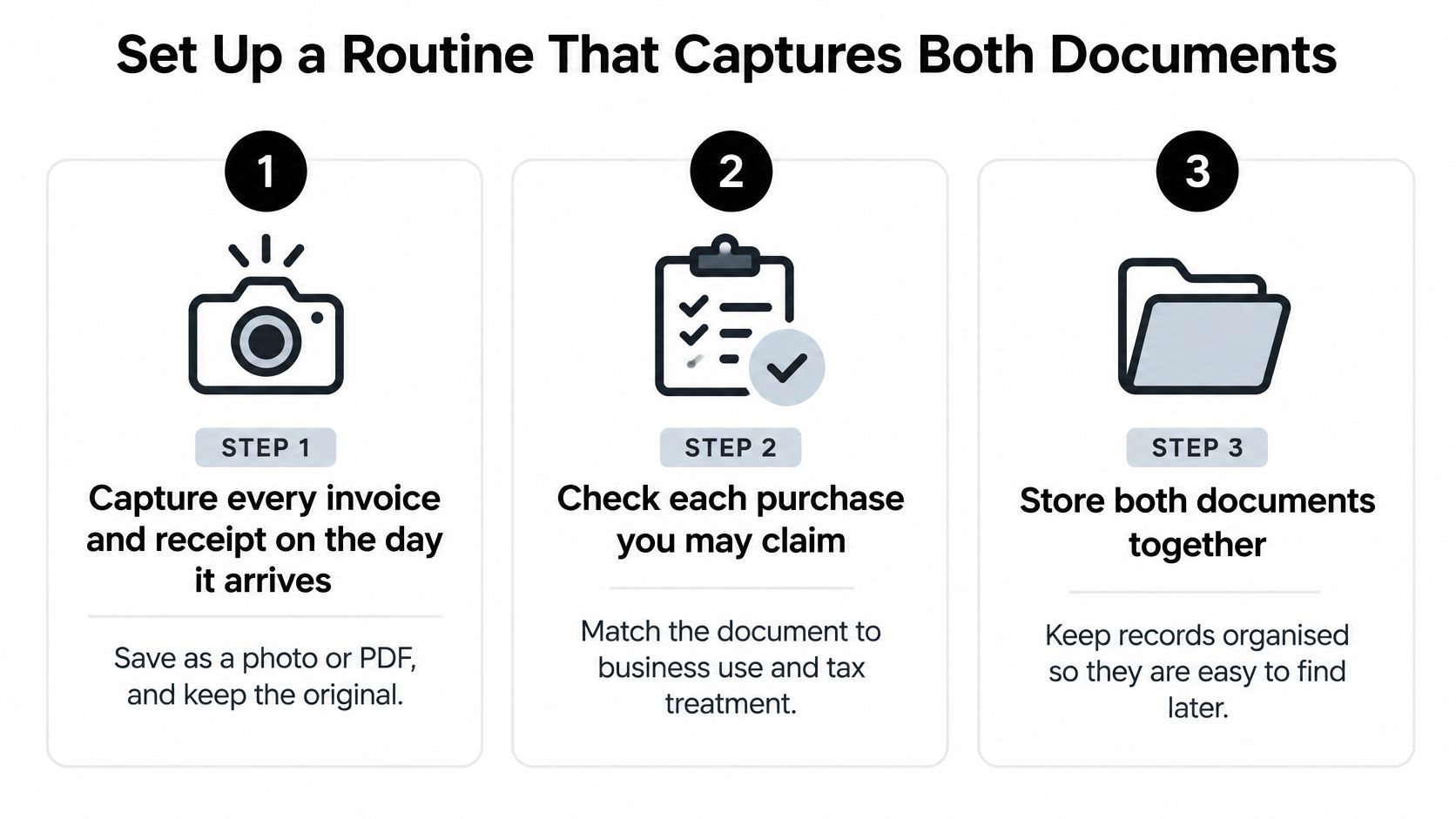
- Capture on the day: Photograph or save every invoice and receipt as it arrives, and keep the original image or PDF.
- Check the fields: Test each purchase you may reclaim against the field list and flag any missing VAT number, rate, or net amount.
- Match to payment: Link each document to its bank line or card payment so supply and settlement sit together.
- Request what's missing: Ask the supplier for a VAT invoice where recovery matters and the receipt lacks VAT details, before reclaiming anything.
- Categorise and post: Post each document to Xero or QuickBooks, one entry per document, so nothing is bundled or double-counted.
- Review monthly: Look for duplicates, missing documents, and credit notes that haven't been matched to their original invoice.
- Apply retention: Archive everything under the retention rule you've adopted and don't delete originals after posting.
A capture tool such as Snyp can take documents by upload, email forwarding, or messaging, extract merchant, date, amount, tax, and currency, and sync them to the ledger, so your time goes on the checks rather than the typing. Automation handles the reading. Your judgement handles whether the document you've got supports the claim you want to make.
The video below walks through how that capture and review flow works in practice, from document arriving to entry posted.
Start with one action before you change anything else. Ask for the VAT invoice before you pay wherever you can. Once the money has left your account, you've lost your advantage, and you're relying on the supplier's goodwill and filing system to recover VAT that a thirty-second request would have secured.
Stop losing input VAT to receipts that were never going to support a claim. Snyp captures your invoices and receipts by photo, email forwarding, or upload, extracts the merchant, date, amount, tax, and currency, and syncs clean entries to Xero or QuickBooks so both halves of every transaction stay together. Start your trial today and make your next VAT return a checking exercise, not a rescue mission.