




How to Get Clients as a Bookkeeper: A Practical Guide

Only 38% of UK SMBs use an external accountant or bookkeeper, leaving 62% handling their finances without that support, according to Dext's UK small-business survey. That changes the question from “How do I compete with every other bookkeeper for referrals?” to “How do I help self-managed business owners recognise the cost of staying stuck?”
That underserved majority is where practical education can outperform generic advertising. Explain how to spot cash-flow blind spots, prepare for VAT, reduce admin overload, or make year-end less painful, and you give a business owner a reason to start a conversation before they search for a bookkeeper.
The Real Opportunity for UK Bookkeepers in 2026
The UK market is broad, but it isn't evenly distributed. There were about 5.5 million private-sector businesses in the UK in 2024, and roughly 99% were small businesses, with nearly 74% operating as one-person firms, according to UK bookkeeping guidance from ANNA Money. Those businesses often don't need a large finance department. They need a reliable person who can turn scattered receipts, bank transactions, and unanswered compliance questions into a dependable process.
The accessible opportunity sits inside the businesses that still manage their own books. Three groups deserve particular attention:
- Sole traders approaching VAT registration: They may have handled their own records successfully until transaction volume, tax obligations, or reporting requirements became harder to manage.
- Owner-managed microbusinesses using spreadsheets: These operators often understand their trade well but lack confidence in reconciliation, categorisation, and month-end routines.
- Growing SMBs whose accountant has absorbed the bookkeeping: The accountant may be focused on year-end work and welcome a specialist who can keep records current between filings.
UK SMB bookkeeping status and where the untapped demand sits
| Segment | % of UK SMBs | Current bookkeeping setup | Conversion difficulty |
|---|---|---|---|
| Self-managed sole traders and microbusinesses | Included in the 62% without an external accountant or bookkeeper | Owner-managed spreadsheets, apps, or informal records | Moderate, if the message addresses a clear pain |
| SMBs approaching greater reporting complexity | Included in the 62% pool | Internal admin with limited finance expertise | Moderate |
| SMBs already using external support | 38% | External accountant or bookkeeper already involved | Higher, because a provider may need to be replaced |
The opportunity isn't just the size of the audience. It's the fact that many prospects need to be educated before they become buyers. A page titled “bookkeeping services” speaks mostly to people already looking. A practical guide to knowing whether your spreadsheet is ready for VAT, or how to find missing expenses, can reach an owner who hasn't yet decided to outsource.
That approach also protects you from competing only on price. You aren't selling data entry to someone comparing generic providers. You're showing a specific type of business owner what poor financial visibility costs in time, confidence, and decision-making.
Choosing a Niche That Makes Client Acquisition Easier
“Bookkeeper for everyone” sounds flexible, but it creates weak marketing. A generalist website, a vague networking introduction, and broad social posts force every prospect to work out whether you understand their situation. A niche removes that translation problem.
The UK profession has become more competitive. The Association of Accounting Technicians reported 123,000 accounting professionals classified as bookkeepers by 2017, while Yell listings rose from about 9,500 to around 14,000 between 2012 and 2017, a rise of roughly 47%, as summarised in industry information from the Institute of Certified Bookkeepers. You don't need to become the loudest generalist. You need to become recognisable to a group with a repeated problem.
Use three filters before committing
First, choose a sector you understand or want to learn. Construction CIS subcontractors, Shopify e-commerce sellers, and UK landlords with small portfolios all have distinct workflows. Familiarity helps you write useful content and ask better discovery questions.
Second, check whether the work fits a repeatable fee model. A niche with predictable transaction patterns is easier to package than one where every client requires a completely different service. You should be able to explain what you handle each month without rebuilding the scope from scratch.
Third, identify a nearby referrer. Construction clients may come through specialist accountants or trade advisers. E-commerce sellers may encounter software consultants and agencies. Landlords may already speak with property solicitors, mortgage advisers, or tax professionals.
Avoid niches that trap you
A niche that's too broad doesn't differentiate you. One that's too narrow may leave you dependent on a small prospect pool or a single referrer. Test the positioning with a simple sentence:
I help [specific business type] keep [specific financial process] under control without [specific frustration].
If the sentence sounds like it could describe every bookkeeper in your town, keep refining it. If it names a real operating problem, you have the foundation for better referrals, sharper content, and a more persuasive sales conversation.
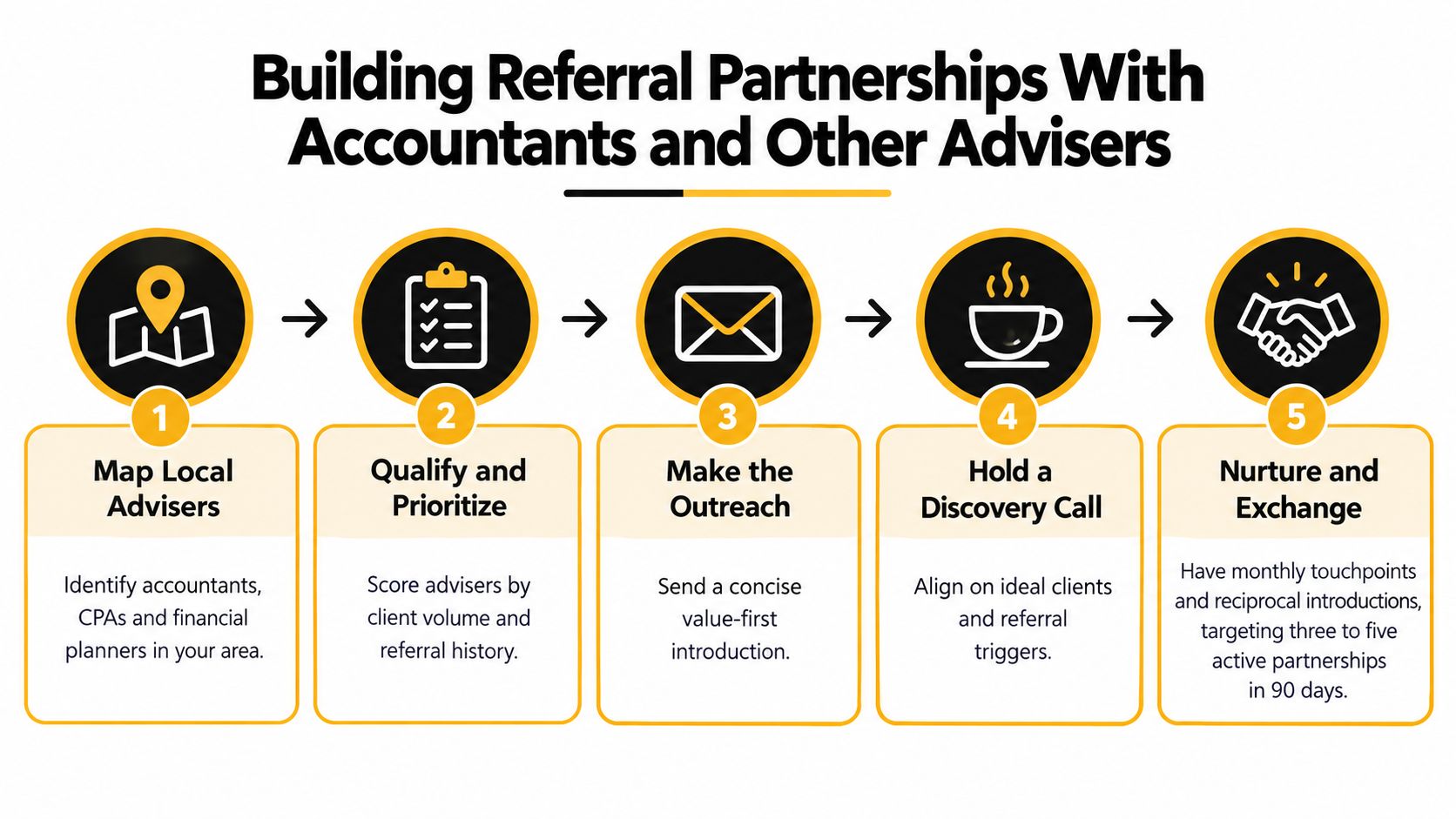
Building Referral Partnerships With Accountants and Other Advisers
Referral-led networking remains the strongest starting point for many UK bookkeepers. One UK-focused source reports that 58% of businesses found their current accounting firm through a peer referral, while accountant referral partnerships are described as converting at 60% to 75% and typically taking one to three months to establish, according to AccountingWEB's guidance on acquiring bookkeeping clients.
Don't approach an accountant with a generic CV and a request to “keep you in mind”. Give them a clear handover promise. Explain which clients you serve, what warning signs suggest a client needs help, how quickly you'll respond, and what information you'll return to the accountant.
Build a useful partner pack
Prepare three simple assets:
- A one-page niche overview: State who you help, what you manage, and which problems indicate a good fit.
- A sample client report: Show how you present reconciliations, exceptions, or outstanding information.
- A client-facing introduction note: Give the accountant wording they can forward when a client needs bookkeeping support.
Map local accountants by client size, sector focus, and apparent service model. Then add non-accountant referrers, such as solicitors, business coaches, financial planners, and software consultants. A construction software provider may know contractors struggling with records. A business coach may meet owners who have outgrown their spreadsheet.
Make the partnership professional
Don't create an arrangement that pressures anyone to breach professional rules or compromise client choice. Agree what a suitable introduction looks like, keep the client in control, and track the source of every enquiry. A basic spreadsheet is enough at first. Record the referrer, niche, date introduced, outcome, and follow-up date.
Aim to develop three to five active accountancy partnerships, rather than collecting dozens of inactive contacts. The source guidance identifies that range as a practical target, and it also warns that consistent enquiries from most acquisition strategies take three to six months. Referred leads may be warmer than cold enquiries, but the relationship still needs care.
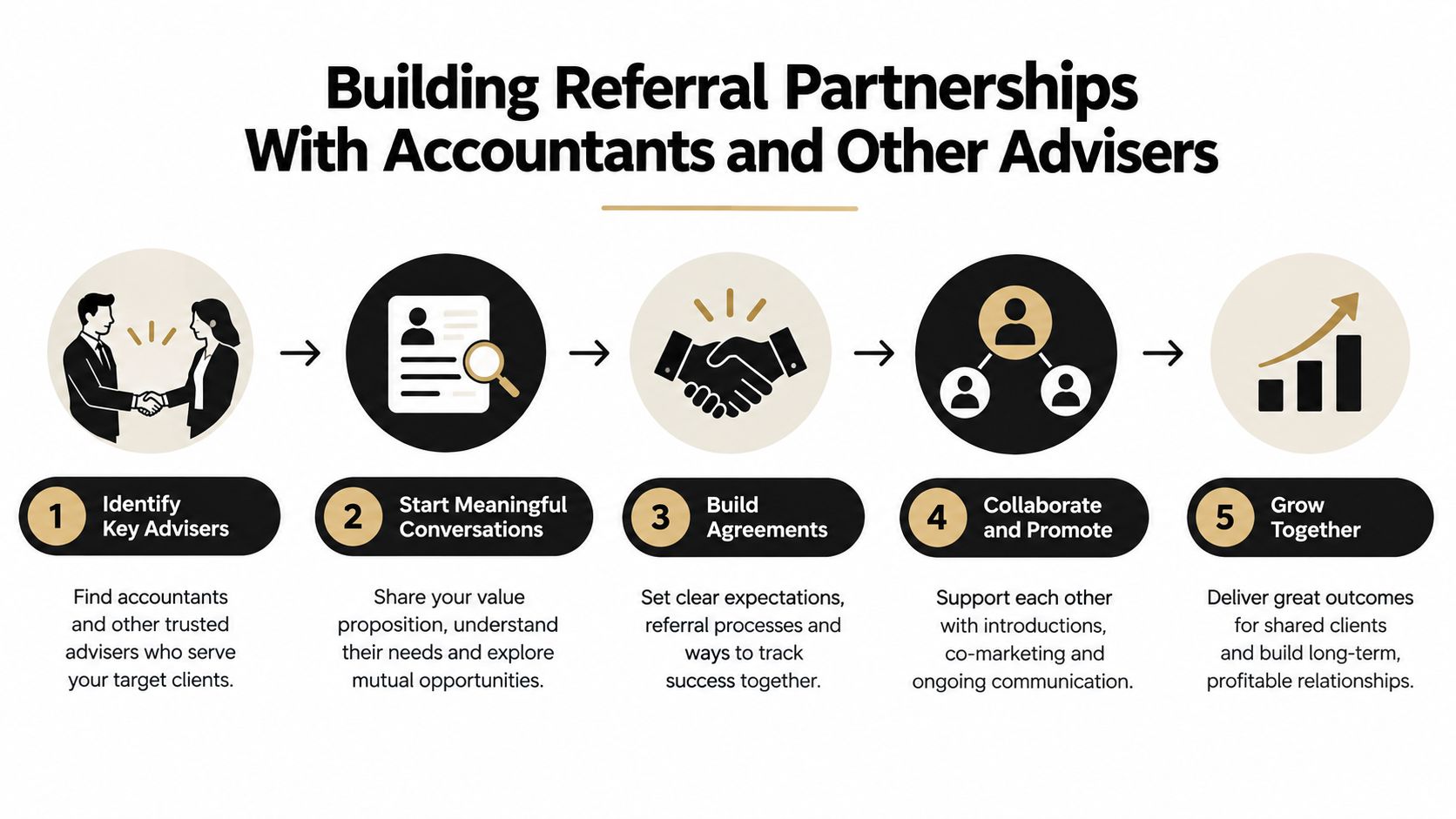
Send a useful update, share a relevant resource, or introduce a suitable contact. Don't turn every interaction into a request for work. Strong partners remember the bookkeeper who makes their client relationships easier.
Picking a Second Acquisition Channel That Compounds
Referrals can start a practice, but they leave you exposed if you wait passively for the next introduction. Choose one additional channel that matches your niche and working habits. Spreading yourself across LinkedIn, local search, directories, and video usually produces a collection of unfinished profiles rather than a dependable pipeline.
The following comparison is a planning tool, not a promise of results. Exact lead timing and conversion depend on your niche, offer, location, proof, and follow-up.
Second acquisition channels compared for UK bookkeepers
| Channel | Setup time | Weeks to first lead | Realistic conversion rate | Monthly upkeep |
|---|---|---|---|---|
| LinkedIn outbound | Short to moderate | Variable | Depends on targeting and follow-up | Regular prospecting and useful engagement |
| Local SEO and Google Business Profile | Moderate | Usually slower than direct outreach | Depends on local competition and intent | Profile updates, reviews, and useful pages |
| Accounting directories | Short | Variable | Depends on profile quality and demand | Keep services, availability, and niche details current |
| Short-form educational content | Moderate | Usually slower at first | Depends on trust and the next-step offer | Consistent production and distribution |
Match the channel to the buyer
For a B2B niche, LinkedIn is usually the most direct option. Search for owners, operations managers, and advisers who fit your criteria, then begin with a relevant observation rather than a sales pitch. Generic posts about “keeping your books tidy” won't stand out. A post about common reconciliation problems for a particular trade has a better chance of starting a useful conversation.
For local trades or hospitality, build a strong Google Business Profile and support it with location-specific service pages. Don't chase broad, saturated terms if your profile and website can't explain why you're suitable for that particular business.
For niches with heavy compliance questions, educational content is often the better long-term asset. Publish answers to the questions prospects ask before they hire help. This guide to marketing for accountants is useful when you need to connect expertise-led content with a broader practice marketing plan.
Directories can support credibility, but they rarely replace a clear niche and compelling offer. Treat them as a foundation, not your entire acquisition strategy.
Turning Leads Into Signed Clients With the Right Offer
A lead doesn't become a client because you followed up often enough. They sign when the service feels understandable, relevant, and safe to start. Your offer should remove uncertainty about what happens after the agreement.
Move away from an open-ended hourly quote where possible. Build fixed-fee packages around transaction volume, reporting needs, or turnover brackets, provided the scope is clear. Present three levels, such as essential record-keeping, regular bookkeeping with reporting, and a fuller package that includes payroll or VAT support where appropriate.
Run a focused discovery call
Use the call to understand the operating problem, not to perform a long product demonstration.
- Ask how records arrive today and who handles them.
- Identify what remains incomplete, late, or stressful.
- Clarify deadlines, software, VAT status, payroll needs, and adviser relationships.
- Repeat the main problem in plain English.
- End with one clear next step, such as a proposal review or onboarding call.
Send a one-page proposal promptly while the conversation is still fresh. Include the scope, exclusions, fee, responsibilities, start date, and the information you need from the client.
A short Loom walkthrough of a sample dashboard can make an abstract service tangible. Show how transactions are reviewed, how exceptions are raised, and what the client sees each month. Don't use a client's confidential information. A clean demonstration is enough.
Answer the objections directly
“It costs more than doing it myself.” Explain what the fee includes and compare it with the time, uncertainty, and missed visibility involved in the current process. Don't defend an unexplained price.
“Switching sounds like a lot of work.” Show the onboarding sequence, the documents required, and what you handle. A prospect is often objecting to disruption rather than the service itself.
“I need to trust you with sensitive information.” Explain your access controls, communication process, review points, and professional boundaries. Specifics build more trust than reassurance.
A clear client onboarding process helps you turn those answers into a visible path from agreement to first completed cycle. The offer itself should do more selling than a long follow-up sequence.
Using Workflow Tools to Stand Out in the Sales Conversation
Operational efficiency becomes a sales asset when the prospect can see it. A business owner who has been chasing receipts and waiting for month-end updates doesn't only want a lower fee. They want confidence that information will arrive, be handled consistently, and lead to useful answers.

Use the sales conversation to show the workflow. Open a demonstration environment and walk through how bank feeds enter the process, how categorisation rules are applied, and what happens when a transaction needs review. The point isn't to list features. It's to let the prospect see how their recurring frustrations will be handled.
A vertical example is more persuasive than a general feature list. For an e-commerce seller, demonstrate the treatment of sales channels, fees, and expense receipts. For a contractor, show how documents can be collected while work is happening away from the office. The tool matters because it supports the niche promise established earlier.
Make the demonstration short
A two-minute screen share can show:
- Input: How the client sends a receipt or supporting document.
- Processing: How the system extracts and categorises relevant information.
- Review: Where you check exceptions and request clarification.
- Output: How structured information reaches the accounting workflow.
Snyp is one option for this type of client workflow. It accepts receipts through WhatsApp, email forwarding, or file upload, extracts details such as merchant, amount, date, tax, currency, and category, and syncs structured data with Xero or QuickBooks for review and reconciliation.
The demonstration should support your judgement, not pretend to replace it. Clients still need a bookkeeper who can interpret exceptions, explain records, and connect bookkeeping activity to business decisions.
If you publish consistently on LinkedIn, a LinkedIn post scheduler can help organise distribution, but scheduling won't fix a weak message. Lead with the prospect's financial problem, then show the workflow that solves it.
The practitioner test is simple. If a prospect can't tell what happens to their documents after they send them, your process is still invisible. Make it visible before they compare you with a cheaper competitor.
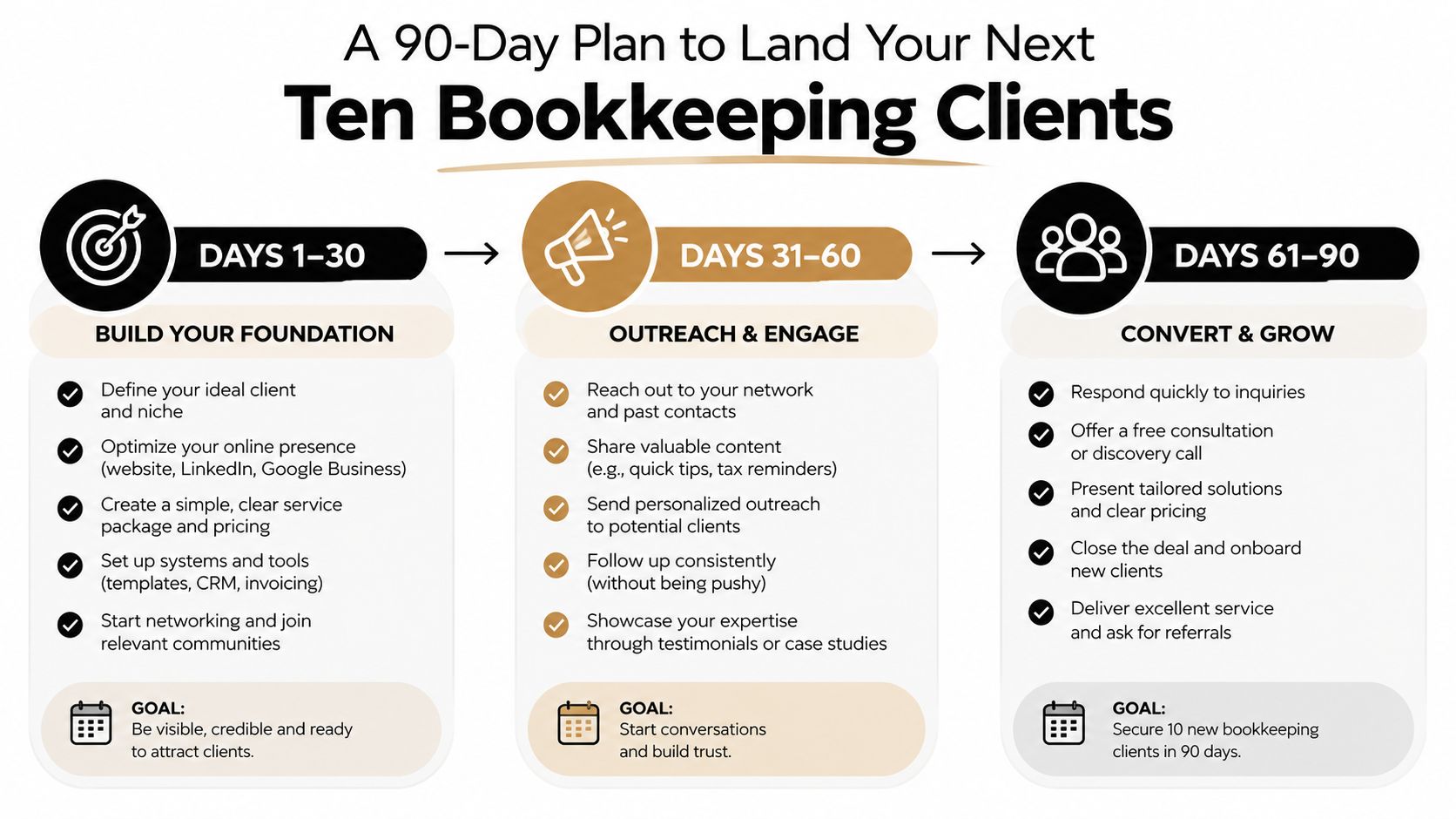
A 90-Day Plan to Land Your Next Ten Bookkeeping Clients
Treat the next three months as a controlled pipeline experiment. The target of ten clients is an objective for the plan, not a guaranteed outcome. Your job is to create enough focused activity to learn which message, niche, and channel produce qualified conversations.
Days one to fourteen
Choose one niche and write the fixed-fee offer before contacting anyone. Prepare your one-page overview, proposal template, discovery questions, and sample report. List five accountants or independent financial advisers who already serve the type of client you want.
Start with existing contacts, then send concise, personal introductions. Ask about the client problems they see repeatedly and explain exactly when your service is suitable. Don't ask every contact for an immediate referral.
Weeks three to six
Launch one second channel. If your niche is B2B, use targeted LinkedIn outreach. If it is strongly local, improve your Google Business Profile and service pages. If prospects repeatedly ask compliance questions, publish practical answers and invite readers to a short discovery call.
Publish two proof-led pieces, such as an anonymised workflow walkthrough and a guide to correcting a common bookkeeping problem. Book calls, record objections, and change the offer when the same confusion appears repeatedly.
For a wider set of ideas on how to improve outbound prospecting results, focus on relevance, follow-up discipline, and clear qualification rather than sending more generic messages.
Weeks seven to ten
Tighten the proposal around the objections you've heard. Add anonymised screenshots or process examples, and test one ethical referral thank-you arrangement that respects client choice and professional obligations. Track every enquiry source and outcome.
Weeks eleven to thirteen
Prioritise onboarding quality. Ask early clients for two suitable introductions each, but make the request specific, such as “Do you know another local contractor struggling with receipt collection?” Review the pipeline by source, niche, response, call, proposal, and signed engagement.
The guide to starting a bookkeeping business can help you connect this acquisition plan with the operational foundations needed to serve new clients properly. At the end of the cycle, keep the channel that produces relevant conversations and remove the activity that only makes you feel busy.
If you want to turn receipt collection into a visible part of your bookkeeping offer, explore Snyp and see how clients can send documents through WhatsApp, email, or upload while you receive structured data ready for review. Use that workflow in your next proposal demonstration, then build your outreach around the specific niche and financial problem you're prepared to solve.