




Expense Categories UK: HMRC Rules and Receipt Guide
You've photographed a fuel receipt, downloaded a laptop invoice and found your phone bill, all in the same evening. You know they relate to work, but you're less sure where to put them, whether you can claim the whole amount, or what your accountant will need later.
The useful way to approach expense categories in the UK is to separate two decisions: what you bought and how it should be treated for tax. A category helps organise your books. It doesn't, by itself, make a receipt deductible. This guide focuses on freelancers and sole traders, rather than limited-company expense rules.
UK Expense Categories at a Glance
A printer-paper receipt and a laptop invoice may come from the same shop, but they do not necessarily belong in the same category. Use the table to identify what you bought, then check whether the receipt needs a tax adjustment before you record it.
UK expense categories and typical HMRC treatment
| Category | Typical costs | HMRC treatment |
|---|---|---|
| Office costs | Stationery, postage, business share of phone and broadband | Allowable; split any private share |
| Travel | Rail, taxi, fuel, parking, business mileage | Allowable for business journeys; private motoring excluded |
| Clothing | Uniforms and specific protective clothing | Allowable for qualifying work clothing; ordinary clothing not allowable |
| Staff and subcontractors | Wages, subcontractor fees | Allowable business costs |
| Stock and materials | Resale goods, raw materials | Allowable when used in the trade |
| Insurance and bank charges | Business insurance, bank account fees | Allowable business costs |
| Premises | Rent, business rates, utilities for business premises | Allowable; apportion any home share |
| Marketing | Advertising, website and promotional costs | Allowable business costs, subject to any capital treatment |
| Subscriptions and training | Business software, trade journals, relevant courses | Allowable when business-related and within the relevant rules |
| Finance costs | Business loan interest, overdraft interest, leasing payments | Allowable when incurred for business |
| Professional fees | Accountancy and business legal fees | Allowable business fees; capital-nature legal costs treated differently |
| Equipment and vehicles | Laptops, machinery, business vans | Usually capital allowances under traditional accounting; cash basis may deduct eligible equipment |
| Fines and private spending | Parking fines, personal drawings | Not allowable |
Choose business labels, not household budget labels
Household budgets group costs by personal consumption. Business categories need to show what the purchase was for and how it should be treated. Electricity, for example, may relate to business premises or be part of a home bill that needs apportioning.
The Office for National Statistics family spending bulletin uses a household spending classification, which is different from a business chart of accounts.
For a takeaway business, packaging used to fulfil customer orders belongs with trading materials, not office stationery because both came from a general supplier. The packaging type may vary, but the category follows its business use. A guide to compare cost-effective takeaway packaging materials can help with the purchasing decision.
Read the receipt, not just the supplier name
A supermarket receipt might include cleaning supplies for business premises, personal groceries and food bought during a qualifying business trip. Separate the items rather than assigning the whole payment one label.
The same applies to a single technology order containing printer paper and a laptop. The paper is an office cost; the laptop may need different tax treatment because it is equipment.
Practical rule: Let the category describe the purchase. Record business use, tax treatment and supporting evidence separately.
The category is the starting point. The treatment decides how much of the receipt, if any, can enter the tax calculation.
Splitting Mixed-Use and Capital Purchases
A phone bill can be an office cost without being wholly deductible. A laptop can be business equipment without qualifying for the same treatment under every accounting basis.
Accounting category answers what the transaction represents. Tax treatment answers how much can enter the tax calculation, and through which route.
Decide the asset question first
Follow this decision order before approving the category:
- Identify the nature of the purchase. Is it something consumed in operating the business, or equipment retained for continuing use? A replacement ink cartridge and a replacement computer aren't the same kind of purchase.
- Establish business use. Decide whether the purchase is wholly business-related or needs an allocation between business and private use.
- Assign the accounting category and treatment. Choose the label, then apply the appropriate revenue or capital treatment under your accounting basis.
Retained use is a useful screening question, not a complete tax test. Repairs, improvements, equipment and vehicles can require a closer look.
HMRC's self-employed expenses guidance distinguishes allowable operating expenses from equipment, machinery and vehicle purchases, with capital allowances generally relevant under traditional accounting and ordinary expense deductions available for eligible equipment under the cash basis.
Don't assume that cash-basis treatment makes every vehicle purchase an ordinary running cost. Identify the vehicle type and check the applicable treatment before posting it.
A repair-versus-replacement decision also deserves its own note. Steel City IT's explanation of when computer repairs outweigh replacement costs can help with the purchasing decision, but the resulting invoice still needs its own tax classification.
Make mixed-use allocations explainable
Use a method that reflects the actual business use and retain the calculation. An unexplained percentage copied forward indefinitely is harder to defend than an allocation supported by bills, usage records or a reasonable written estimate.
Mixed-use and capital purchases: split method and evidence
| Purchase | Split or treatment | Evidence to keep |
|---|---|---|
| Mobile phone bill | Business call and data share only | Itemised bill and written split method |
| Home office | Business share of relevant rent, council tax or utilities | Floor-area or hours calculation appropriate to the cost |
| Car fuel and mileage | Business journeys only; use the chosen permitted calculation method consistently | Mileage log with journey purpose |
| Meals on business trip | Check current HMRC subsistence rules before claiming | Receipt, trip record and business purpose |
| Laptop used at home | Business-use share; capital allowances under traditional accounting or eligible cash-basis deduction | Purchase invoice and use estimate |
| Business van | Capital allowances under traditional accounting, or eligible cash-basis treatment, with private-use adjustment | Mileage log and ownership record |
| Bank charges | Usually wholly business for a dedicated business account | Bank statement line and explanation of any private element |
For home-working costs, match the allocation to the particular bill rather than applying a convenient percentage to everything. A home-office accounting guide can help you organise the calculation and supporting notes.
A meal receipt needs particular care. Eating while working doesn't automatically make lunch a business expense; keep the journey details and establish whether the subsistence rules permit the claim.
Fix the decision, not merely the label
HMRC's taxable-profit helpsheet distinguishes business and private motoring, excludes fines, and addresses different treatments for equipment and vehicles under the relevant accounting basis.
Use those distinctions to correct common posting errors:
- Mixed receipt posted in full: Separate the business and private items, then allocate shared costs using a recorded method.
- Every car payment labelled travel: Establish whether it relates to a running cost, vehicle acquisition or private journey. Retain the mileage calculation.
- Equipment buried in office costs: Flag the retained asset for review so its treatment doesn't depend on an automatic merchant rule.
- Fine mistaken for parking: Distinguish a parking charge from a penalty. Keep the penalty out of allowable expenses.
- Drawings recorded as a cost: Treat money taken for personal use separately from business expenditure.
A more detailed category list won't repair an unsupported business-use allocation.
For VAT-registered businesses, assess VAT separately from the income-tax expense. Don't assume that an allowable expense automatically produces recoverable VAT, or that the same adjustment can be applied without checking the evidence.
How to Categorise a Receipt Step by Step
Use a repeatable capture routine, whether you're entering receipts yourself or reviewing extracted information. Complete the tax decisions before approving the final posting.
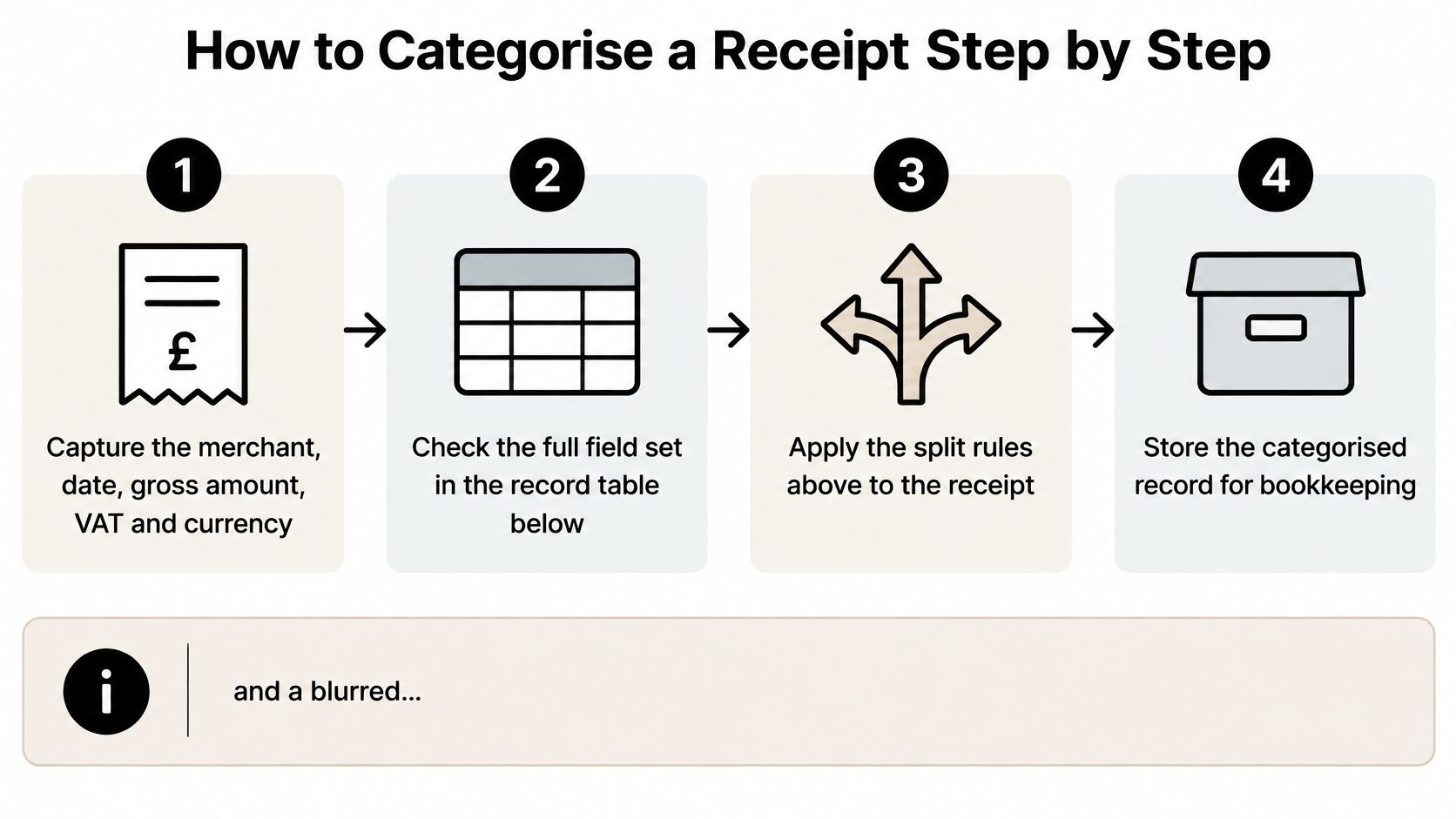
This flow summarises the capture and storage process.
Follow the receipt through to approval
- Capture the document clearly. Record the merchant, date, gross amount, VAT and currency. Check that the photo includes the full receipt and that the totals are readable; a blurred image may leave you unable to substantiate the entry later.
- Select a parent category and useful child label. Use travel > rail rather than creating separate accounts for every train operator. Keep the label tied to the nature of the purchase.
- Confirm the asset decision. Check whether the item needs an asset flag or can proceed as an operating cost. Don't let a supplier-based suggestion override what the invoice contains.
- Enter the business-use allocation. Use wholly business treatment only when you can support it. Where a receipt contains unrelated purchases, split its lines rather than forcing one percentage across everything.
- Write the purpose while you remember it. Client site visit, Leeds explains more than business travel. For tools or materials, add the job or project reference.
- Send uncertainty for review. Flag an unclear meal, missing VAT detail or mixed personal purchase. A visible unresolved item is preferable to an apparently complete but unsupported entry.
- Approve and match the payment. Confirm that the categorised receipt corresponds to the bank transaction, allowing for any documented payment differences.
The receipt-field table below provides the capture checklist. Use it to check completeness rather than entering the same information in several disconnected places.
Keep corrections visible
Say you photographed a hardware-store receipt containing a tool for a customer job and household supplies. Preserve the original image, split the lines and explain the exclusion, rather than editing the captured total to hide the private purchase.
For a video walkthrough, use the embedded player.
A straightforward receipt should finish with a clear category, business-use allocation and purpose note. A mixed receipt may need several coded lines, but those lines should remain attached to the same source document and payment record.
Records HMRC Expects You to Keep
A bank statement proves that money moved. It may not show what you bought, whether the purchase included VAT, or why it related to your business. Keep records of business expenses and, where applicable, VAT records, as set out in HMRC's record-keeping guidance for self-employed people. For mixed-use purchases, retain evidence of the business share and how you calculated it.
Capture a complete receipt record
The fields below help connect each receipt to its category, tax treatment and supporting evidence.
Receipt fields that support an audit trail
| Field | Why it matters | Example |
|---|---|---|
| Supplier | Links the receipt to the category and bank line | Rail operator name |
| Date | Places the cost in the correct accounting period | Travel date printed on the receipt |
| Net amount | Records the value before VAT | Invoice subtotal excluding the VAT shown |
| VAT | Supports VAT recovery where registered and eligible | VAT amount printed on a valid supporting invoice |
| Gross amount | Supports matching to the bank statement | Total charged to the business debit card |
| Business-use percentage | Records the allocation used in the calculation | Wholly business for a qualifying client journey, with the reason recorded |
| Category label | Provides a consistent reporting hierarchy | travel > rail |
| Purpose note | Explains why the cost was incurred | Client site visit, Leeds |
For a foreign-currency purchase, keep the original currency and the conversion information used in your books. Link the receipt to any supplementary invoice so the documents can be understood together. A Snyp guide to organising supporting documents alongside accounting entries may help you set up that filing structure.
Give travel records extra attention
A business trip may produce rail tickets, a hotel invoice and meal receipts. Keep each cost on a separate expense line: the documents are different, and their VAT treatment may differ even when they relate to the same journey.
Use a shared trip reference to connect the records. If a hotel invoice includes accommodation and other purchases, review the lines separately rather than applying one treatment to the whole total.
Hierarchical labels make the calculation easier to follow:
- travel > accommodation identifies the nature of the hotel cost.
- insurance and bank charges > bank charges identifies a banking fee separately from a supplier payment.
- office costs > telephone keeps a recurring communications bill easy to retrieve.
Evidence check: A reviewer should be able to trace the reported figure through the calculation to the original document.
Keep supporting documents in a form you can retrieve later. The filing total is only the result; the record should show how you reached it without relying on your memory.
Reconciling Expenses in Xero and QuickBooks
A receipt photographed weeks after a job may still show the total clearly, but you may have forgotten the client, journey or reason for buying it. Reconciliation should check that context as well as the payment.
HMRC's small-business expenses guidance emphasises retaining supporting records such as receipts, invoices, bank statements and mileage records, which aren't normally submitted with the tax return.
Preserve the job context
For contractors and field-service workers, add the job reference when capturing fuel, parking, tools or meals. Record relevant attendees for a meeting-related purchase and the journey details supporting a mileage calculation.
Keep a review status too. Captured, awaiting explanation and approved are different stages; an imported receipt shouldn't appear fully checked just because it has reached the accounting software.
Match, check and approve
Use this sequence in Xero or QuickBooks:
- Match the gross payment and date. Find the corresponding bank line, accounting for any documented settlement delay. Check whether the software already contains a bill or expense before creating another.
- Confirm the account mapping. Compare the suggested account with your chart of accounts and the purchase itself.
- Inspect the VAT entry. Compare the extracted tax with the supporting document and the treatment you've established.
- Resolve review flags. Clear missing explanations, mixed-use questions and asset decisions before approving the transaction.
UK expense categories mapped to typical Xero and QuickBooks accounts
| UK category | Typical Xero account | Typical QuickBooks category |
|---|---|---|
| Office costs | Office Expenses | Office Expenses |
| Travel | Travel - National | Travel |
| Premises | Rent or Lease | Rent or Lease |
| Insurance and bank charges | Insurance / Bank Fees | Insurance / Bank Charges |
| Subscriptions and training | Subscriptions | Dues & Subscriptions |
| Finance costs | Interest Expense | Interest Paid |
| Professional fees | Accounting / Legal Fees | Legal & Professional Fees |
| Equipment and vehicles | Fixed asset register | Fixed asset |
These are illustrative account names, not guaranteed defaults. Training may need a different account from subscriptions, and cash-basis equipment treatment may require a different posting from the fixed-asset example.
Use Xero tracking categories for reporting dimensions such as projects or locations where appropriate, rather than multiplying expense accounts for each client.
Automate capture without automating assumptions
Receipt-capture tools can extract merchant, amount, date, tax, currency and a suggested category from WhatsApp, forwarded email or uploaded JPEG, PNG and PDF documents. A connection to Xero or QuickBooks can then pass the structured information into the bookkeeping workflow.
The review requirement remains. A tool should leave an ambiguous restaurant receipt or equipment purchase visible for a decision, rather than turn uncertainty into a confident posting.
If you're comparing wider finance systems, Bidwell accounting software tenders offers a procurement resource to consult alongside your requirements. Include document attachment, review controls and account mapping in that assessment, not just the availability of a bank feed.
Check the final record inside your accounting platform. Successful transfer isn't the same as successful reconciliation: the attached document, coded expense and matched payment must agree.
Set Your Category Rules Before Filing
Write a short expense policy that you or your bookkeeper can apply without reopening the same discussion for every receipt. Start with the categories you use, not every account your software offers.
A freelance designer may need clear rules for software, home working, travel and equipment. A mobile tradesperson will need more attention on materials, vehicles and job-linked purchases.
Put the rules into practice this week
- Choose a compact category list. Use recognisable labels from the lookup table and add detail only where it improves reporting or resolves a recurring classification problem.
- Document shared-cost methods. Record how you allocate phone and home-working costs, what evidence supports the method and when you'll review it.
- Define the asset flag. Make equipment and vehicle purchases stop for a treatment decision before they enter ordinary running costs.
- Set a purpose-note policy. Require explanations for ambiguous purchases and costs above your own agreed review threshold. That threshold is an internal control, not permission to omit supporting evidence below it.
- Assign approval responsibility. Decide who resolves unclear receipts and how that decision is recorded.
- Apply the policy consistently. Review exceptions rather than allowing each new receipt to create a different rule.
Test the complete record
Select a manageable batch of recent receipts and follow them from capture to the reconciled bank entry. Include a shared phone bill, a straightforward business purchase and an equipment invoice so you test different decisions.
Check whether the category, VAT treatment and business-use calculation remain connected to the original document. Ask your bookkeeper to inspect the exceptions before you extend the workflow to the rest of your records.
If receipts still arrive through message threads, inboxes and paper folders, trial a capture tool using that same batch. Judge it by whether you can explain and retrieve the finished entries, not by how quickly it reads a total.
Snyp captures receipts from WhatsApp, forwarded email and file uploads, extracts transaction details and syncs results to Xero and QuickBooks. Visit Snyp to test it against your category rules with a batch of real receipts, then check the supporting documents, tax details and reconciled entries before adopting the workflow.