




Contractor Expenses: What You Can Claim in the UK

A hotel invoice for two nights near a site, a fuel receipt for the drive there, and a laptop bought because the old one died mid-project. All three are contractor expenses in the everyday sense. Whether all three reduce your tax bill depends on things the receipts themselves don't say.
That gap is where most claims go wrong. Rarely in the arithmetic, and rarely through dishonesty, but through the assumption that spending money on work automatically makes a cost deductible.
The taxpayer, the engagement and the business purpose decide it. The receipt only records that money moved.
Which Contractor Expenses HMRC Allows
Most of what a contractor spends across a year fits a short list of headings, and HMRC's treatment of those headings is stable enough to plan around. Scan the rows below for the cost you're holding, then read the condition attached to it.
| Expense | Usually claimable | Key condition |
|---|---|---|
| Wages paid to staff | Yes | Includes employer National Insurance |
| Rent for business premises | Yes | Only the business share if the premises are shared |
| Lighting, heating and business telephone | Yes | Mixed-use costs claim the business proportion only |
| Postage and stationery | Yes | Keep itemised receipts |
| Fuel, vehicle insurance and repairs | Yes, if used for business | Use mileage or actual costs, not both |
| Agency fees and subcontractor costs | Yes | Record who was paid and for what |
| Employee benefits | Yes | Check the benefit rules before claiming |
| Business-related training | Yes | Must relate to the trade |
| Accountancy and professional fees | Yes | Business share only if personal tax work is included |
| Professional insurance and subscriptions | Yes | Must relate to the trade |
| Equipment and software | Usually, through capital allowances | Claim the cost through allowances, not as a one-off expense |
| Client entertainment | No | Disallowed under the self-employment rules |
| Depreciation | No | Claim capital allowances instead |
| Own salary or drawings | No | Not a business expense |
| Personal National Insurance | No | Paid from personal income |
Usually claimable is the answer you'd give before seeing the paperwork. Key condition is where claims fail, and it's the column worth reading twice.
The first ten rows share one logic. The cost has to be incurred for the trade, and where an asset or a bill serves two purposes, only the business share counts. Equipment is the row people misread. A laptop isn't banned, it's claimed through capital allowances rather than as a one-off line in the expenses ledger, which changes the timing of the relief rather than removing it.
The disallowed rows cause the arguments at year end. Client entertainment stays disallowed however obviously it served a business conversation. Depreciation is replaced by capital allowances. Drawings and personal National Insurance belong to you, not to the trade.
The two questions to ask of any receipt
Was it incurred to earn this year's trading income? Would the business have paid it if you'd gained nothing personally from it?
A yes to both usually survives review. A no to either means the cost belongs somewhere else, or nowhere at all. Nothing in the table overrides those two questions, which is why the next part is the one that decides most borderline claims.
The Wholly and Exclusively Test Explained
A bus pass shows the rule most clearly. You buy it to reach a client's site during the week and to go shopping on Saturday. One purchase, two purposes, and only the work journeys can be claimed. The cost is shared, so the claim has to be shared with it.
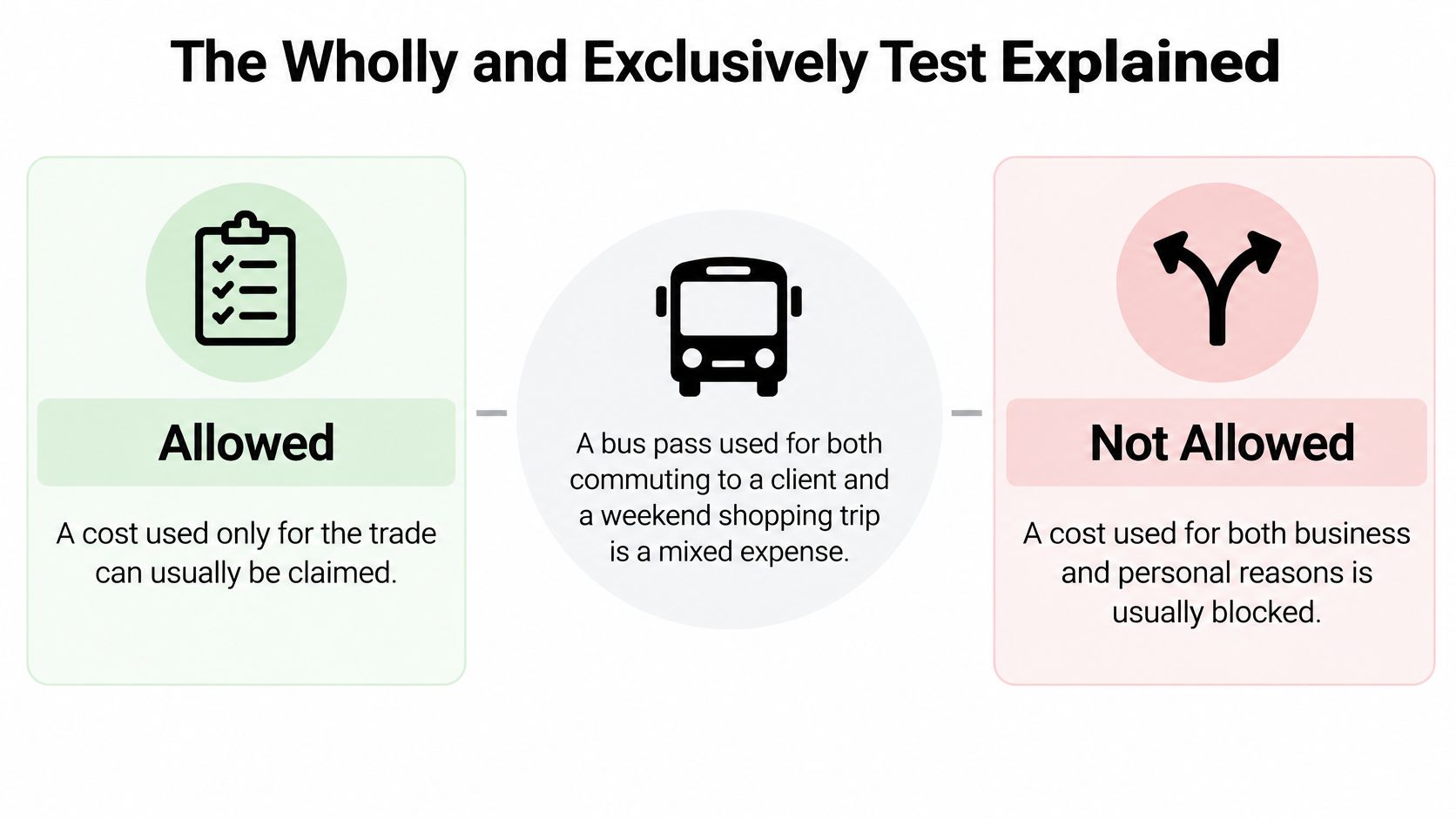
HMRC's self-employment notes for the SA103F supplement state the condition plainly: a cost is deductible only where it's incurred wholly and exclusively for the trade, and where a vehicle, home office or other asset serves both business and personal use, only the business proportion is normally allowable.
That is a purpose test, not an amount test. A £4 parking charge on a site visit passes. A £400 dinner that happened to include a client's name in the conversation usually doesn't.
How the test applies to travel
HMRC draws the line at the route and the relationship to your established base. Journeys between your business base and your work locations are usually allowable. Ordinary travel between home and that base generally isn't, even when you carry tools and answer calls on the way.
The rule bites hardest on contractors whose first job of the day is wherever the client happens to be. Keep the base, the location and the purpose in the record and the claim defends itself.
Recording the business share
Take a phone contract at £600 a year with a reasonable 70% business use. The allowable figure is £420, and the part that matters is the note explaining why 70% is fair: call logs, data usage, a second handset for personal calls, whatever basis you can stand behind. Homes and vehicles work the same way. Only the business proportion is normally allowable.
The trade-off is honest. Splitting mixed-use bills costs admin every month, and it creates an opening for overstatement if the percentage drifts upward without evidence. Claiming nothing costs you real money. I'd take the split every time, with the basis written down in the same place you keep the receipts.
Pick one basis, write down why you chose it, and apply it every month of the year. A reviewer can follow a written basis. They can't follow a guess.
Mileage Rates and Vehicle Costs
Simplified expenses replace a folder of fuel receipts with a single mileage figure. For a sole trader running a car or van, that trade is usually worth making, though it isn't free.
| Vehicle | First 10,000 business miles | Each further business mile |
|---|---|---|
| Car or goods vehicle | 45p | 25p |
| Motorcycle | 24p | 24p |
HMRC's simplified expenses guidance sets those rates and treats the flat figure as covering fuel, insurance, repairs, servicing and general running costs. Nothing gets tracked separately.
The worked example
Say a subcontractor drives 12,000 business miles in the tax year. The first 10,000 miles at 45p produce £4,500. The final 2,000 at 25p add £500. The deduction is £5,000, and the record needed to support it is a log, not a shoebox.
Two things decide whether that beats the alternative. The first is what the vehicle costs to run: a newer van with low servicing bills often does better on the flat rate, while an older car with heavy repair costs can do better on actual expenses. The second is how much private mileage sits in the same vehicle, because the flat rate sidesteps that allocation entirely.
Once you've elected the mileage method for a vehicle, it generally continues for as long as you use that vehicle for business. Choosing it after claiming capital allowances or actual costs on the same vehicle isn't available.
That is why the comparison should happen before the first claim of the year, not at the self assessment deadline. Run both numbers on a spreadsheet, pick the larger defensible one, and note the date you elected.
The record-keeping minimum is a log showing the date, the start and end points, the distance and the business purpose for each trip. HMRC expects business mileage to be evidenced trip by trip, not reconstructed from a total. If you want a routine for keeping that log current, this guide to tracking business mileage covers the practical side of capturing journeys as they happen.
Travel, Subsistence and Overnight Costs
The overnight subsistence allowance is one of the few expenses where HMRC publishes a fixed figure, and the figure is the easy part. Whether the payment stays tax-free depends on the engagement, the workplace and the reason for the stay, none of which a receipt proves on its own.
Take a three-night stay on a qualifying construction site. At the current rate of £50.81 per night, that comes to £152.43, payable free of tax where the arrangement and the payment meet HMRC's conditions.
HMRC's Business Income Manual guidance on lodging and overnight subsistence rates publishes the rate history behind that figure, and the progression matters when you're checking an older claim.
| Period from | Rate per night |
|---|---|
| 8 January 2018 | £39.37 |
| 7 January 2019 | £40.37 |
| 6 January 2020 | £41.18 |
| 10 January 2022 | £42.21 |
| 9 January 2023 | £43.27 |
| 8 January 2024 | £48.16 |
| 6 January 2025 to 3 May 2026 | £50.81 |
The move from £39.37 to £50.81 is an increase of £11.44, roughly 29.1% over seven years. A London supplement sits outside the nightly figure and is taxable in its own right.
Why the paperwork needs dates, not totals
A receipt for accommodation or meals cannot be treated as tax-free on its own. The contractor has to show the work arrangement and the payment both meet the rules, so each claim needs the location, the dates and the category attached line by line.
Rates change at known dates in early January. A stay that spans the changeover, a December checkout followed by a January one in the same hotel, can fall under different rate periods. A claim recorded only as a total cannot be matched back to either.
That detail matters more as project costs tighten. In the fourth quarter of 2024, nearly 40% of UK construction professionals surveyed by Gardiner & Theobald reported that project preliminaries costs had increased and 52% expected them to rise over the following year, according to Gardiner & Theobald's input cost report. Overnight and travel costs sit inside that pressure.
A site-to-site journey is a business trip. A daily run from home to your base is commuting, whatever the distance. If you're booking your own stays rather than receiving an allowance, the Stay Norwich Apartments contractor guide sets out what to check before you commit to a longer booking.
Before submission, confirm which rate period applied on each date, keep the work location with every claim, and separate meals from accommodation so each line can be reviewed on its own conditions. For the boundary between a business journey and a commute, this explanation of what counts as business travel is the reference I'd keep open.
Umbrella, Agency and Off-Payroll Contractors
A contractor works through a limited company for eight months, takes a six-month umbrella assignment through an agency, then goes direct as a sole trader. The work barely changes. Everything about the claim does.

The assumption worth challenging is that the same receipt produces the same answer in all three arrangements. HMRC's guidance on working through an umbrella company confirms umbrella workers hold employment rights, while the tax treatment still turns on the employment arrangement and the assignment circumstances. The taxpayer, the engagement and the business purpose decide the claim. The paper it came on is only evidence of the spend.
Four questions that sort most travel claims
- What's the employment status? Sole trader, company director, agency worker and umbrella employee are four different starting points.
- Who directs and controls the work? Supervision and direction shape the analysis of the engagement.
- Is the workplace regular or temporary? A site you attend for two years is not the same as one you attend for two weeks.
- Does the assignment continue? A gap or a new contract can reset the position entirely.
Off-payroll working adds a further constraint. Deductions can be restricted, a flat-rate allowance applies only in particular circumstances, and workers treated as employees under the off-payroll rules don't automatically gain holiday pay, statutory payments or pension auto-enrolment, as BGM's guide to off-payroll working sets out.
The same purchase across four statuses
Take four purchases: a laptop, a training course, mileage and a professional subscription. A sole trader claims each against trading profit where it serves the trade. An outside-IR35 limited company buys through the company accounts. An inside-IR35 engagement can see the deduction restricted. Through an umbrella, the same item may or may not be reimbursed depending on the assignment.
| Status | Who decides the claim | Main test |
|---|---|---|
| Sole trader | The trade's own books | Wholly and exclusively for the trade |
| Outside-IR35 limited company | The company's accounts | Wholly and exclusively for the company's business |
| Inside-IR35 engagement | Off-payroll rules | Deductions can be restricted; a flat-rate allowance applies only in particular circumstances |
| Umbrella employment | The employment arrangement | Assignment status and subsistence rules |
A receipt proves you spent money. It doesn't prove the spend belongs to the right taxpayer in the right engagement.
Contractors moving out of employment into a first assignment usually need the basics of pricing, invoicing and record keeping before the tax questions make sense; this beginner freelancing advice from Mega Income Stream covers that groundwork. Whatever the background, settle the status with an accountant before you claim. HMRC asking afterwards is the expensive version.
How to Document and Track Every Expense
Documentation does two jobs. It proves the spend happened, and it proves why. Most systems handle the first well and the second badly, which is why claims built on bank statements alone collapse under review.
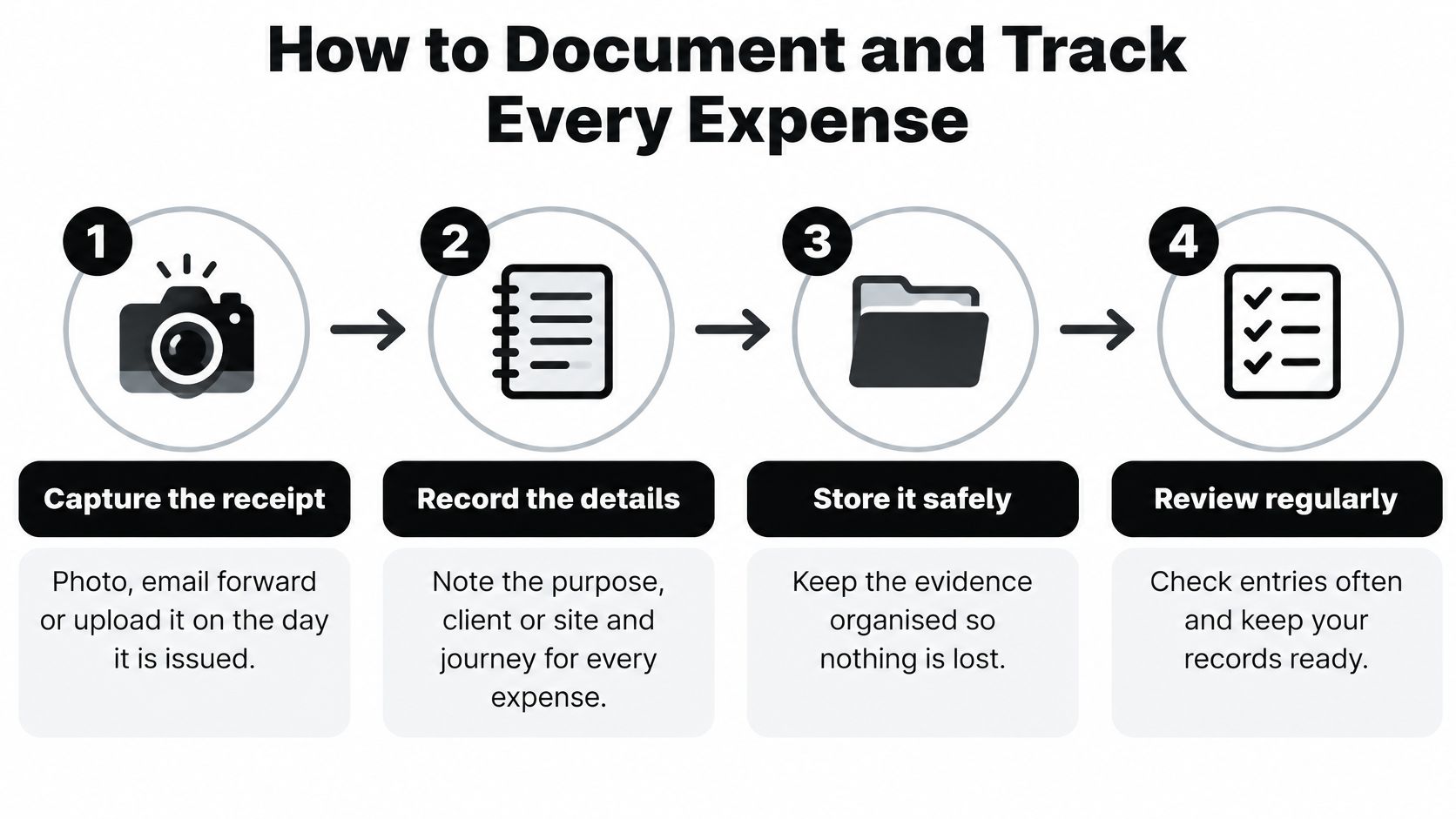
- Capture on the day. Photograph the receipt, forward the email or upload the PDF before you leave the site. Anything that waits until Friday gets reconstructed from memory, and memory is a poor witness.
- Write down the purpose. For every travel cost, note the client or site and the journey. The purpose carries the claim; the total doesn't.
- Assign the matching HMRC heading. Materials, car and van costs, premises, accountancy, professional subscriptions. If you use software that suggests categories from your chart of accounts, that saves time, but the suggestion still needs a human check.
- Split mixed use and record the percentage. Write the figure and the reason together, so the 70% on the phone bill has a note behind it.
- Apply CIS discipline to subcontractor payments. HMRC's CIS 340 guide for contractors and subcontractors makes the point that travel, fuel, subsistence and accommodation paid to or on behalf of a subcontractor can form part of the contract value and be subject to CIS deduction. Record the payer, the beneficiary, the contractual obligation and whether value passed to the subcontractor, then reconcile those fields to the payment statement before calculating deductions.
- Reconcile monthly. Match receipts to the bank statement every month while the transactions are still familiar. A three-month gap turns reconciliation into detective work, and the HMRC record keeping requirements explain what has to be retained and for how long.
- Keep records for at least five years after the 31 January submission deadline for the relevant tax year. Digital and physical filing both work; a consistent structure is what makes retrieval fast when someone asks, which this guide to organising receipts covers in detail.
The capture, extraction, review and sync sequence is the part worth automating. With Snyp, a user uploads a receipt on the web, forwards it by email or sends it by WhatsApp, and the AI assigns the most appropriate expense category from their own chart of accounts. They review and confirm the data, and the approved entry syncs to Xero or QuickBooks. The suggestion is a suggestion, so the check stays with the person who knows the job.
What a defensible record looks like
Four elements, every time: a dated receipt, a stated purpose, a category, and a business share where the cost was mixed. Everything else is convenience.
Confirm Your Claims Before the Tax Year Ends
Five decisions stay open until you close the year, and each one is harder to fix afterwards.
- Choose the mileage method for each vehicle. Compare expected actual costs with the flat-rate result, elect, and write down which method you chose.
- Set your business-use percentages. Phones, premises and home office costs each need a figure and a reason recorded in the same place.
- Confirm your engagement status if you've moved between a limited company, an umbrella and agency work during the year. Get it settled with an accountant before you claim anything.
- Check every overnight claim for a date, a work location and the rate period that applies to it.
- Reconcile every subcontractor payment under the Construction Industry Scheme to the payment statement before you calculate deductions.
The order matters: decide the claim, then file the evidence. Filing first and justifying later is how overstated returns happen.
Once those are settled, move to a monthly routine. Capture each receipt as it arrives, categorise it against the HMRC headings, and reconcile it to the bank statement. Snyp supports that rhythm: users can forward email receipts to their unique Snyp email address and have them processed automatically, and approved receipts sync to Xero or QuickBooks where the data is categorised and formatted for reconciliation. It costs £19 per month.
Record-keeping organises the evidence. It doesn't decide whether a cost is claimable. The purpose, the engagement and the business share decide that first.
Snyp keeps the evidence side of contractor expenses moving without adding another Friday admin session. Snap a receipt, forward the email, or send it over WhatsApp and the merchant, amount, date and VAT come back categorised against your own chart of accounts, ready to sync to Xero or QuickBooks. Start with the trial at Snyp and see how much of the shoebox disappears in the first month.