




Allowable Expenses UK: What You Can Claim in 2026
You're sorting through a phone bill, a fuel receipt and a laptop invoice, trying to decide what belongs in your tax return. Each purchase helped you work, but some also helped you personally. That's where claiming expenses gets less straightforward than putting receipts into a business folder.
For sole traders and ordinary business partnerships, the useful question isn't just “Is this a business expense?” It's “What can I claim, and what evidence supports that amount?” Start with the categories, then check the purpose, the private element and the accounting treatment. Limited companies need a separate approach to payments to their owners.
Allowable Expenses UK Categories at a Glance
Every purchase you claim has to answer two questions: which heading it sits under, and what share of it the business used. The table below sets out the main headings, typical examples, and the condition each claim must meet.
| Category | Typical examples | Key condition |
|---|---|---|
| Office costs | Stationery, postage, phone bills | Business use only, or business share if mixed |
| Business travel | Fuel, parking, public transport | Journey made for business purposes |
| Staff and subcontractors | Wages, subcontractor fees | Paid for work done for the business |
| Stock and materials | Raw materials, goods for resale | Used or sold within the business |
| Premises | Heating, business rates, rent | Business part only where premises are part private |
| Insurance and bank charges | Business insurance, business bank fees | Relates to the business account and cover |
| Advertising and marketing | Website, adverts, printed material | Promotes the business |
| Subscriptions and training | Business software, relevant courses | Relates to the trade |
| Professional fees | Accountancy, legal and consulting fees | Business-related work, subject to any capital treatment |
| Loan interest and leasing | Business loan interest, lease payments | Borrowing or leasing for the business |
Read each row from left to right: identify the purchase, match its category, then check the condition. The final column matters most. A phone bill belongs under office costs, yet any private calls on it remain non-deductible.
The headings broadly reflect how HMRC groups business spending, although the detailed treatment must match your business structure. A limited company's treatment of payments to its owners does not carry across to a sole trader.
Use the category as a starting point
Say you buy printer paper for customer contracts and household use. The shop receipt confirms what you bought, but it doesn't identify how much the business used. Keep a reasonable allocation alongside it, such as a short note of how you worked out the business share, rather than automatically claiming the whole purchase.
The same distinction applies to professional fees. An accountant's invoice for preparing business accounts has a clear business connection. An invoice covering business work and personal advice needs closer examination, so ask the provider to separate the services on the invoice itself.
A useful first check: Can you explain the business reason in a sentence and point to evidence supporting it?
That check doesn't settle every tax question. Equipment, mixed-use spending and costs with inseparable private purposes need additional decisions. It does, however, separate a supported claim from a receipt that merely looks work-related.
When reviewing allowable expenses UK traders commonly claim, treat the category as a filing label rather than permission to deduct everything inside it. Keep the original description on each receipt visible so you or your accountant can assess the actual purchase.
How Expenses Cut Your Tax Bill
An allowable expense reduces taxable profit. It doesn't produce a pound-for-pound tax refund. You still bear the cost of the purchase, with tax relief applying through the profit calculation.
Keep your sales and expense records together when working out the result.
Using the illustration set out in HMRC's expense guidance, £40,000 of turnover minus £10,000 of allowable expenses leaves £30,000 of taxable profit. The important distinction is between reducing the amount subject to tax and receiving the expense amount back.
Your eventual saving depends on the tax treatment of the profit being reduced. If a deduction reduces income otherwise taxed at a higher marginal rate, the Income Tax saving is greater than where it reduces income taxed at a lower rate. Buying something unnecessary still leaves you worse off financially.
Compare the available routes
For eligible sole traders, the trading allowance is an alternative to claiming actual expenses against the same income. You can't use both routes for that income, so total your supported costs before making the comparison.
Use this sequence:
- Check eligibility. Confirm that the allowance is available for the income concerned.
- Total allowable claims. Remove private spending and review equipment separately.
- Compare the alternatives. Choose the appropriate route based on the supported deduction, not the number of receipts you've collected.
A laptop needs classification before it enters your expense total. Under traditional accounting, equipment generally requires consideration of capital allowances rather than an ordinary expense deduction. Under cash-basis accounting, equipment can often be deducted as an expense, subject to the relevant exceptions.
The following video offers another way to approach the profit calculation.
Don't claim the laptop as both an ordinary expense and a capital allowance. Record the chosen treatment, retain the invoice and identify any private use before including the permitted deduction in your calculation.
The Wholly and Exclusively Test Explained
For sole traders and eligible partnerships, a cost must be incurred wholly and exclusively for the trade to qualify. HMRC's Business Income Manual explains this as a test of purpose, including the distinction between separable business expenditure and inseparable dual-purpose spending.
| Cost | Why it does not qualify | Correct treatment |
|---|---|---|
| Fines for breaking the law | Disallowed expenditure, even where connected with work | Exclude from allowable expenses |
| Personal drawings | Money taken out for private use | Record as drawings, not expenses |
| Owner's salary | A sole trader isn't an employee of their own business | Record withdrawals as drawings |
| Owner's National Insurance | A personal contribution rather than an ordinary trading cost | Keep outside business expenses |
| Everyday clothing | The private purpose cannot normally be separated from its work use | Exclude ordinary clothing; assess genuine uniform or protective clothing separately |
A purchase doesn't pass merely because you wouldn't have bought it without work. Everyday clothing illustrates the problem: wearing it to meet customers doesn't remove its ordinary personal purpose.
Equally, a mixed-use item isn't automatically disallowed in full. Where an identifiable business element can be separated objectively, that element may qualify. Where business and private purposes are inseparable, choosing a percentage doesn't solve the problem.
Evidence the purpose, not just the payment
A bank transaction proves that money left an account. It may not show what you bought, who benefited or why the trade needed it. A receipt gives more detail, but you may still need a short explanation.
Keep the following information attached to the transaction:
- Supplier and transaction date, so the purchase can be traced.
- Amount and VAT details, where relevant, to support the accounting entry.
- Business purpose, describing the task, project or activity involved.
- Allocation method, where a measurable private element has been excluded.
Say you subscribe to software used for client illustration work and personal projects. Record the business activities it supports and how you've measured the business element. “Software subscription” is a category; it isn't an explanation of the claim.
Write the business purpose when you make the purchase, while you can still explain it clearly.
If you can't articulate the purpose, flag the transaction for review instead of forcing it into an allowable category. A doubtful claim becomes harder to assess once the project has finished and the supporting emails have disappeared.
Mixed-Use Costs and Simplified Expenses
Phones, cars, broadband and rooms at home often serve business and private purposes. For an actual-cost claim, you need a defensible way to identify the business element. The method should reflect use, not produce the largest deduction.
For example, itemised calls can support a phone allocation. A home-cost calculation may consider the space used and the time it's used for work. Keep the reasoning alongside the bills so another person could follow it.
HMRC's simplified expenses guidance offers flat-rate alternatives for qualifying vehicle use, working from home and living in business premises. These options are available to sole traders and partnerships without a company as a partner, not to every business or every expense category.
| Method | Basis | Rate or amount |
|---|---|---|
| Vehicle mileage | Qualifying business miles logged | Apply the relevant vehicle mileage rate and mileage band |
| Working from home | Qualifying hours worked at home each month | Apply the monthly flat-rate band matching recorded hours |
| Living in business premises | Household occupancy | Apply the prescribed private-use adjustment for the occupants |
Check the applicable rates and eligibility before calculating the claim. The method is simplified, but the activity records still matter: business miles, home-working hours or household occupancy.
Compare the result before choosing
Actual costs require more supporting bills and allocation work. They can nevertheless produce a different deduction from a flat-rate method, particularly where running costs or household overheads are substantial.
For home working, list the potentially relevant household costs, identify the business proportion and compare the permitted result with the simplified method. Don't automatically include an entire broadband bill within a home-working calculation without checking how it should be treated. A practical home office accounting guide can help you organise those records.
For a vehicle, gather the running-cost evidence and a journey log before comparing approaches. Check the vehicle's existing tax treatment too. Simplified mileage isn't available where its cost has already been claimed as an expense or through capital allowances.
Other combinations also need care:
- Home-working treatment. Don't combine simplified home use with the alternative living-in-business-premises adjustment.
- Ordinary purchases. Stationery, stock and professional invoices don't become flat-rate claims because you use simplified mileage.
- Changing circumstances. Record changes in work patterns rather than carrying an old allocation forward without review.
The best method is the permitted one you can substantiate and maintain consistently, not necessarily the one that looks easiest when filing day arrives.
Keeping Records That Support Every Claim
A receipt proves money changed hands. Proving the purchase was allowable takes more: the document, the business purpose and, where a cost is shared, the split you applied and why.
HMRC's self-employed expenses guidance makes the choice between actual costs and simplified methods particularly relevant for home working and vehicles. Keep records for the method you use. A flat-rate mileage claim needs a journey log; an actual-cost vehicle claim needs the fuel and repair bills themselves. Same car, different file.
| Expense | Evidence to keep | VAT note |
|---|---|---|
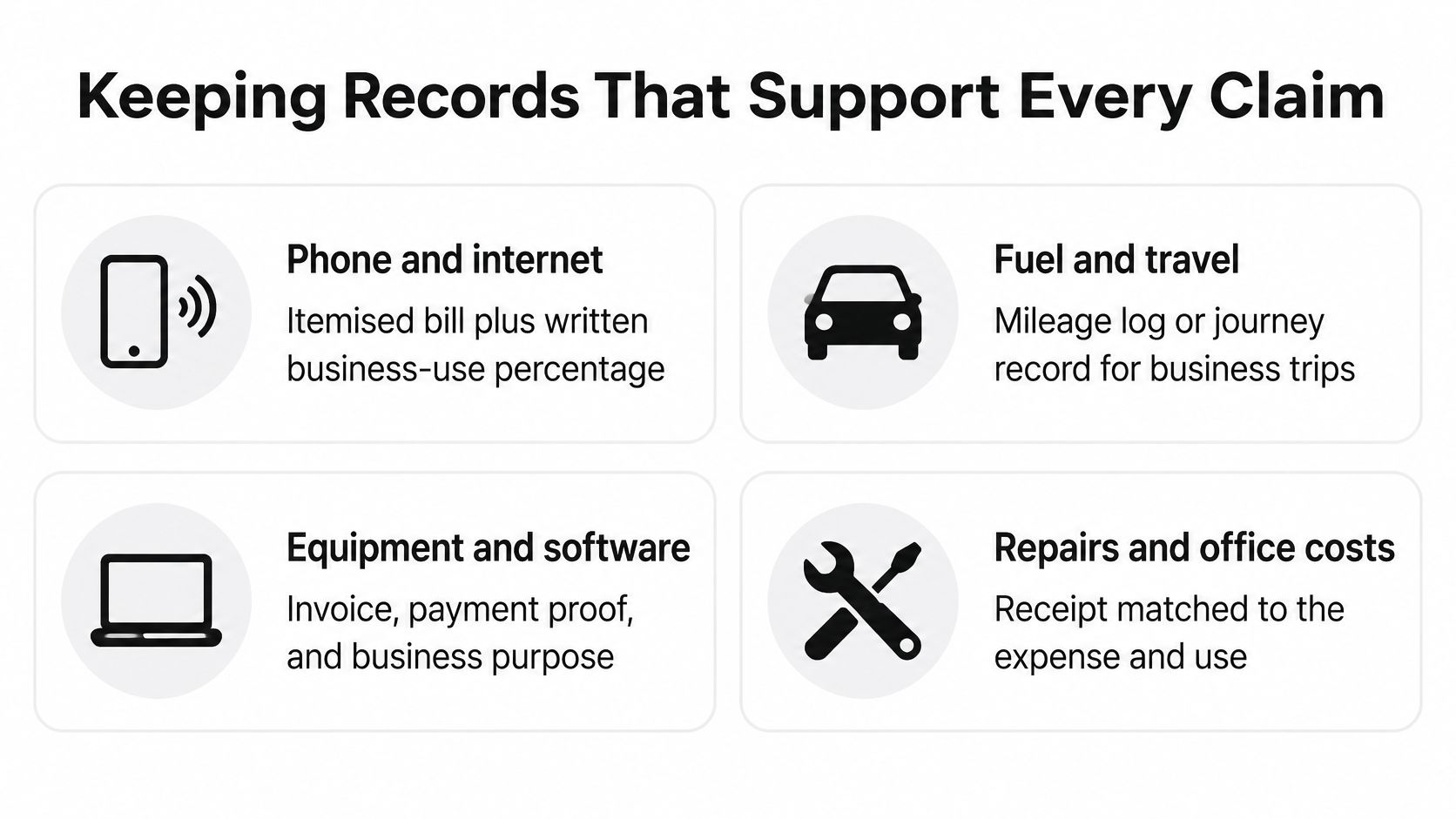
| Fuel and travel | Receipts plus a mileage log or journey record | Check the specific VAT rules for cars and fuel |
| Phone and internet | Itemised bills and a supported business-use estimate | Check for a valid VAT invoice before reclaiming |
| Office supplies | Receipt showing supplier, date and amount | Retain the VAT details shown |
| Software subscriptions | Invoice or statement identifying the service | VAT recovery requires registration and eligibility |
| Professional fees | Invoice with a clear description of the work | Check registration, eligibility and invoice evidence |
| Mixed personal purchases | Receipt, business purpose and allocation method | Consider the eligible business share separately |
The checklist below summarises the supporting record for each purchase type.
Prepare records for digital reporting
According to HMRC's Making Tax Digital for Income Tax guidance, qualifying sole traders with income above £50,000 must use the system from 6 April 2026. Lower thresholds are scheduled to follow, taking the requirement to more than £30,000 from 6 April 2027 and more than £20,000 from 6 April 2028, so confirm which band applies to you as each date approaches. Compatible software must maintain digital income and expense records and submit quarterly updates.
Missing descriptions, duplicate entries and unresolved private-use allocations become real problems once quarterly updates are due. Clear them before preparing a submission, and keep a correction trail that explains any figure you change.
A practical HMRC record-keeping workflow can help connect documents, bookkeeping entries and review tasks. Where paper originals remain part of your system, Admiral's Yard Self Storage's guide to storing tax paperwork safely in Bristol offers additional storage context.
If a receipt is missing, request a duplicate from the supplier and keep the matching bank or card statement as secondary evidence. Don't replace an unknown amount with an unsupported estimate: a claim you cannot evidence is a claim you may have to withdraw.
Allowable Expenses by Business Type
The same purchase can require a different claim when the working arrangements change. These scenarios show the decision to document, rather than suggesting that a job title creates automatic entitlement.
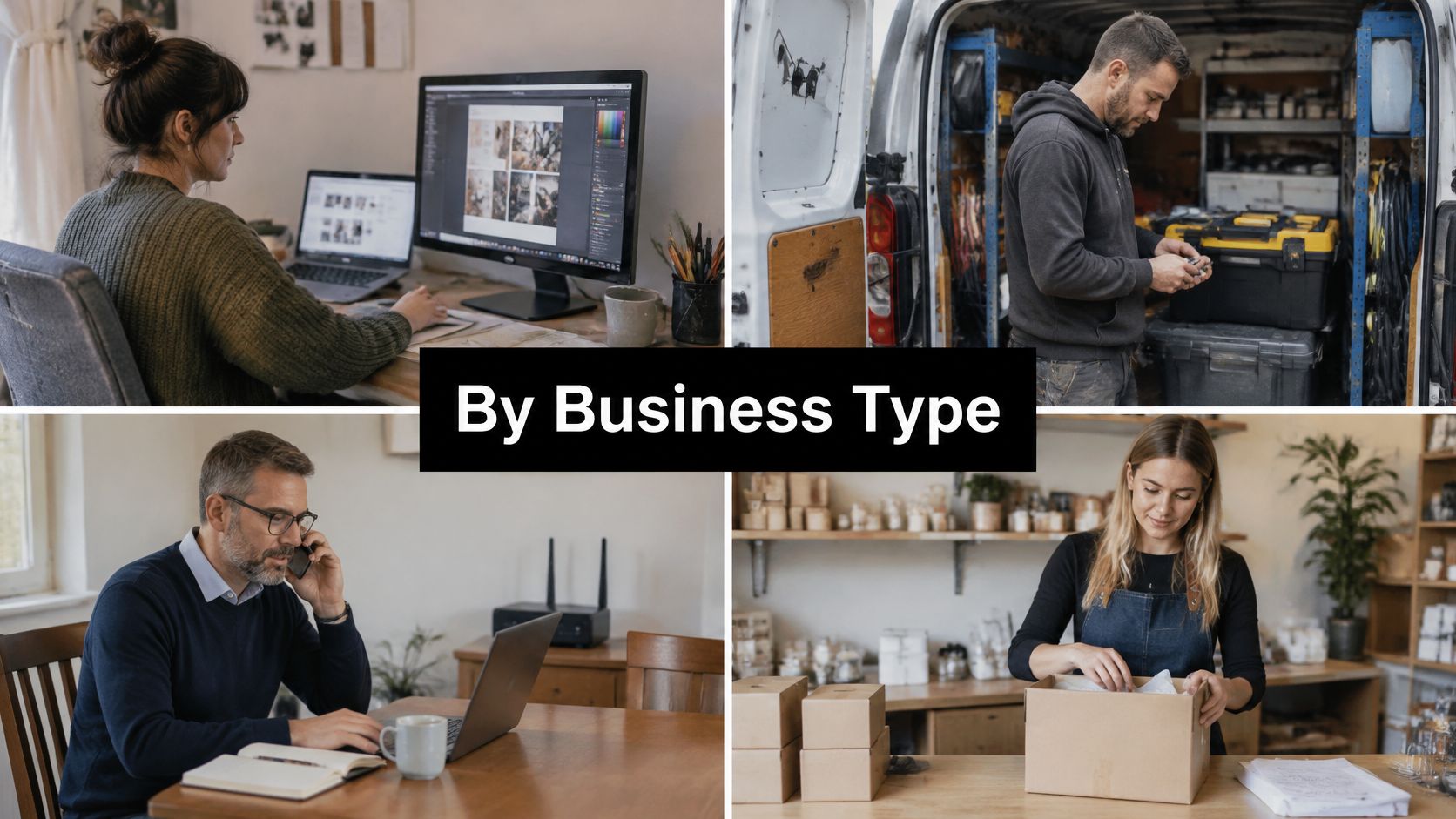
A freelance designer working at home
A designer uses a dedicated illustration subscription for client work, while the household shares the broadband connection. The subscription may support a full business claim; broadband needs an evidenced business allocation. Home costs require their own permitted calculation.
The deciding question is what has private use. Don't apply the same percentage to every purchase merely because you work from home.
If the designer needs a refurbished laptop, Used Mobiles 4 U's guidance to check a used ThinkPad's battery health can help assess the purchase before committing. The tax record still needs the invoice, business purpose and appropriate accounting treatment.
A contractor visiting client sites
A contractor keeps journey details alongside parking and travel receipts. Before claiming, they establish whether each journey qualifies as business travel, then apply the permitted vehicle method without duplicating costs already covered by it.
A routine for tracking business mileage helps preserve destinations and journey purposes. The key decision is whether the journey qualifies, not whether the contractor happened to carry tools.
A trader buying stock and subcontracted work
A seller purchases goods for resale and pays a subcontractor to prepare customer orders. Supplier invoices, subcontractor descriptions and payment records support the entries.
Money transferred to the owner's personal account belongs elsewhere. The distinction is payment for a business input versus withdrawal of business money, even when both leave the same bank account.
A small firm using professional advisers
An accountant prepares business accounts, and a solicitor reviews a trading contract. The invoices should describe those services clearly, with any personal advice separated. A late-filing penalty doesn't become deductible just because it appears alongside professional costs.
A limited company needs a separate owner-payment analysis. A director's salary processed through payroll can be a company expense, subject to the applicable rules; dividends aren't deductible expenses. Don't classify company payroll as sole-trader drawings.
In each case, retain enough detail for someone reviewing the books to understand the transaction without guessing what happened.
Check Your Expense Records Before Filing
A claim survives filing only when the record behind it shows what was bought, why it was business, and how any private share was removed. Work through these checks before submitting a return or preparing an update:
- Trace every entry to evidence. Match each claim to a receipt, invoice or other supporting document showing the supplier, date, amount and relevant VAT details. Clear duplicates, such as the same receipt forwarded by email and uploaded on the web, and resolve payments you cannot explain.
- Test the split on mixed-use costs. Every entry with a personal element should show the business proportion and the basis for it. If a phone bill or vehicle cost rests on a round estimate, rebuild the allocation from the log or reduce the claim to what the records support.
- Check method records. Reconcile mileage and home-working logs with the chosen calculation. Make sure the vehicle's previous treatment permits the method you're using, and confirm no cost already covered by that method has been claimed again elsewhere.
- Remove excluded spending. For sole traders, keep drawings, the owner's salary and personal National Insurance outside expenses, and review fines and ordinary clothing separately. If you buy packaging, keep purchasing compliance distinct from deductibility: Packaging Panda's guide on how to cut costs with compliant packaging covers plastic packaging tax, while your check here is whether the purchase is evidenced and business-related.
- Approve the final treatment. Confirm you have not combined the trading allowance with actual expenses for the same income. Snyp extracts receipt details, and approved receipts sync to Xero or QuickBooks for reconciliation, with professional service expenses carrying the correct nominal code. The allowability decision and the private-use split remain yours.
Keep each receipt attached to the journey, job or period it belongs to, so the story of a cost stays readable months later. Snyp captures receipts through web upload, email or WhatsApp and sends structured expense records into your accounting workflow, while your business-purpose and private-use decisions stay ready for review.